How to Get Coaching Clients in 2026: A Marketing Guide for Career Coaches
By Philippe Cailloux · · 50 min read

Be the obvious coach for one kind of change, and make it easy to say yes
I talk with career coaches all the time while building Callings.ai, and the question I hear most is some version of how to get coaching clients: how to be found, and how to be picked for that first free call. I just came back from HR Tech, where we had a booth and talked with hundreds of people who work in career management. Callings also organizes career coaching webinars on a regular basis, with some of the best-known coaches in the field. And I’ve been the client myself: over my career, I’ve worked with several career and professional development coaches, including a writer who helped me with my personal brand and bio, a resume writer, and an executive group coaching program.
Building Callings also gave us data no single coach has. To build our coach directory, we read 73,151 pages on the websites of US career coaches, resume writers and career counselors, and wrote down what each one publishes: who they help, what they offer, what they charge and how to start. That’s 10,999 coaches today. We also do the search work on those pages, for Google (SEO) and for AI assistants like ChatGPT and Claude (what people now call GEO), so that the people who ask for help find the coaches who offer it. Coaches don’t pay for any of it.
Recently, a coach wrote in to correct her listing in our directory, and then asked me how she could get more exposure and be picked for more free discovery calls. This post is my long answer, for her and for every coach with the same question. It’s meant to help you increase your visibility and your impact: what your competition looks like, what changed now that your clients carry a capable AI assistant in their pocket, and the specific moves that get a coach found and chosen.
My verdict, after all of it: be the obvious coach for one kind of change, and make it easy for the right person to say yes. Most of this guide is about how.
For information only, as of October 31, 2026. Our figures describe what coaches publish on their own websites, read as of October 31, 2026. Platform prices and rules change often, so each one links to its source. I’m not a lawyer or a tax adviser, and the official sources always have the final word.
Full disclosure: Callings is my product, and one section of this page describes the tools we built for coaches. The research stands on its own: our figures are aggregates of what coaches publish (no coach is named), the outside figures link to their sources, and coaches don’t pay to be listed or to rank in our directory.
Last updated: October 31, 2026. I’ll do my best to keep this page current as the directory is refreshed and as platforms change their terms. Changes are listed in the update log at the bottom.
At a glance
| Question | Short answer |
|---|---|
| How many coaches am I up against? | 10,999 in our directory of US coaches. 99.5% work by video, so most compete nationally, not locally |
| What do most coaches leave out? | Only 3% publish all five basics a buyer looks for: who they help, a free first call, a booking link, client testimonials and a price |
| What do coaches charge? | Among coaches who publish a price, a single session is $150 at the median (the middle half charge $100 to $225), and a package $400 |
| Has AI shrunk demand? | For tasks, yes: searches for “resume writer” fell 58% in three years. For coaching, no: “career coach” rose 13%, and “career change coach” more than tripled |
| Can a chatbot replace a coach? | Not on today’s evidence. In a 2026 randomized trial with leaders, human coaching worked, and an AI coach did no better than a waiting list |
| How do clients find a coach? | Mostly through people they trust, then they search your name. AI assistants mostly cite directories and your own site |
| What’s the highest-leverage change? | One sentence that names who you help through which change, used everywhere, with proof and a booking link next to it |
| Where’s the biggest opening? | Light, timely support between sessions: 40% of coaches promise accountability, but only 7% say how it happens between sessions |
Where this fits in Callings
Callings is a platform for the whole job hunt: our members find and track jobs, tailor their resumes, prepare for interviews, build their network and their personal brand. Coaching is one part of it, and it has two sides: job seekers looking for the right coach, and coaches working with their clients.
| Part of Callings | What it is | What it does for you as a coach |
|---|---|---|
| The coach directory (callings.ai/career-coaches) | Public pages for 10,999 US coaches, built from what they publish on their own websites, organized by kind of help, audience and city | A free listing that people find through Google and AI assistants. If your website describes your coaching, you’re probably already in it |
| Find a coach and Find Coaches | For our members: coach suggestions matched to their background, and a search in their own words, each with a personal match report | Members who want help find you by what you do and who you help. It’s free for them |
| Coach search in Claude and ChatGPT | The Callings connector lets members search the directory from their AI assistant | Your listing reaches people where they already ask for advice |
| The Coach Console (callings.ai/coach) | A workspace to follow your clients’ job searches between sessions, with their consent | Free while it’s in beta. See what happens between sessions |
We promote the coaches in our directory for free, through the search and AI-assistant work on their pages and through guides like this one. I see it as promoting career coaching itself: a job seeker with a good coach does better, and the coaches who do this work well deserve to be found.
Table of contents
- Why it matters: being good is no longer enough to be found
- Who am I competing with?
- Has AI shrunk the market for career coaches?
- What do clients get from a coach that AI can’t give them?
- How specific should my niche be?
- What should my website show?
- How do people find a coach now?
- Which marketing channels are worth my time?
- Who can send me clients?
- How do I turn a free call into a client?
- How should I package and price my coaching?
- What happens between sessions? The biggest opening
- The other side: what a job seeker sees
- About our data
- Mistakes to avoid
- Checklist
- Frequently asked questions
- Resources
Why it matters: being good is no longer enough to be found
In From Applying To Being Found, I wrote about the years I’ve spent with career coaches, recruiters, headhunters, hiring managers, job seekers and workforce professionals: “One pattern kept showing up: the market is shifting from finding a job to being found.” The same shift happened to coaches. People rarely line up a list of coaches and compare them one by one. They ask someone they trust, search a name, or ask an AI assistant, and the coach who is easiest to understand gets the call.
In Why The Messenger Matters, I put it this way: “When everyone can produce polished copy, identity becomes the signal.” A coaching website written with the same AI tools as everyone else’s reads like everyone else’s. What sets you apart is what only you can say: who you have helped, through which change, and how you work.
And in AI Raises The Bar, about my own field: “As AI started generating more code, the hard part did not disappear. It moved.” Coaching is going through the same move. Drafts, research and practice questions are nearly free now. The hard part moved to judgment, confidence and follow-through. That’s where a coach’s value moved too, and it’s where your marketing should point.
So this guide has three parts: know your competition, show clearly what you do and for whom, and build the kind of support between sessions that software now makes possible and only a coach can give.
Who am I competing with?
About eleven thousand coaches who, from the outside, look a lot alike. Here’s how the 10,999 coaches in our directory present themselves:
| How they present themselves | Coaches | Share |
|---|---|---|
| Leadership coach | 4,473 | 40.7% |
| Career coach | 3,309 | 30.1% |
| Resume writer | 1,199 | 10.9% |
| Life coach who does career work | 959 | 8.7% |
| Career counselor | 911 | 8.3% |
| Personal brand strategist | 148 | 1.3% |
Three things shape the competition:
- Almost everyone works remotely. 99.5% offer sessions by video, and a quarter work only remotely. A coach in Ohio competes with coaches in California and New York, unless the client wants to meet in person.
- Most are experienced. Of the 7,397 coaches who state their experience, the median has 15 years (the middle half, 8 to 20). A third have 20 years or more. Experience is expected; it doesn’t set you apart on its own.
- Most list many things. 27% list five or more specialties, and 43% don’t name any audience, role or industry they serve. 36% say they serve “any” career level.
That last point is the opening. Look at what coaches list among their specialties, then at what they make their main focus:
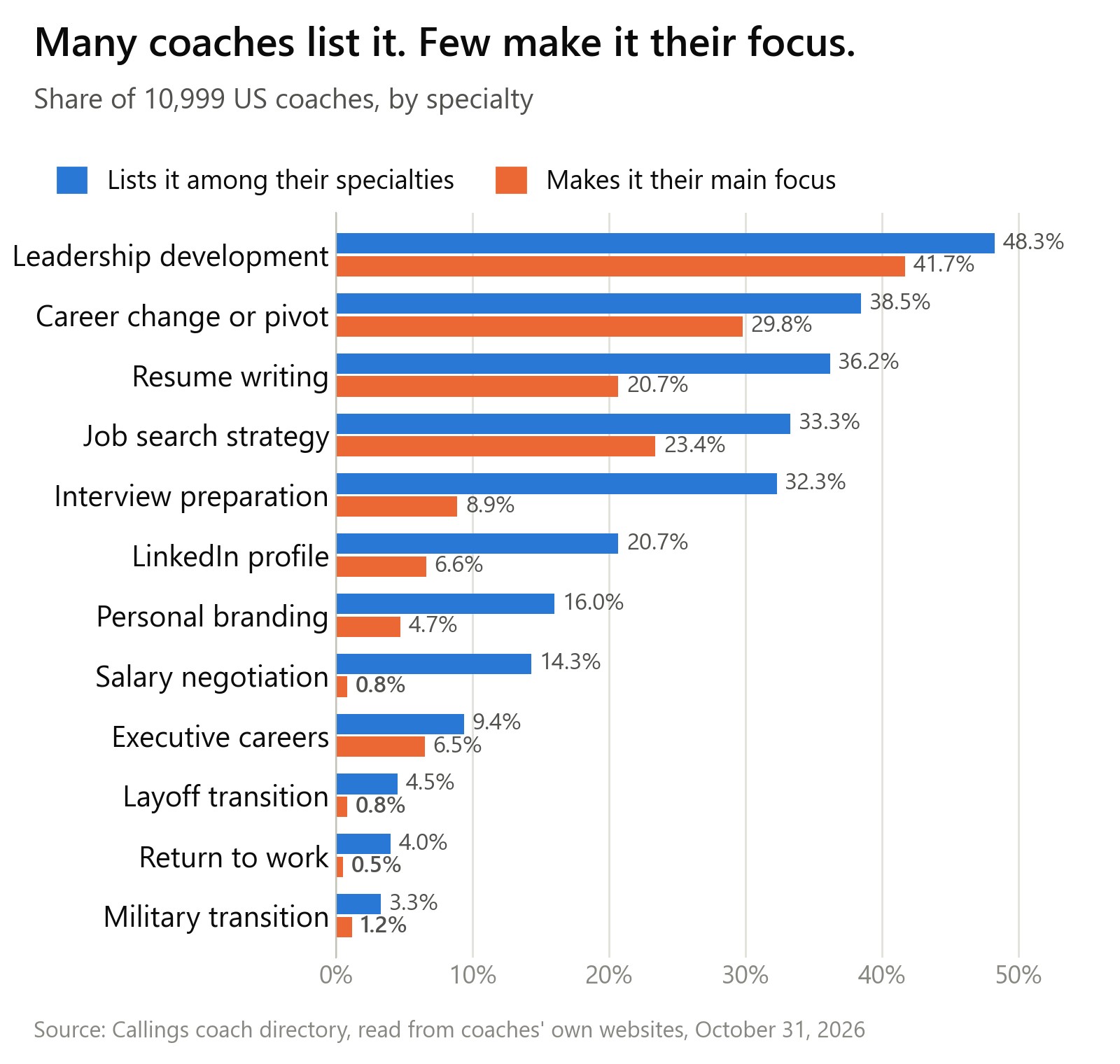
Leadership development and career change are crowded both ways: many list them, and most of those make them their focus. Other specialties are offered widely as an add-on and almost never owned. One coach in seven lists salary negotiation, but fewer than one in a hundred makes it their main focus. The same goes for coming back to work after a break, and for the first weeks after a job loss. Interview preparation, LinkedIn profiles and personal branding follow the same pattern.
Then look at who coaches say they help. Executives are by far the most crowded audience: 58% of the coaches in our directory mention them. Some large professions have very few coaches who speak to them by name:
| Audience (our directory page) | Coaches who mention them | Monthly Google searches for “career coach for …” | People in that group in the US (BLS) | People per coach |
|---|---|---|---|---|
| Executives | 6,411 | 390 (for “executive career coach”) | No single count | |
| Women | 798 | 110 | ||
| Federal employees | 720 | Too few to measure | 2.68 million federal civilian jobs (September 2026) | About 3,700 |
| Veterans | 444 | About 10 | 8.3 million in the labor force (2025) | About 18,800 |
| Lawyers | 335 | 170 | 754,500 salaried lawyers (May 2025) | About 2,300 |
| Teachers | 300 | 50 | 3.6 million K-12 teachers (May 2025) | About 12,000 |
| Adults with ADHD | 208 | 90 | ||
| Physicians | 95 | Too few to measure | 862,800 jobs (2025) | About 9,100 |
| Nurses | 86 | 170 | 3.4 million registered nurses (May 2025) | About 39,000 |
Read this table with care. People describe their situation in many ways, so a search count is a floor, not the whole demand. The BLS counts are an upper bound on who might want a coach, and they measure different things: jobs for the occupations (which leave out the self-employed, so there are more lawyers and physicians than shown), the labor force for veterans. Sources: BLS occupational employment, May 2025, the Occupational Outlook Handbook for physicians, federal employment, September 2026 and veterans, 2025. But the direction is clear: if you’re a former nurse or teacher who coaches, saying so on your website puts you in a much smaller crowd than “executive coach”.
What it means for you:
- Pick the change, not only the audience. “Nurses” is an audience. “Nurses with ten years at the bedside who want a role away from it” is a change someone can recognize themselves in.
- List what you want to be known for, and fold the rest into it. If salary negotiation is part of every engagement, say so inside your main service instead of listing it as a twelfth specialty.
- Check your own corner. Our directory pages show how many coaches serve each audience, kind of help and city, for example career coaches for nurses, for teachers or for executives. Read ten listings in your niche the way a client would, and write down what none of them says.
Has AI shrunk the market for career coaches?
No. But it changed what people look for. Here’s three years of Google searches in the US, comparing the year to September 2023 with the year to September 2026:
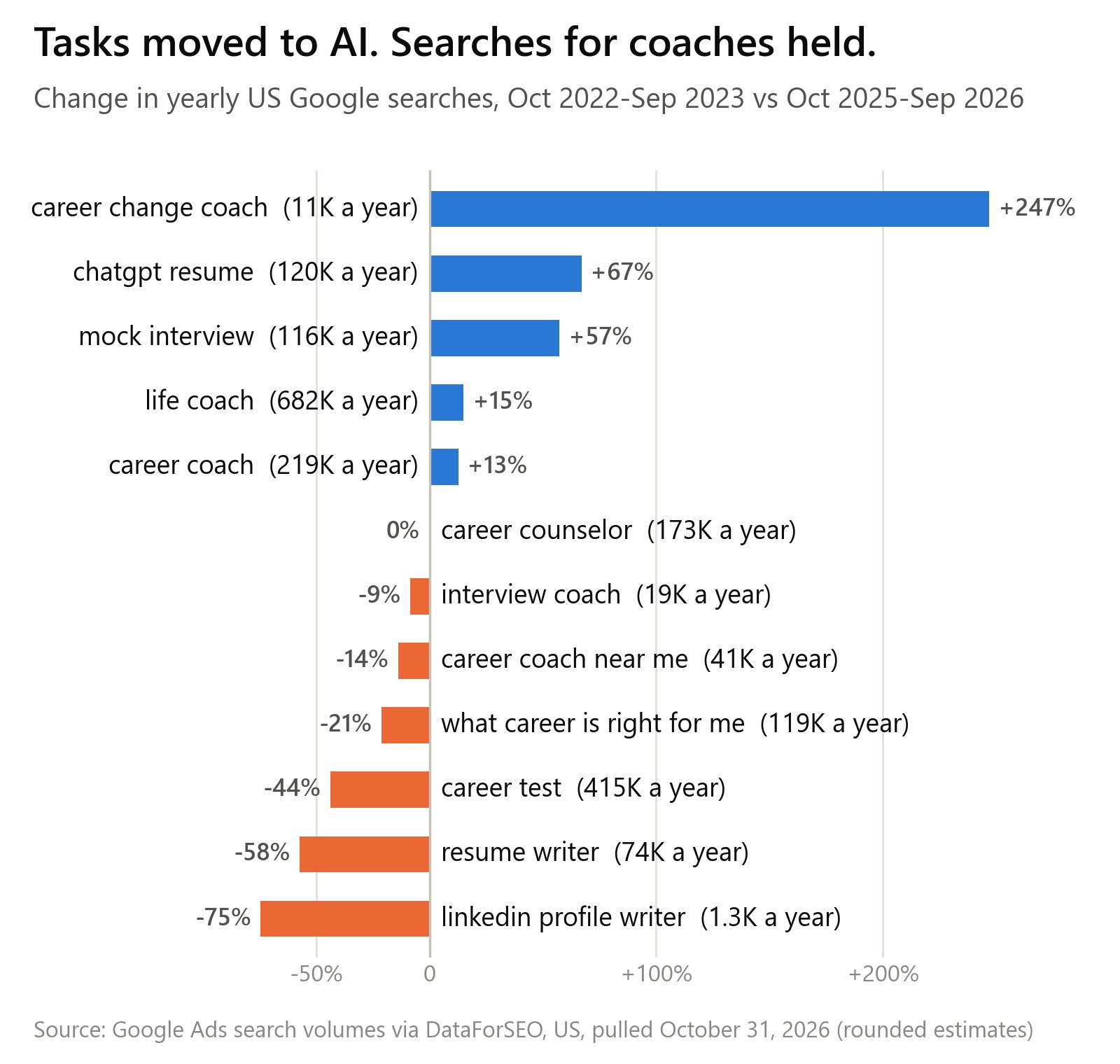
Searches to hire someone for a task that AI now does well fell sharply: “resume writer” by 58%, “linkedin profile writer” by 75%, and “career test” by 44%. Over the same years, searches for “chatgpt resume” rose 67%. People didn’t stop wanting a better resume. They started writing it with AI.
Searches for a person held up: “career coach” rose 13% and “life coach” 15%, while “career change coach” more than tripled, from about 3,300 searches a year to 11,400. Even “ai career coach” grew, from about 970 searches a year to 5,040. That’s still small next to 219,000 for “career coach”, but it tells you that your clients now compare you with software. One caveat: Google’s search volumes are rounded estimates, and the year to September 2025 had one-off spikes for several phrases, so I compare the first and the last of the four years.
How many job seekers use AI? Surveys disagree, from 28% (Employ, May 2026) to 77% of US job seekers (Greenhouse, October 2026), depending on how they ask. What they agree on is that AI made applying cheap. LinkedIn reported about 9,500 applications a minute in October 2025, and in Greenhouse’s survey, 60% of job seekers said they had changed, or thought about changing, how they write so it doesn’t read as AI.
And searches take longer. In September 2026, the median time out of work was 11.5 weeks, against 9.2 in 2019, and 27.1% of unemployed people had been looking for 27 weeks or more (BLS). Employers hired at a rate of 3.3% of jobs in August, against 3.9% in 2019 (JOLTS). And people put their own chance of finding a job within three months, if they lost theirs, at 46.1% in September, against 59.9% in 2019 (New York Fed).
What it means for you: deliverables are becoming commodities; decisions, confidence and follow-through are not. A long, quiet search with hundreds of polished applications is exactly when a person needs someone in their corner. That’s the work to market.
What do clients get from a coach that ChatGPT, Claude or Callings can’t give them?
I’m in an odd position to answer this. Callings gives job seekers much of what a coach used to produce on paper: a fit score for every job, a resume and cover letter tailored to each one, interview preparation, a report on their market fit. A Claude or ChatGPT subscription costs about $20 a month, and the ICF’s global average for one coaching session is $234. So what’s left for a coach? On the evidence, a lot, and it’s the part that matters most.
What the research says
- Human coaching beat an AI coach with leaders. A randomized trial published in 2026 in Human Resource Development International split 114 leaders into three groups: four weekly sessions with an accredited human coach, a chatbot coach, or a waiting list. Human coaching improved most outcomes. The chatbot group “did not improve significantly on any of the outcome variables”, had more dropouts and complaints, and four people who left it asked for a human coach instead.
- The older “AI equals human” result is narrow. A 2022 study in PLOS ONE found a goal-setting chatbot did as well as human coaching, but with undergraduates, a scripted bot and one goal measure. Its authors still concluded that humans keep the edge in “context awareness, transfer of learning, and higher-order complex sense-making.”
- The relationship carries the results. A 2020 meta-analysis in Human Relations (27 samples, 3,563 coaching processes) found the working alliance between coach and client correlates .41 with client outcomes.
- Job seekers need skills and motivation together. A 2014 meta-analysis in Psychological Bulletin (47 studies) found job search programs gave participants 2.67 times the odds of finding work, and the gains in employment appeared only when building skills came with building motivation. Software is good at the skills half.
- Reporting progress to someone works. A 2016 meta-analysis in Psychological Bulletin (138 studies) found that keeping track of progress helps people reach their goals, more so when the progress is reported to someone else.
- Relationships still decide hires. In LinkedIn’s January 2026 Labor Market Report, applicants who were already connected with someone at the company were 3.6 times more likely to be hired.
- AI assistants tend to agree with you. A 2025 working paper found 11 leading AI models affirm users’ actions 50% more than people do, and users rated the flattering answers higher. The ICF puts it bluntly in its 2026 white paper on coaching and AI: general assistants are “designed to deliver a pleasing output to the user, which is contrary to the challenge necessary for personal growth.”
- Clients want a human in charge. In the ICF’s 2026 consumer study, 80% of consumers prefer coaching that is human-led in some form, while staying open to technology in a supporting role.
What “coach-grade” software changes for you
The floor rose. Your clients arrive with a polished resume, a plan from ChatGPT and a list of target companies. They don’t need you to produce those. They need you to tell them which parts are wrong, what to do first, and to notice when they stall. In Who is in the loop?, I wrote that “responsibility, judgment, and meaning still need a human owner.” In a job search, that owner can be a coach.
In practice, it changes what you sell: less “I’ll write your resume”, more “I’ll make sure your search works”. And it gives you new things to say.
Eight marketing angles for the AI era
Each comes with a line you could adapt for your website. Write your own version; a line copied from a guide is the opposite of the point.
- Human-led, AI-assisted. 80% of consumers want coaching led by a human, and only 19% of coaches invested in new technology last year (ICF 2025), so saying how you use AI, and where you don’t, already sets you apart. “Between our sessions, you’ll use AI for drafts and practice. The judgment calls, we make together.”
- Accountability that gets the search finished. 40% of the coaches in our directory promise accountability; 7% say how it happens between sessions. Say how. “A short check-in every week, and a note from me before every interview.”
- A second opinion on what the AI told you. AI models agree with their users more than people do. Offer to review the resume, the target salary and the plan a client built with ChatGPT or Claude, and say what you’d change and why. “Bring me what the AI wrote. I’ll tell you what a hiring manager will think.”
- Your network beats their volume. When applications are nearly free, introductions are scarce. LinkedIn’s 3.6 times is the argument; your offer is a plan for who to talk to, practice for those conversations, and introductions where they’re appropriate. “Fewer applications, more conversations.”
- Use AI without sounding like everyone else. 60% of job seekers worry about sounding like AI, and only 1.9% of the coaches in our directory sell a service that involves AI. Teach clients to use it well: prompts that start from their own stories, and an edit that puts their voice back. “Use AI like a pro, and still sound like yourself.”
- Steady through a long search. The median time out of work is 11.5 weeks, and more than a quarter of unemployed people have been looking for six months or more. Market the stamina, not only the strategy. “For job searches that are taking longer than you planned.”
- For the hard calls. Senior, ambiguous, high-stakes moves are where people most want a person in the room. In our directory, coaches who focus on vice presidents and the C-suite publish a median session price of $179, against $135 for coaches who say they serve any level. “For leaders deciding what’s next, when the stakes are high.”
- Ethics you can see. Publish a short AI and data policy: which tools you use, what you never paste into them, and how clients agree to it. The ICF’s Code of Ethics, in force since April 2025, extends a coach’s ethical and legal obligations to “any technology systems I may utilize”, artificial intelligence included (Standard 2.5). “How I use AI, and how I protect what you tell me.”
How specific should my niche be?
Specific enough that the right person recognizes themselves in one sentence, and that someone else knows when to send people your way.
There’s no credible study of how much more a specialized coach earns: the “30% to 50% more” figures on coaching blogs trace back to nothing I could find. What the data does show points the same way, though. The ICF’s 2023 study ties the highest fees to coaches who serve executives and to clients whose coaching is paid by someone else, though those factors overlap with experience. And in a 2015 survey of professional-services firms by Hinge, a marketing firm, the top reason for ruling out a provider someone had referred was “I couldn’t understand how they could help me or my firm” (43.6%). A vague niche loses referrals you never hear about.
Four tests make a niche workable:
- Someone pays. The people you serve can afford you, or someone pays on their behalf.
- You can reach them. There’s an association, an alumni network, a community or a topic on LinkedIn where they gather, and where you can be seen.
- You have proof. Your own background in that field, or results with clients like them.
- Something makes them look now. A job loss, a promotion, a career change, a return to work after a break, a first job, leaving the military.
Then write one positioning sentence: who you help, through which change, toward what. For example: “I help nurses with ten years at the bedside move into health tech roles without starting over.” Or: “I help senior engineers after a layoff run a focused search they can keep up for as long as it takes.” Use it, word for word, in your website headline, your LinkedIn headline, your LinkedIn Service Page and every directory profile.
Consistency is no longer only branding. In March 2026, LinkedIn rebuilt how its feed ranks posts, with AI models that read members’ industry, skills and experience, and each author’s headline, company and industry. So use the same words in your headline, your About section, your services and your posts: that’s how the feed, and the people in it, learn what you’re about.
Our data adds two signals. Salary negotiation, a return to work after a break and the first weeks after a job loss are each the main focus of fewer than 1% of coaches, while thousands of people search for help with them. And among coaches who publish package prices, those who name an audience publish a median package of $500, against $300 for those who don’t. That’s a correlation, not proof that naming an audience raises your prices, but it’s consistent with the ICF’s findings.
You don’t need a rebrand to test a niche. In AI Demands Micro-Pivots, I argued for “a steady series of small corrections across product, positioning, and execution.” For a coach, that means changing your headline and one service page, running it for a month, and reading what the inquiries say.
What should my website show?
Five basics, near the top, in plain text. A buyer comparing coaches looks for who you help, a free first call, a way to book it, proof from real clients, and a price or a range. Each one alone is common. All five together are rare:
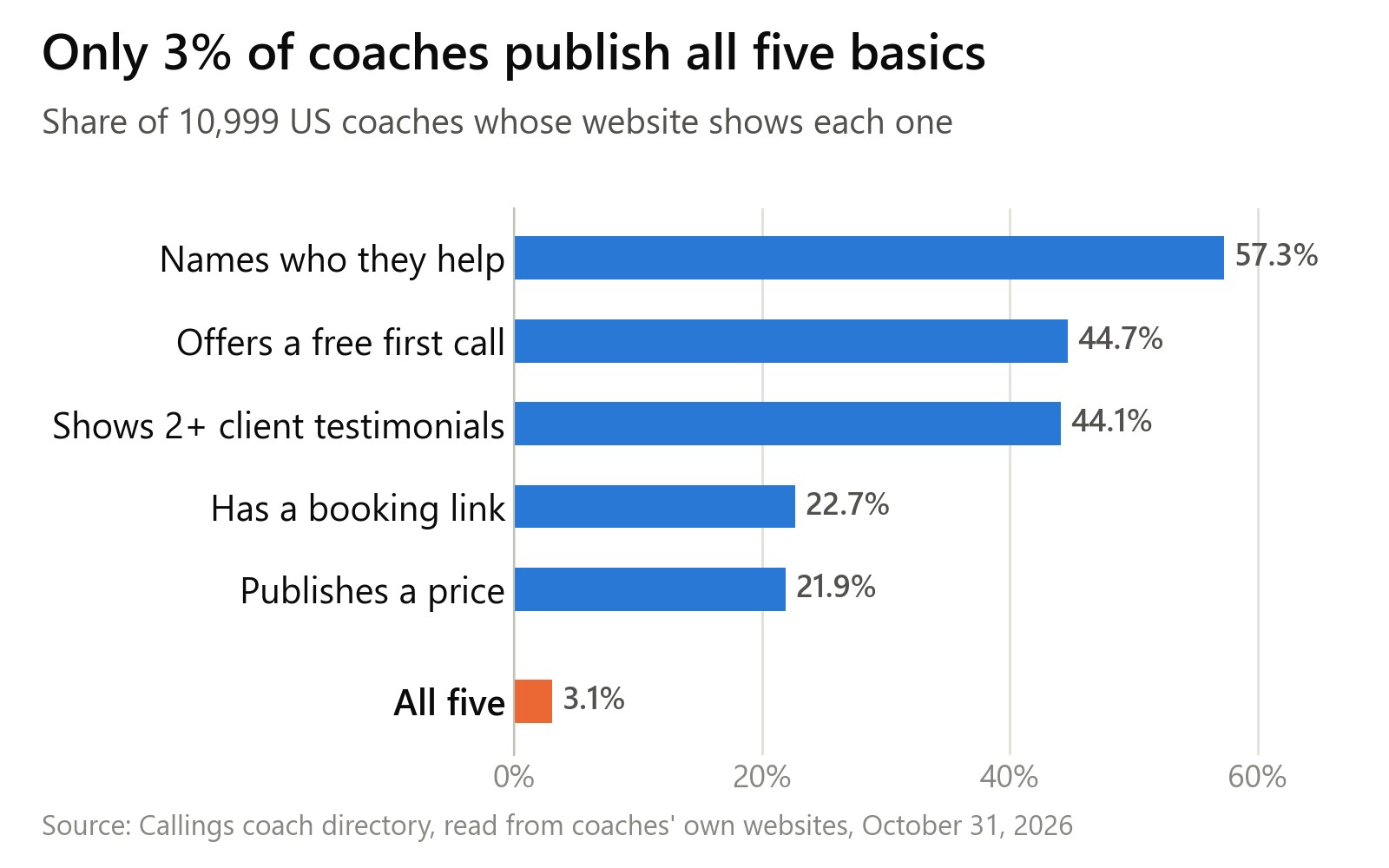
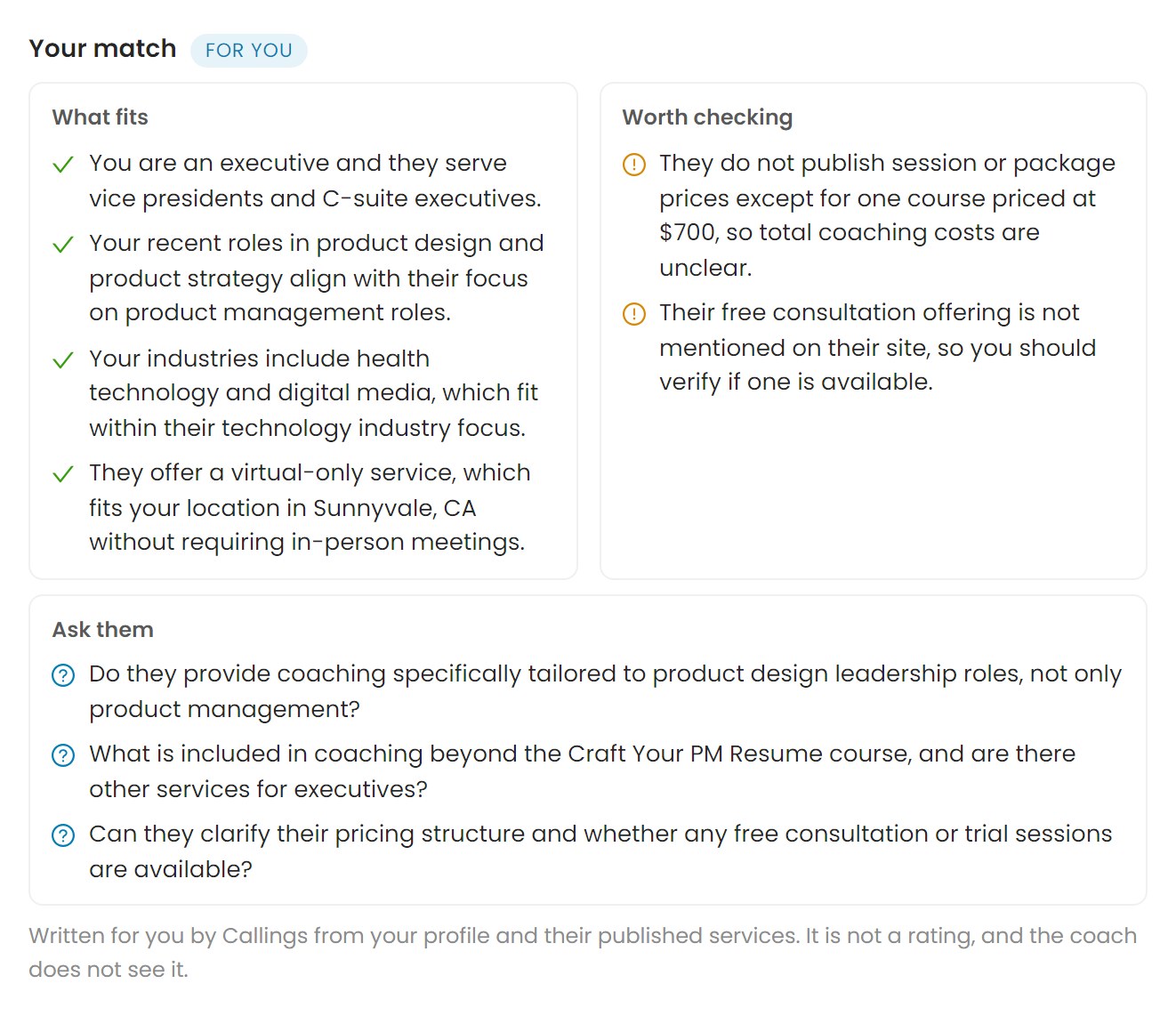
Every gap becomes a question a prospect has to ask, or a reason to call someone else. You can see it from their side: when a Callings member opens a coach’s record, a match report written for them lists what fits, what’s worth checking, and questions to ask. Here’s one of mine:
One page per service
For each service, say who it’s for, the format and length, the price or a range, what’s included, what a client can expect, your credentials, and how to start. Put those facts near the top, in text, not in images, PDFs or tabs: search engines and AI assistants read text, and so does a person skimming on a phone. Add a short FAQ with the questions people ask before booking (price, virtual or in person, how many sessions, your credentials).
Prices
Only 21.9% of the coaches in our directory publish a price, and the ones who do are also more likely to offer a free first call (69% against 38%) and a booking link (39% against 18%). If you’d rather not publish a list price, publish a range or a “starting at” price. A prospect who can’t tell whether you cost $150 or $5,000 often won’t ask.
Proof that holds up
Ask for written consent and use your client’s own words. The FTC’s rule on consumer reviews and testimonials, in force since October 21, 2024, bans fake testimonials, including ones written by AI, and the civil penalty can reach $53,088 per violation. Under the FTC’s endorsement guides, a testimonial about results (“I negotiated a 30% raise”) is read as typical unless you say what typical results are. And never offer anything in exchange for a Google review: Google forbids it.
Promises
Promise what you’ll do, not what the job market will do. A job guarantee is a red flag for buyers and a legal risk for you. California treats fee-based career counseling, career management and resume services as “employment counseling services”, with a written contract, a “no guarantee” statement, a three-business-day right to cancel and a bond, among other rules (Civil Code 1812.501 and following). If you sell prepaid packages to people in California, check with a lawyer.
Credentials
Translate the acronym (“ICF Professional Certified Coach, 500+ hours of coaching”) and link to the issuer’s verification page. In the ICF’s 2010 consumer study, the only public data on this, 84% of coached respondents said credentials were important, but 36% didn’t know whether their own coach had one. A credential nobody can read is wasted.
Tax lines
Take “tax deductible” and “HSA eligible” off your pricing page unless a tax adviser has confirmed them for your clients. Employees’ job search expenses are no longer deductible (the 2025 tax law, P.L. 119-21, made the suspension permanent), and coaching isn’t a medical expense under HSA and FSA rules.
How do people find a coach now?
Through people first, then through search, and more and more through AI assistants.
People first. In Hinge’s survey of professional-services buyers, the top reason to see someone as an expert was being “highly recommended by friends and colleagues” (57%). In a 2020 executive coaching survey by Sherpa Coaching, personal referrals were used ten times more often than any other way of finding a coach.
Then a search for your name. Our own Search Console data says the same thing from the other end: almost all the Google clicks to our coach pages land on an individual coach’s profile, and most come from people searching that coach’s or that practice’s name. Generic searches like “career coach” show the pages but rarely get the click. A referral is followed by a search, so make sure what people find matches what they were told. Google yourself in a private window today, with and without the word “coach”, and make every profile say the same thing: your website, LinkedIn, directories, podcast bios.
Directories and marketplaces
| Where | What it costs (October 2026) | How it works | Best for |
|---|---|---|---|
| Callings directory | Free | Built from your own website. No sign-up, no paid placements | Every coach with a website |
| ICF Credentialed Coach Finder | Free for ICF members who hold an ICF credential (membership is $270 a year). The paid enhanced listing was discontinued | A trust directory: you’re listed because of your credential | ICF-credentialed coaches |
| LinkedIn Service Page | Free. Premium Business adds more (see LinkedIn below) | People send requests for proposals to several providers | Every coach |
| Noomii | Pro: $37 a month or $447 a year, plus a 30% commission on clients from its matching program. Elite: $97 a month or $1,164 a year, plus 15%. Paid plans are a 12-month commitment | A directory plus matched leads, which Noomii says average one to two a month, “sometimes none” | Coaches who reply fast and want a supplement |
| Psychology.com Find a Coach | $49 a month or $490 a year, first 30 days free. No paid ranking | New: opened October 29, 2026. Registry credentials are checked by hand | Credentialed coaches willing to test a new directory |
| Psychology Today | $29.95 a month | Lists licensed mental health professionals. A coach without a clinical license doesn’t meet its listing requirements | Licensed counselors who also do career work |
| Thumbtack | No membership fee. You set a price per lead and a weekly budget, and pay for the leads you get | Local leads, shared with other pros | Coaches who meet clients in person in a metro area |
| Bark | Prepaid credits, $2.35 each at the standard US rate. A lead’s cost in credits depends on the service and the market. Credits bought since November 2025 expire after 3 months | You pay to contact buyers who posted a request | Testing demand for a new offer |
| Upwork | A fee of 0% to 15% per contract on new contracts, plus Connects to send proposals ($0.15 each) | Clients post projects; you send proposals | Resume and LinkedIn profile writers |
| Fiverr | Fiverr keeps 20% of each order | Fixed-price packages (“gigs”) | Resume and LinkedIn profile writers |
| Association directories (NCDA, PARWCC, NRWA, CDI) | Included with membership | Trust directories for members and credential holders | Members with the association’s credential |
Two kinds of places are mixed together here: trust directories, where you’re listed because of a credential or a membership (the ICF and the career associations), and lead marketplaces, which route buyers to you and charge per lead, per response or as a commission. Before paying a marketplace, work out the cost per paying client: what you pay per lead, divided by the share of leads you turn into clients. And read the contract: on some platforms you pay for leads you don’t win, a paid plan can commit you for a year, and prepaid credits can expire.
Google Business Profile: only if you meet clients in person
Google allows a Business Profile only for businesses that meet their customers in person, at an office or at the customer’s location, so a coach who works only by video isn’t eligible. If you do meet people in person, set one up with your real business name, the closest category, and up to 20 service areas within about two hours of your base. It matters more than it used to: in a 2026 study of local searches by BrightLocal, a local-marketing software company, Business Profiles were about 67% of the local sources cited by Google’s AI Overviews.
AI assistants
Here’s the short version of what the people who run these systems say:
- Google: it’s still SEO. Google’s 2026 guide says optimizing for generative AI search “is optimizing for the search experience, and thus still SEO”, and that you don’t need special files, markup or writing styles to appear in its AI features. What helps is a unique point of view and first-hand experience, in text, on pages Google can index.
- Mentions beat links. In a 2025 study of 75,000 brands by Ahrefs, an SEO software company, mentions on other websites correlated far more with visibility in AI Overviews (0.664) than backlinks did (0.218). For a coach, mentions come from podcasts, association and alumni directories, speaker pages, guest articles and coach directories.
- Let the right crawlers in. Each assistant reads the web with its own crawler: OAI-SearchBot and ChatGPT-User for ChatGPT, Claude-SearchBot and Claude-User for Claude, PerplexityBot for Perplexity, Googlebot for Google’s AI features and Bingbot for Copilot. Blocking them keeps you out of their answers. Training crawlers such as GPTBot, ClaudeBot and CCBot are a separate choice, with no documented effect on those answers. Google-Extended is different again: blocking it doesn’t affect Google Search or AI Overviews, but it stops Gemini apps from using your pages to answer people.
- Check your website builder’s switches. In a sample of 594 coach websites we checked, only 3 blocked an AI search crawler, so this is a two-minute check, not a common trap. But the switches can surprise you. Squarespace’s “Block known artificial intelligence crawlers” box blocks 26 bots, mostly training crawlers, but also Google-Extended and DuckDuckGo’s AI assistant; it doesn’t block ChatGPT’s, Claude’s or Perplexity’s search crawlers (Squarespace). Seeing GPTBot in your Squarespace robots.txt doesn’t mean it’s blocked: look for a “Disallow: /” line under it. Wix blocks no AI crawler by default, but the example on its help page blocks ChatGPT-User, the agent ChatGPT uses to read a page someone asks about, so don’t paste it without reading it. Search Console also has a “Search generative AI” setting since August 2026: make sure it says Include.
- Skip the myths. There’s no public evidence that an llms.txt file helps you get cited, and structured data isn’t a shortcut into AI answers. And Google stopped showing FAQ rich results in May 2026, so write your FAQ for readers and assistants, not for a dropdown in Google’s results.
Measure what works
- In Google Analytics 4, the default “AI Assistant” channel shows visits from ChatGPT, Gemini, Copilot and others. ChatGPT usually adds “utm_source=chatgpt.com” to the links it cites, which makes those visits easy to spot.
- In Search Console, the Generative AI performance report shows impressions from AI Overviews and AI Mode. Bing Webmaster Tools has an AI Performance report for Copilot citations.
- Add UTM tags to the links on every profile and directory listing (for example “?utm_source=callings&utm_medium=directory”), so you can see which ones send visitors.
- Make “How did you hear about me?” a required question on your booking form. It’s the most reliable tracker you have.
- Once a month, ask ChatGPT, Claude, Gemini and Perplexity the same ten questions a client would ask (“career coach for nurses moving into tech”, “is a career coach worth it for a mid-career change”), and note who they cite.
Which marketing channels are worth my time?
The ones where the people you help already spend time, and where your positioning sentence can repeat itself for months. Pick two and do them well rather than five badly.
For career coaches, LinkedIn is where clients, referrers and employers overlap. Since its March 2026 rebuild, LinkedIn says engagement pods and automated comments aren’t allowed, and it’s working to make them ineffective, so the only strategy left is the real one: useful posts and real conversations. Buffer’s data on millions of posts points to 2 to 5 posts a week, with carousels earning nearly three times the engagement of other formats, and the advice from every serious source is the same: reply to every comment, on your posts and on others’.
Set up your free LinkedIn Service Page: it lists your services, lets anyone send you a request for free, and shows reviews from your clients. Reply within a day: requests close once enough providers have answered. Premium Business ($69.99 a month, or $539.88 a year, in the US) adds a “Request services” button that also shows on your posts and messages, a showcase with your ratings and latest review, and more matched requests. And since October 2026, LinkedIn’s Advice Sessions let invited US Premium Business members sell paid one-to-one sessions from their profile, paid out after 30 days minus Stripe’s processing fee. Hosting is by invitation for now, so treat it as a door that’s opening, not a channel to plan around.
A newsletter with a public archive
21.8% of the coaches in our directory mention a newsletter on their website, but only 5.3% of their home pages link to a newsletter page. That matters: an article behind a sign-up form can’t be found by Google or quoted by an AI assistant. Publish the issue, then keep it public on your own domain. Kit is free up to 10,000 subscribers, beehiiv up to 2,500. Judge it by clicks and replies, not opens: Apple’s Mail Privacy Protection affects roughly 55% to 60% of all email opens (Litmus), so open rates mostly count machines. In MailerLite’s benchmark of 3.6 million campaigns, the click rate for coaching newsletters was 1.42%.
Podcasts, as a guest
58% of Americans aged 12 and older listen to a podcast every month, and 68% of those aged 35 to 54 (Edison Research, The Infinite Dial 2026). YouTube is now the leading platform for podcasts, so favor shows that publish video. No study measures how many clients a guest spot brings, but each one leaves a page on another website with your name, your niche and a link, which is exactly the kind of mention that helps with search and AI assistants.
Workshops and webinars
52% of the coaches in our directory mention workshops, webinars or masterclasses. They work best with a partner who brings the audience: an association, an alumni office, a community group. Record them, send the replay to everyone who registered, and turn the best ten minutes into a video and an article.
Quizzes, a book, YouTube
11% of coaches offer a quiz or self-assessment, 14% have written a book, and 21% link to a YouTube channel from their home page. Each can work, and each takes months. A book is a credential and a speaking ticket more than a lead source.
Paid search
Do the math before you spend. Google Ads data put the average click on “career coach” at about $17.66 in the US in October 2026, and on “career change coach” at about $40.26. LocaliQ, which sells ad services, puts the average cost per lead in its “Career & Employment” category at $67.36 for 2026. At that price, a $150 single session needs 45% of leads to buy just to cover the ads, while a $1,500 package needs 4.5%. And Google restricts targeting for “services for job seekers” in the US, so you’ll target by search terms and topics, not by age or ZIP code. Ads can work for packages; they rarely work for single sessions.
How the channels compare
| Channel | Money | Time | When it pays off | Best for |
|---|---|---|---|---|
| Referrals and partners | Free | An hour or two a week | Steady, once people know what you do | Everyone, first |
| LinkedIn posts and comments | Free | 2 to 4 hours a week | Months | Coaches whose clients are on LinkedIn (most) |
| LinkedIn Service Page | Free | An hour to set up | Weeks | Everyone |
| Directories | Free to about $50 a month | An hour each | Weeks | Everyone: start with the free ones |
| Newsletter | Free to start | 2 to 3 hours a week | Months | Coaches who like to write |
| Podcast guesting | Free | A few hours an episode | Months | Coaches who like to talk |
| Workshops with a partner | Free | A day to prepare | Weeks | Coaches with a clear niche |
| Paid search | $17 to $40 a click | An hour a week | Days, if the math works | Packages, not single sessions |
The hours are my estimates, not measurements: use them to plan, then track your own.
Who can send me clients?
People who see what you do, more than people you ask. In a survey of advisers by XPX and Hinge (a vendor survey of 262 people), visible expertise drove 27.4% of referrals, and asking for referrals 2.2%. So make yourself easy to refer before you ask anyone:
- Past clients. Give them a one-line description they can forward (“She helps nurses move into health tech”), and a link to your booking page.
- Coaches with a different specialty. A resume writer and an interview coach, a leadership coach and a career change coach: you see the same people at different moments. Agree on what each of you does, and send each other the clients who need the other.
- Associations in your niche. Offer a talk, write for their newsletter, run a workshop for their members.
- Alumni career offices. Many run events for alumni and welcome speakers who know a field.
- Therapists and financial planners. Their clients often face career decisions. Agree on where coaching ends and therapy begins, and refer back when it’s not yours.
Check the rules on referral fees before you offer or accept one. The ICF’s Code of Ethics allows them but requires you to tell the client (Standard 3.8). NCDA’s Code of Ethics bans them for its members. The NASW Code of Ethics forbids social workers to pay or take a fee for a referral when they provide no service. And CFP professionals must disclose them. When in doubt, refer for free.
How do I turn a free call into a client?
45% of the coaches in our directory offer a free first call. Most say it lasts 30 minutes (49% of those who say), and 15 minutes is the next most common (23%). But only 23% offer a link to book it: everyone else asks people to write first and wait.
There’s no credible benchmark for how many free calls turn into clients, so build your own. Count inquiries, calls booked, calls held and clients signed, by source, every month. After three months, you’ll know which channel and which page bring people who buy.
What helps, from the evidence we have and from practice:
- A booking link with reminders. Calendly’s free plan sends no reminders; Cal.com’s free plan does. In healthcare, a meta-analysis found reminders cut missed appointments from 21% to 15%. A free call isn’t a doctor’s appointment, but the reminders work the same way.
- A short form before the call. Three questions: what’s going on, what they’ve tried, and “How did you hear about me?”
- A call with a shape. Listen first. Then say back what you heard, what you’d work on together and how (the sessions, and what happens between them). Then state the price, the length, what’s included and how either of you can stop. The ICF Code of Ethics expects the client to understand these terms before coaching begins; put them in writing.
- A written follow-up the same day. A short summary of what you heard, the plan you’d propose, the price and a link to start. A person who’s in the middle of a job search will forward it, or come back to it at 11 p.m.
How should I package and price my coaching?
Here’s what the coaches in our directory publish, each counted once at their lowest published price:
| Coaches with a price | 10th percentile | 25th | Median | 75th | 90th | |
|---|---|---|---|---|---|---|
| One session | 1,325 | $60 | $100 | $150 | $225 | $350 |
| A package (including resume packages) | 1,701 | $79 | $150 | $400 | $1,097 | $2,500 |
By kind of coach, the median session is $195 for leadership coaches, $150 for career coaches and career counselors, $146 for life coaches and $125 for resume writers. By the clients they serve, it’s $179 for coaches who focus on vice presidents and the C-suite, $150 for those who focus below that, and $135 for coaches who say they serve any level. Among metro areas with at least 25 coaches who publish prices, New York leads at $195, then Columbus ($175), Dallas ($172.50) and Los Angeles ($170); Chicago and Atlanta sit at $150. These are descriptive: an executive coach in New York differs from a resume writer in Ohio in many ways besides the niche and the city.
For context, the ICF’s 2025 global study puts the average fee at $234 for a one-hour session, mostly from business and leadership coaches. Its 2023 study gives North America $272 a session, but only about $98 of revenue for every hour a coach actually worked. Sessions are only part of the job; marketing, preparation and admin take the rest. That gap is the strongest argument for packages over single sessions, and for systems that make the hours between sessions count.
What I’d do with these numbers:
- Sell an outcome over a period, not hours. “Twelve weeks to a focused search” says what the client gets. “Six sessions” says what you spend.
- Write the between-session support into the package. Only 6.9% of coaches say what happens between sessions in the description of a service. It’s the part clients value most once they’re in a long search, and the part they can’t get from software.
- Offer a group version. 25% of coaches offer a group program, and almost none offer a membership (0.6%). A group lowers the price per person and adds peer accountability.
- Make paying easy. Only 6.9% publish a payment plan. Splitting a package into monthly installments through your own payment processor costs normal card fees (Stripe charges 2.9% plus 30 cents in the US). Buy-now-pay-later services cost about twice that, and their terms may exclude coaching.
- Name what’s AI-assisted, and price it as such. A few coaches already sell services like “Resume Tailoring with AI” or “Mock Interview Practice with AI Avatar”. Practice and drafts can be cheaper and faster; your judgment is the premium.
What happens between sessions? The biggest opening
If I had to bet on one opportunity for career coaches over the next few years, it would be this one: light, timely support between sessions.
A job search is won or lost between sessions. The weekly call is where you plan together. The other six days are where your client applies, follows up, stalls, gets a rejection, or gets an interview on two days’ notice. That’s where the evidence says outcomes move: progress reported to someone, a relationship that holds, and the motivation to keep going.
The research is specific about what kind of support works. In a field experiment with about 1,100 young job seekers in South Africa, writing a concrete job search plan raised job offers by 30% and employment by 26%, while weekly reminders on top of the plan added nothing (American Economic Journal: Applied Economics, 2019). In Denmark, one-to-one meetings with a caseworker every other week raised employment among newly unemployed people (Scandinavian Journal of Economics, 2017). In Switzerland, a single missed meeting meant about 5% longer unemployment, and the whole effect came from the better half of caseworkers (Journal of Labor Economics, 2020). Generic messages do much less: six motivational emails to 200,720 Swedish job seekers didn’t help them find work (Journal of Public Economics, 2026). Proactive coaching by phone, email and text, on the other hand, kept more college students enrolled and raised graduation by 4 points in a trial with 13,555 students (Educational Evaluation and Policy Analysis, 2014). What moves people between sessions is specific, personal and tied to what they’re doing, and it comes from someone who knows them. That’s a coach, not a reminder app.
Most coaches already know this. 40% of the coaches in our directory promise accountability, but only 7% say how it happens between sessions, and most of it happens by email or text when the client remembers to write. The problem isn’t willingness. It’s visibility: you can’t see what your client did this week unless they tell you, and the clients who most need a nudge are the ones who go quiet.
Light touch means short and timely: two lines when something happens, not a weekly report. A congratulation the day an interview is booked. A nudge when applications stop. A question the night before a final round. A note when a client hasn’t signed in for a week. Each takes you two minutes, if you know when to send it.
How a job search platform changes what a coach can see
This is where a platform for the whole job hunt changes what a coach can do. Our members run their search in Callings: their job tracker, applications, tailored resumes, contacts, interviews and plan. When a client shares their search with you, the work they already do becomes the update. You don’t chase spreadsheets or ask “how’s it going?” at the start of every session: you see it, and you spend your time on what to say.
That’s what the Coach Console does today. It’s free while in beta, with no card and no seat count, and any coach can sign up at callings.ai/coach:
- Clients join with their consent. You invite them by email, by uploading a list, or with one reusable link for your email signature or a workshop slide. Or your client invites you from Callings. Before anything is shared, they see what you’ll see and what you’ll never see (their AI chats, their private notes, their contacts’ names and details, and their billing), and they make one choice, “Share my job search”, which they can turn off at any time. Sharing and messaging their coach don’t require a paid Callings plan.
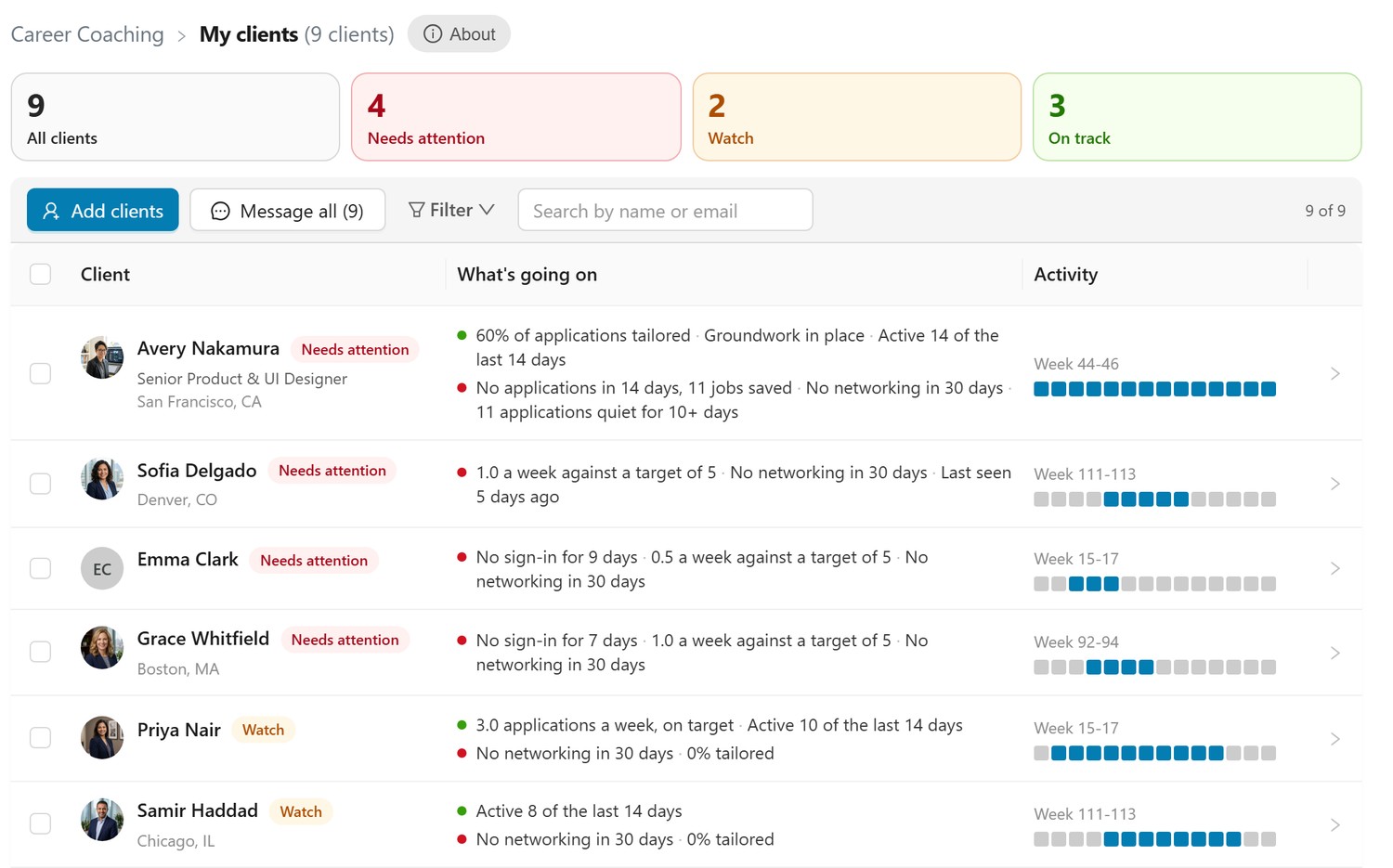
- Your clients, sorted each morning. Every morning, My clients sorts your clients into Needs attention, Watch, On track and New, with up to three things going well and three to work on for each one, such as “No sign-in for 9 days” or “1.0 a week against a target of 5”. These come from clear rules applied to what the client did, not from a model’s guess, and clients never see their tag.
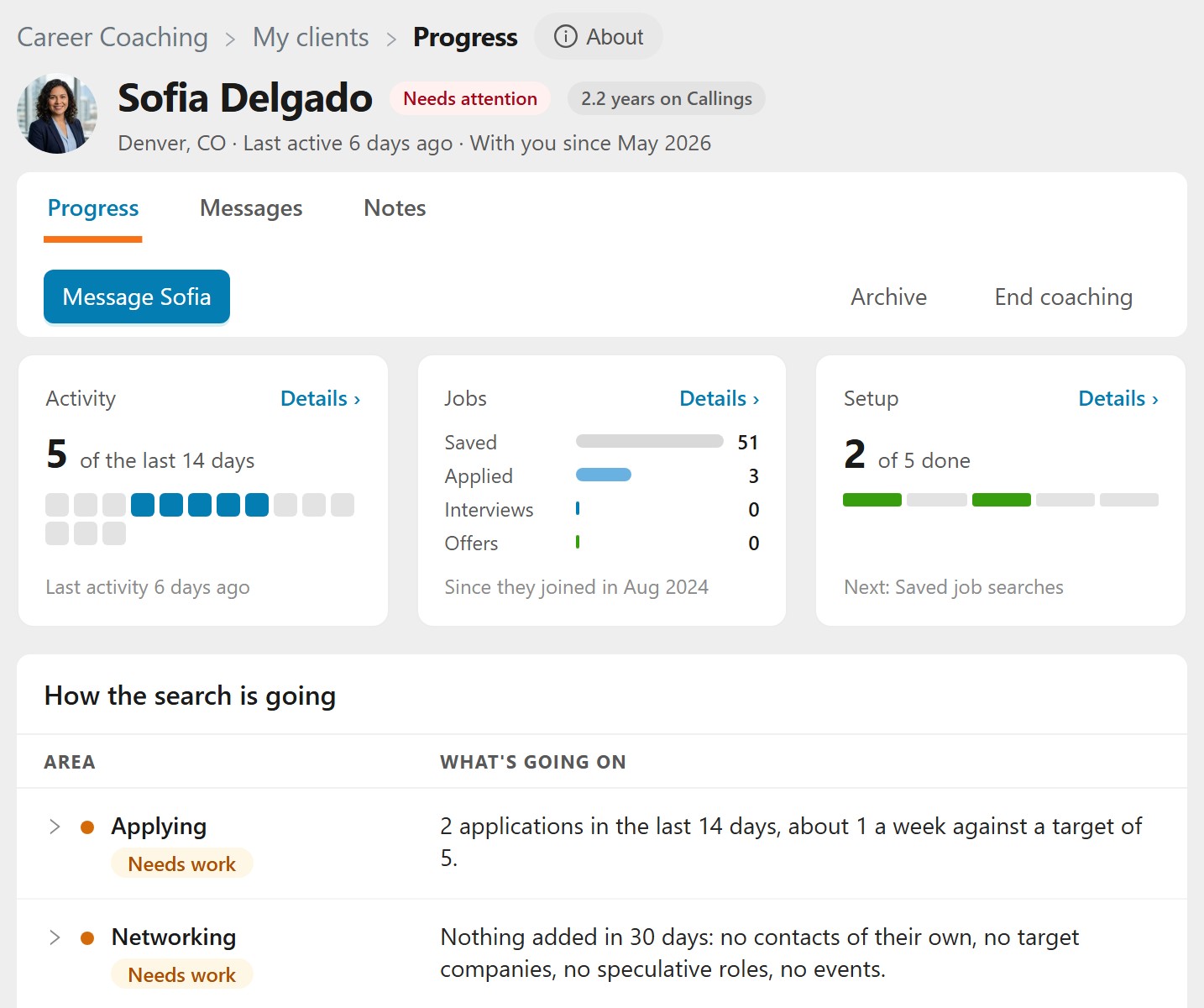
- A page for each client. Their activity, their jobs saved, applied to, interviews and offers, what they’ve set up, and how the search is going in each area, worst first. A private Notes tab is yours alone: the client never sees it, and no AI in Callings reads it.
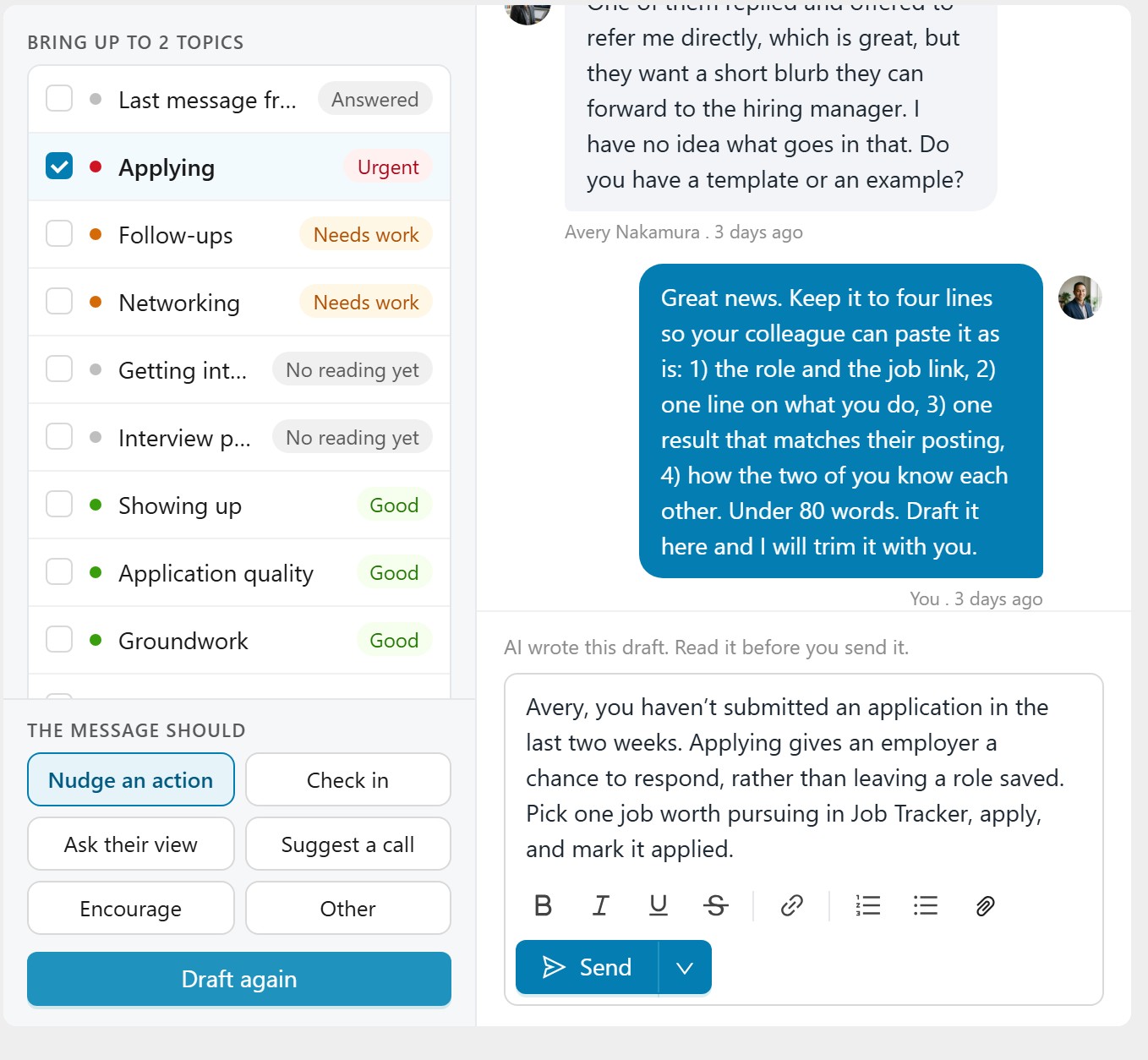
- One conversation per client, with drafts you edit and send. Pick up to two topics and what the message should do (nudge an action, check in, ask their view, suggest a call, encourage), and Callings drafts a short message in a few seconds, from the client’s situation and your conversation so far. You edit it and send it. Nothing is ever sent for you, and the AI never reads your private notes. “Suggest a call” adds your booking link when you’ve saved one, and Message all writes to every client on your list, each in their own conversation.
- Clients reach you from where they work. A client can ask you about a job, a resume or a report with Ask my coach, right from that record, and can message you from Claude or ChatGPT through the Callings connector, after previewing the message.
- Groups and a profile. Put clients in groups (a cohort, a program), and keep a coach profile with your photo, your bio and your booking link.
A word on the drafts. The note “AI wrote this draft” is shown to you, not to your client: once you’ve read it, edited it and sent it, it’s your message. Whether and how you tell clients that you use AI for drafts is your call, under the AI and data policy I suggested above.
Where technology-assisted coaching is going
Here’s where I think this goes, and what we’re building toward.
Today, a coach with twenty clients sees each of them for an hour every week or two, and fills in the rest from memory and email. Software already does part of a coach’s old job, such as drafts, practice and research, at any hour. The next step isn’t replacing the coach. It’s a plan shaped to each client’s week, with the coach’s judgment applied at the moments that matter.
For a client, that looks like a plan that adapts to what they did yesterday: a nudge from their coach the day they stall, a question before the interview that matters, a congratulation the day an offer arrives, an assignment from their coach that shows up in their plan on the right day. For a coach, it looks like software that does the noticing and the first draft, while you decide, adjust and send, and steer each client’s plan instead of rebuilding it every session.
That’s how quality and scale stop being a trade-off. The closest evidence comes from therapy. Regular feedback to therapists on how each client is doing improves results modestly and reduces dropout (Clinical Psychology Review, 2021), and programs guided by a therapist can match face-to-face therapy (World Psychiatry, 2023), in one trial with about 5 hours of the clinician’s time instead of up to 20 sessions (American Journal of Psychiatry, 2018). No study has measured this for coaching yet, but the pattern is the one I’d build for: the person stays in the loop, and the technology tells them when their attention is needed. When the noticing is done for you, more of your attention goes where it changes outcomes, and you can support more clients without any of them getting less of you. That’s better coaching, happier clients, and a practice that can grow without burning you out.
We’re working on the next pieces: letting you steer a client’s weekly plan (more of one front, less of another), and notes and short surveys from you that land in your client’s plan at the right moment. The foundation is what we’ve already built: one platform where the job search itself happens, so the coaching can be as personal as the search.
How to offer between-session support, with or without Callings
- Write it into your offer. Say what the client gets between sessions: “a short check-in every week, replies within one business day, and a note from me before every interview.”
- Set the boundaries too. Your hours, your response time, and what isn’t included. “Unlimited access” sounds generous and burns you out.
- Use a shared record. A tracker the client keeps up (in Callings or in a spreadsheet), so updates don’t depend on their memory or their mood.
- Make every message specific. Generic reminders don’t move people. A note about the interview they have on Thursday does.
- Prepare the five moments. Stalled, interview booked, rejection, offer, silence. Write a two-line message for each, in your own voice, and adapt it each time.
- Check what works. Look at whether clients are more active the week after you write to them. Keep the messages that move people.
The other side: what a job seeker sees
Knowing what your future clients see helps you decide what to put on your own site. On Callings, a job seeker can find you in several ways, all free for them:
- Find a coach. Seven suggested coaches for their background, a mix of kinds of help, each with a record of what the coach publishes and a personal match report, which isn’t a rating and which the coach never sees.
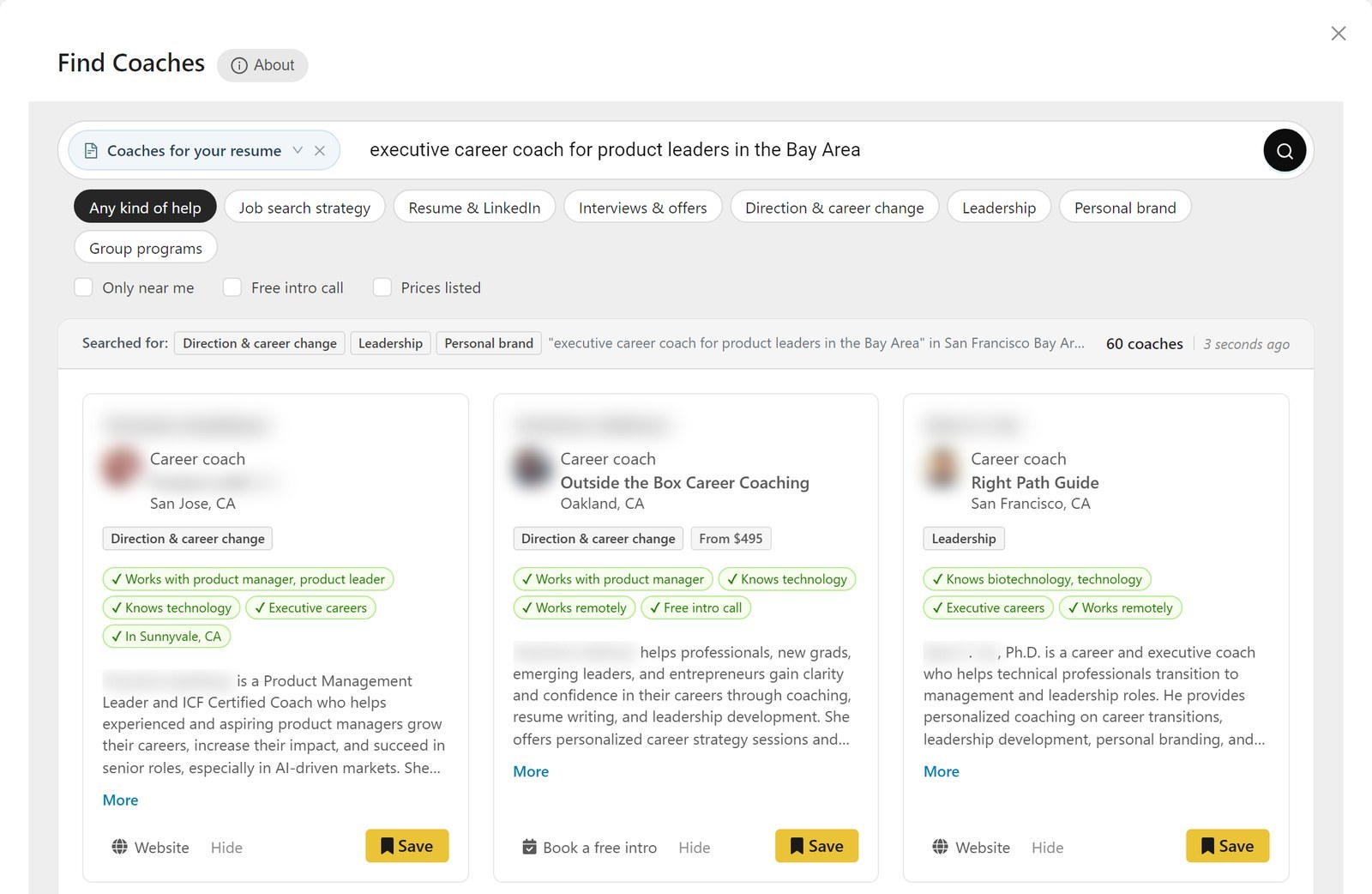
- Find Coaches. A search in their own words, by need, place and level:
- Reach Out. A drafted inquiry about hiring the coach, which the member edits and sends themselves. It never mentions Callings, and coaches aren’t told when a member looked at them.
- Their AI assistant. Members who connect Claude or ChatGPT to Callings can search the directory from there.
- Our public directory. Anyone can browse callings.ai/career-coaches by kind of help, audience and city, with guides such as what a career coach costs.
A few things are true everywhere. Your page shows only what you publish about your practice, mostly on your own website: your services and what they include, your published prices with the date we read them, your credentials and your process. It never shows your photo (initials only), your email or phone number, a rating, a review, an overall score or a paid placement. We check sites every week and re-read a page when it changes, so when you update your website, your listing follows. And if anything is wrong, every page has a link at the bottom, “Listed here? Ask us to update or remove a listing.”, that opens our contact form with your page attached.
About our data
- The directory. 10,999 US career coaches, resume writers, career counselors and group programs, as of October 31, 2026. A listing needs its own website or a public professional profile showing that the person or firm works with individual clients. Coaches who only work inside one company, people who have retired, and businesses that turned out to be job boards or therapy practices are left out.
- What we read. 73,151 pages from the websites of 10,923 of them: services, prices, about pages and process. A coach can list several specialties; their main focus is the one to three things their site leads with (the headline, the first lines about them, the main promise). Prices count each coach once, at their lowest published price.
- The five basics. A price (or “starting at”), a free first call, a booking link, at least two client testimonials on their own website, and a named audience, role or industry.
- Search demand. Google Ads search volumes for the US, through DataForSEO, pulled October 31, 2026, added up from October to September. They’re rounded estimates.
- AI crawlers. A random sample of 600 coach websites, 594 of which answered, checked October 31, 2026. Sites behind Cloudflare can block bots at the firewall, which robots.txt doesn’t show, so our 0.5% is a lower bound.
- How people reach our coach pages. Our own Google Search Console data, October 2026, described in words only.
- Everything is descriptive: no figure here proves that one choice causes another. Outside figures link to their sources.
Mistakes to avoid
- Listing every specialty. Twelve specialties read as none. Lead with one change, and fold the rest into it.
- Hiding the price and the process. A prospect who can’t tell what you cost or how you work calls the coach who says it.
- “Contact me” as the only next step. Put a booking link next to every call to action.
- Writing that lives only behind a sign-up form. Google and AI assistants can’t read it, and neither can a prospect checking you out. Keep a public archive.
- Testimonials without consent, or invented ones. It’s an FTC violation, and the penalty can reach $53,088 each.
- Promising a job. Promise your work and your process; the market decides the rest.
- Different facts on every profile. Your site, LinkedIn and directories should say the same thing in the same words.
- Ticking “block AI crawlers” without knowing what it blocks. Some switches block more than training.
- Selling only what AI now does well. A resume alone competes with a $20 subscription. A resume as part of a search that works doesn’t.
- Chasing every channel at once. Two channels done for six months beat six channels done for two.
- Engagement pods and automation on LinkedIn. LinkedIn doesn’t allow either, and it’s working to make both ineffective. Real comments on other people’s posts work better.
- Buying ads for single sessions. At about $67 a lead, the math rarely works.
- Unlimited access between sessions. It sounds generous, and it burns you out. Promise light, timely support, and say what it includes.
Checklist
This week
- ☐ Write your positioning sentence: who you help, through which change, toward what.
- ☐ Google your name and your practice in a private window, and list what’s wrong or out of date.
- ☐ Check yourdomain.com/robots.txt, your website builder’s AI crawler setting, and Search Console’s “Search generative AI” setting.
- ☐ Put a booking link with reminders next to every “contact me”.
- ☐ Find your listing in our directory and ask us to fix anything that’s wrong.
This month
- ☐ Rewrite your home page headline and one service page around the five basics.
- ☐ Publish a price, a range or a “starting at” price.
- ☐ Ask three past clients for a testimonial in their own words, with written consent.
- ☐ Set up your LinkedIn Service Page, and use your positioning sentence in your headline.
- ☐ Publish a short AI and data policy.
- ☐ Add “How did you hear about me?” to your booking form, and UTM tags to the links on your profiles.
- ☐ Write what happens between sessions into your main package.
This quarter
- ☐ Pitch three podcasts or associations in your niche.
- ☐ Agree on referrals with two coaches who do different work.
- ☐ Put your newsletter archive on your own domain.
- ☐ Ask the AI assistants your ten client questions every month, and fix wrong facts where they come from.
- ☐ Review inquiries, calls and new clients by source, and drop the channel that brings nothing.
- ☐ Try a shared record of the search with two or three clients (the Coach Console is free while in beta).
Frequently asked questions
Is AI replacing career coaches?
Not on the evidence so far. AI took over tasks: searches to hire a resume writer fell 58% in three years while searches for a career coach rose 13%. In a 2026 randomized trial with leaders, human coaching improved outcomes and a chatbot coach didn’t. What changed is what clients pay for: judgment, confidence and follow-through rather than documents.
Should I niche down?
Yes, enough that the right person recognizes themselves in one sentence and others know whom to send you. Test it in small steps: a new headline and one service page for a month. See how specific your niche should be.
Should I publish my prices?
Publish at least a range or a “starting at” price. Only 21.9% of coaches do, and those who do are also more likely to offer a free call and a booking link. A prospect who can’t guess your price often won’t ask.
How long should a free consultation be?
Most coaches who say offer 30 minutes, and 15 minutes is the next most common. Long enough to listen, reflect back and explain how you work; short enough that you can offer it to everyone who asks.
How do I show up in ChatGPT’s or Claude’s answers?
The same way you show up in Google: clear pages in plain text, facts that match everywhere, and mentions on other sites (podcasts, associations, directories). Make sure your site lets the AI search crawlers in, and check your builder’s switches. See AI assistants.
Do I need an ICF credential?
No credential is required to work as a career coach in the US (counseling is different: counselors can be licensed by their state). A credential helps with buyers who check, with platforms and with some directories; with individual clients, a clear niche and specific proof often weigh more. If you have one, explain it in plain words and link to the verification page.
Can I use AI with my clients’ information?
Carefully, and with their agreement. Don’t paste identifiable client details into a consumer AI tool without consent, turn off model training or use a business plan, and say in your AI and data policy what you use and what you never share. The ICF’s Code of Ethics extends a coach’s obligations to the technology they use.
Should I offer group coaching?
If your niche shares a common path, yes. 25% of coaches offer a group program. A group lowers the price per person, adds peer accountability, and gives you a second product next to one-to-one coaching.
Is LinkedIn Premium worth it for a coach?
The Service Page is free, so start there. Premium Business adds a “Request services” button, a showcase of your services and reviews, and more matched requests, for $69.99 a month or $539.88 a year in the US. It’s worth it if your clients are on LinkedIn and you’ll answer the extra requests. Otherwise, a clear headline and a well-written free Service Page go a long way.
Are paid directories worth it?
Some are, for some coaches. Work out the cost per paying client before you pay, read the contract (some plans are a year long and can’t be canceled), and start with the free ones. See directories and marketplaces.
How do I get listed on Callings, or fix my listing?
If your website describes your coaching, you’re probably already listed: search your name in our directory. To fix or remove a listing, use the link at the bottom of your page, “Listed here? Ask us to update or remove a listing.” If you’re not listed yet, send me a note with your website.
Do coaches pay to be listed or to rank on Callings?
No. Coaches don’t pay to be listed or to rank, and there are no paid placements. The best thing you can do for your listing is the same thing that helps everywhere else: say clearly on your own website who you help, how, at what price, and how to start.
Is the Coach Console free?
Yes, while it’s in beta, with no card and no seat count. Your clients don’t need a paid Callings plan to share their search with you or to message you.
Resources
Callings (free)
- Our career coach directory, by kind of help, audience and city. Read the listings in your niche the way a client would.
- What clients read before they hire: what a career coach costs, how to choose a career coach, coach or counselor?, free career help and credentials explained
- How to Find the Right Career Coach, our guide for job seekers, with prices and red flags from the same directory
- The Coach Console, free while in beta, and what your clients see: My Coach and Find a Coach
- The figures in this post: see about our data
Rules and ethics
- FTC: Consumer Reviews and Testimonials Rule, questions and answers and Endorsement Guides: what people are asking
- ICF Code of Ethics and NCDA Code of Ethics
- California Civil Code 1812.501 (employment counseling services)
Being found
- Google: AI features and your website, optimizing for generative AI search and Google’s crawlers, including Google-Extended
- Google Business Profile: eligibility guidelines and service areas
- AI crawlers: OpenAI, Anthropic and Perplexity
- Measuring: Search Console’s Generative AI performance report, the “Search generative AI” setting and GA4’s default channel groups, including AI Assistant
- LinkedIn: Service Pages FAQ and Premium Business features for Service Pages
Data
- ICF Global Coaching Study 2025 and ICF consumer awareness study 2026
- BLS: unemployed persons by duration and JOLTS
- New York Fed Survey of Consumer Expectations
Tools (check prices on their pages; they change often)
- Booking: Cal.com, Calendly, TidyCal, Acuity Scheduling
- Newsletters: Kit, beehiiv
- Coaching practice platforms: Paperbell and similar tools for contracts, payments and scheduling
Last word
When I wrote From Applying To Being Found, I was thinking of job seekers: “In a market full of polished sameness, being found matters more than applying well.” It turns out to be just as true for the coaches who help them. Your clients now have a confident AI voice in their pocket. What they need from you is the judgment, the relationship and the follow-through it can’t give them, and a way to find you.
So here’s my advice, feature or not: name the change you help people through in one sentence, put the five basics on your website, be visible where the people you help already gather, and make the time between sessions part of what you offer. That’s how you get coaching clients in 2026: by being easy to find, easy to understand, and hard to replace.
If you want to see your competition, browse the directory. If you want to try light, timely support between sessions with a few of your clients, the Coach Console is free while in beta.
If something on this page is wrong, out of date, or missing something you’ve found useful, please send me a note. I’d rather fix the page than have you rely on something that’s no longer true.
Thank you for the work you do!
Philippe
Update log
- October 31, 2026: First version. Figures from the Callings coach directory as of October 31, 2026 (10,999 coaches, 73,151 pages read), Google search volumes pulled the same day, and platform terms checked on their own pages the same day.