How to Find the Right Career Coach: The 2026 Guide for Job Seekers
By Philippe Cailloux · · 38 min read

Don’t look for “a career coach”. Look for the help your situation needs
Over my career, I’ve worked with several career coaches, and no two of them did the same job. One was a writer who helped me with my personal brand and a short biography. One was a resume writer. One ran an executive group coaching program. Along the way, I’ve also helped many colleagues through their own job searches.
As I build Callings.ai, many of our members rely on career coaches too, in very different capacities and scopes: for example, a resume writer for a week, an executive coach for several months, a group program, or a couple of mock interviews before a final round. The words “career coach” cover all of it, which makes it hard to know what to look for, what to expect and what to pay.
So we built the data. We read what career coaches, resume writers, career counselors and group programs across the United States publish about their own practice, on their websites and professional profiles, and ended up with a directory of 11,091 of them. 2,309 publish their prices. More than 80,000 web pages later, we had answers to the questions this guide is about: who does what, what it costs, which credentials mean something, and which promises should make you walk away.
This page is what I found, organized so you can find the kind of help that fits your situation, know what to expect, prepare, and pay a fair price. Where Callings can help, I say so, with links to our new public directory of career coaches and to the features we built from the research: an AI search engine for coaches, and coach suggestions matched to your background, each with a personal match report.
For information only, as of October 1, 2026. Prices are what coaches publish on their own websites, read as of September 30, 2026. Most coaches don’t publish prices, so treat every figure here as a guide to ask with, not a quote. The sections on credentials, contracts and taxes link to the official sources; I’m not a lawyer or a tax adviser, and those sources always have the final word.
Full disclosure: Callings is my product, and part of this page describes features we built. The research stands on its own: every figure comes from what coaches publish or from an official source, coaches don’t pay to be listed or to rank in our directory, and I’ve tried to write the page I would want to read before hiring help.
Last updated: October 1, 2026. I’ll do my best to keep this page current as the directory is refreshed, as prices and rules change, and as readers point out what I got wrong. Changes are listed in the update log at the bottom.
At a glance
| Question | Short answer |
|---|---|
| What does a career coach do? | Helps with one part of your career or job search: direction, strategy, your resume and LinkedIn profile, interviews, negotiation, leadership or visibility. Most specialize |
| Is it regulated? | No. Anyone can use the title “career coach”. Counselors can be licensed by a state board, and coaching credentials are voluntary |
| What does it cost? | A single session: about $150 at the median. A career coaching package: about $700. An executive package: about $2,400. A resume: $199 entry level, $313 mid-career, $499 executive |
| How long does it take? | A resume: about 4 days and 2 rounds of revisions. Interview coaching: about 3 sessions. Career coaching: about 6 sessions over 12 weeks; executive coaching, 8 sessions over 24 weeks |
| Is there free help? | Yes: nearly 2,300 American Job Centers, college career centers, public libraries, programs for veterans, and a free first conversation with 45% of coaches |
| How do I choose? | Match the kind of help to your problem, ask who they usually work with, get the full price and terms in writing, check credentials with the issuer, use the free consultation, and walk away from guarantees |
| Where do I find one? | Referrals, the directories of the credentialing bodies (ICF, NCDA, CCE, PARWCC, NRWA, CDI), and our career coach directory |
Where finding a coach fits in Callings
Callings is a platform for the whole job hunt, and finding a coach is one part of it. Coaches sit under Networking > People > Coaches, next to your recruiters and contacts, and the suggestions get better the more of the rest you use:
| Area of Callings | What it covers | What it brings to finding a coach |
|---|---|---|
| Personal Brand: My Insights, My Resumes, My Campaign, My Posts | Your strengths and market fit, your resumes, your personal website, your writing | Your resume is what we read to suggest coaches and to write your match report |
| Opportunities: Find Jobs, Job Tracker, Target Companies | Finding roles, tracking applications, the companies you’re aiming at | Your saved search preferences and recent applications tell us where you’re heading and how the search is going |
| Networking: People, Events, Associations, Community | Your recruiters and contacts, coaches, events and professional groups | The Coaches tab, the coaches you keep, and the inquiry you send them |
Some of what a coach does, Callings also does in software: a resume and cover letter tailored to each job, preparation for each interview, a report on your market fit. A coach earns their fee on what software can’t do: judgment about your situation, honest feedback, accountability week after week, and experience with many searches like yours.
Table of contents
- What I learned building a directory of 11,091 coaches
- The kinds of career help, and who does what
- Coach, counselor or therapist: which titles are regulated
- Which kind of help fits your situation
- What a career coach costs
- What to expect when you work with a coach
- How to prepare before you hire anyone
- How to choose: questions to ask and credentials to check
- Contracts, refunds and the law
- Red flags
- Free and low-cost help
- Where to find a career coach
- How Callings helps you find and vet a coach
- How we built the directory
- Mistakes to avoid
- Checklist
- Frequently asked questions
- Official resources
What I learned building a directory of 11,091 coaches
A directory is only useful if you can trust what’s in it, so we were strict about what got in. A listing needs its own website or a public professional profile showing that the person or firm works with individual clients. Coaches who only work inside one company, people who have retired, and businesses that turned out to be job boards or therapy practices were left out. For everyone else, we read the pages of their site that matter (services, pricing, about, process) and wrote down only what they publish: each service and what it includes, the price, whether a first call is free, credentials, background, refund terms. That’s 50,783 services, each with what the coach says it includes.
Eight things stood out.
1. The title tells you very little. Of the 11,091, 45% present themselves as career coaches, 27% as leadership coaches, 12% as life coaches who do career work, 8% as resume writers, 6% as career counselors and 1% as personal brand strategists. A “career coach” can be a former recruiter who rewrites resumes, a licensed counselor who uses formal assessments, or a former executive who coaches other executives. Look past the title to the services.
2. Most don’t publish prices. Only 21% do. Among coaches, resume writers publish prices most often (42%) and leadership coaches least often (8%). Another 12% say outright that you have to contact them for pricing.
3. Almost all of them work by video. 99.6% offer virtual sessions, and 64% also offer to meet in person. Unless you want to sit in the same room, you can look nationally, which widens your choice a lot.
4. A free first conversation is common. 45% offer one, usually 30 minutes long. Coaches who publish their prices are almost twice as likely to offer it (71% against 38%).
5. They are experienced, and many came from the hiring side. The median coach has 15 years of experience (some count their whole career, not only their years coaching). Of the coaches who describe a career before coaching, 29% worked in HR or recruiting, 21% in education, 21% in senior executive roles and 12% in counseling or psychology.
6. A third hold a credential you can check. 33% list a named credential from a body that issues it: a coaching federation, a career development association, a resume writers’ association or a state license. The others may be excellent; you just have to judge them on other evidence.
7. Real guarantees are rare, and that’s a good sign. Only 35 coaches (0.3%) promise a job offer, and 104 (0.9%) guarantee interviews, usually as a free rewrite if the resume brings none. Nobody controls an employer’s hiring decision, and at least one state forbids job guarantees outright (more in contracts).
8. Few publish their refund terms. Only 9% do. Of those, about 30% offer some kind of refund and 19% say there are no refunds at all. Most of the time, you’ll have to ask.
The kinds of career help, and who does what
I’ve hired three of the kinds of help below myself (a personal brand and biography writer, a resume writer and an executive group program). They solve different problems, and the counts show how many coaches in our directory offer each one (a coach often offers several):
| Kind of help | What they do | Usual format | In our directory |
|---|---|---|---|
| Job search coach | Targeting, a plan, networking, applications, staying on track | Sessions or a package over a few weeks or months | 5,890 |
| Resume writer | Writes your resume for you, often your LinkedIn profile and cover letter too | A done-for-you package with revision rounds, about 4 days | 3,611 offer it; 857 mainly write resumes |
| LinkedIn profile writer | Rewrites your profile, sometimes coaches you on using LinkedIn | Done for you, or a session | 2,071 |
| Interview coach | Mock interviews with feedback, your stories, answers to the hard questions | 1 to 3 sessions before an interview process | 4,263 |
| Salary negotiation coach | Helps you weigh an offer and negotiate it | 1 or 2 sessions, often on short notice | 965 |
| Career change coach | Helps you choose a direction and plan the move | A package over 2 to 6 months, often with assessments | 4,778 |
| Career counselor | Career guidance from a trained counselor, often licensed, often with formal assessments | Sessions | 674 |
| Executive career coach | A senior search: positioning, network, search firms, boards, confidentiality | A package or a retainer over months | 3,725 |
| Leadership coach | Leadership in the role you have; some also help executives move | Months, often paid for by the employer | 2,994 mainly coach leadership |
| Personal brand strategist | How you present yourself: your biography, LinkedIn, writing, speaking | A project or a few sessions | 4,221 |
| Career assessments | A formal instrument (MBTI, Strong, CliftonStrengths, DiSC) with a debrief | 1 or 2 sessions | 1,124 |
| Group program | A cohort with a curriculum: job search bootcamps, career change programs | About 10 weeks, usually cheaper per hour | 83 programs, and 2,852 coaches who run groups |
| Outplacement | Career transition services your former employer pays for | Weeks to months, sometimes part of a severance package | Ask HR before you hire anyone |
Two more people often come up in the same conversation, and neither is a career coach:
- A mentor is usually free and shares what they learned doing the job you want. The International Coaching Federation (ICF) puts the difference simply: “A mentor shares their hard-learned wisdom, advice, encouragement, and lessons”, while “a coach helps you discover your strengths, set clear goals, and create your own roadmap to success.” You may want both.
- A recruiter works for the employer, not for you. As the Federal Trade Commission puts it, “Honest placement firms do not typically charge a fee to job candidates. Instead, the hiring company pays them a fee to find qualified candidates.” A coach is the reverse: you pay, and they work for you, which is why no honest coach can promise you the job.
Coach, counselor or therapist: which titles are regulated
This distinction matters most when something goes wrong.
“Coach” is not a regulated title. In the ICF’s own words, “Anyone can say, ‘I’m a coach.'” The ICF also describes coaching as an “unregulated industry” with “no special legal protection”, where disputes are settled under ordinary contract law. Credentials exist, and some are demanding (see credentials), but they’re voluntary.
“Counselor” can be. Every state now licenses professional counselors (titles such as LPC, LMHC or LCPC), and the Bureau of Labor Statistics notes that “some states require licensure for career counselors”. A licensed counselor answers to a state board, and you can look up their license there. 251 coaches in our directory list a state counseling license.
A certification is not a license. The National Career Development Association (NCDA) says it plainly: “Certifications, licensure, and permission to practice are unrelated concepts.”
A coach is not a therapist. The ICF describes therapy as “the space to heal, recover from past traumas”, while “coaching is often future-oriented”. If a layoff or a long search has turned into anxiety or depression that gets in the way of daily life, a licensed mental health professional is the right first call, and a good coach should tell you so.
Our guide to career coach, counselor or life coach has the short version, with how many of each we list.
Which kind of help fits your situation
Find the line closest to where you are. The last column is worth trying before you pay anyone.
| Your situation | What usually helps | Who to look for | Try first |
|---|---|---|---|
| Lots of applications, no interviews | Better targeting, and a resume that fits the roles | A job search coach; a resume writer if you’re changing field or level | Check that you’re aiming at roles you match; tailor your resume to each posting |
| Interviews, but no offers | Practice with honest feedback | An interview coach who runs mock interviews | Practice out loud with a friend; record yourself |
| An offer in hand | Weighing it and negotiating | A salary negotiation coach, one or two sessions | Pay data for the role and the city |
| You don’t know what’s next | Direction, often with assessments | A career change coach or a career counselor | The free O*NET Interest Profiler; conversations with people in the roles |
| You want to change careers | A plan for the move, and a story that bridges the gap | A career change coach first, then a resume writer | Informational interviews |
| You were laid off | What your former employer offers, then a plan | Outplacement if offered; an American Job Center; a job search coach | Ask HR about outplacement; your state’s Rapid Response services |
| A senior or executive search, maybe confidential | Positioning, network strategy, search firms, an executive resume | An executive career coach and an executive resume writer | Your network and former colleagues |
| A first management role, or a bigger one | Leadership development | A leadership coach, often paid for by your employer | Ask about a coaching or development budget |
| Visibility matters for the role you want | A clear story, told consistently in public | A personal brand strategist or a biography writer | A personal website and a few posts |
| Student or new graduate | First targets, a resume, interview practice | Your college career center first, then coaches for new grads or a group program | Your career center |
| Veteran or transitioning service member | Translating military experience, a first civilian search | Free programs first, then coaches for veterans | TAP, VA career counseling, Hire Heroes USA (see free help) |
| Returning after a break | An updated story, confidence, a plan | A job search coach who works with returners | Your former network |
| A disability, ADHD or a health condition that affects work | Accommodations, a good fit, support | Your state’s vocational rehabilitation agency; coaches for adults with ADHD | State vocational rehabilitation |
If your field has its own rules, look for someone who knows them. We keep hubs for executives, tech professionals, healthcare professionals, finance professionals, women, federal employees, lawyers, teachers, physicians and nurses, plus combinations such as resume writers for federal employees, resume writers for tech professionals, interview coaches for executives, career change coaches for teachers and career change coaches for lawyers.
Do it yourself, or hire?
Not every problem needs a professional. This is the rule of thumb we use on our directory pages:
| Area | Do it yourself when | Hire someone when |
|---|---|---|
| Resume | You’re staying in the same field and level, and you have recent results to cite | You’re changing field or level, coming back after a long break, or many applications brought no interviews |
| Interviews | It’s an early round in a format you know | It’s a final round or a panel, a new kind of role, or you tend to freeze |
| Job search | Interviews are coming in | Three months without traction, or a senior search that runs on your network |
| Career direction | You already have two or three target roles | You don’t know what comes next, or you want structure and a formal assessment |
| Leadership | You have a mentor who has done the job | A first management role or a bigger team, often paid for by the employer |
| Personal brand | The role you want doesn’t depend on visibility | Visibility or thought leadership is part of the role |
What a career coach costs
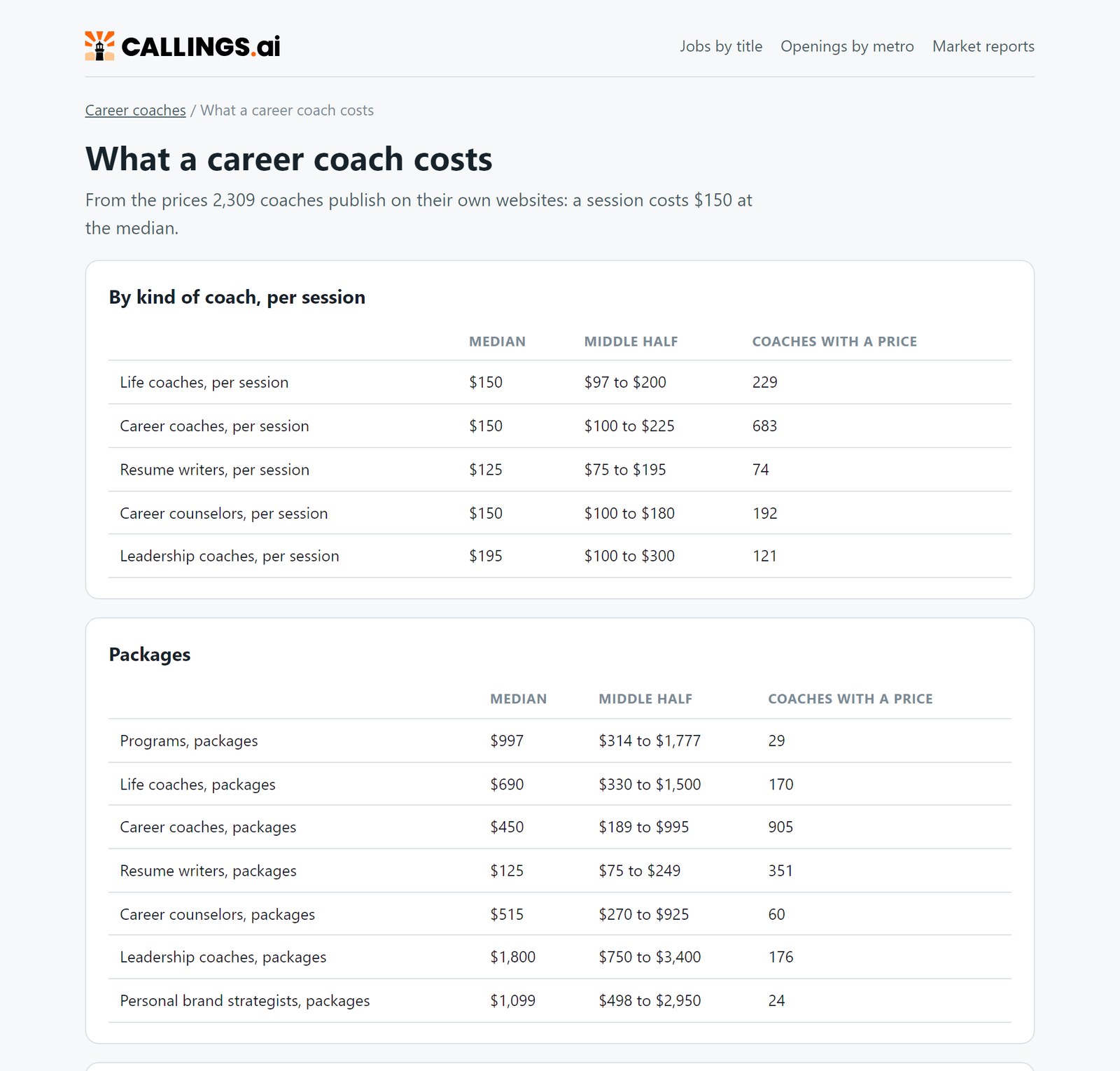
These are the prices coaches publish on their own websites, read as of September 30, 2026. Each coach counts once, at their lowest price for the service (their starting price), and the “middle half” is the range where the middle 50% of coaches fall. Remember that only one coach in five publishes a price: the ones who don’t may charge more, or less.
Coaching
| Service | Starting price (median) | Middle half | Typical shape | Coaches |
|---|---|---|---|---|
| Career coaching, one session | $150 | $99 to $200 | 60 minutes | 1,080 |
| Career coaching, package | $700 | $399 to $1,500 | 6 sessions over 12 weeks, about $186 a session | 803 |
| Career coaching, monthly | $400 | $199 to $710 | Ongoing | 169 |
| Executive career coaching, one session | $290 | $195 to $450 | 60 minutes | 130 |
| Executive career coaching, package | $2,400 | $999 to $4,000 | 8 sessions over 24 weeks, about $350 a session | 206 |
| Interview coaching, one session | $150 | $100 to $249 | 60 minutes | 234 |
| Interview coaching, package | $399 | $190 to $662 | About 3 sessions | 117 |
| Group program for individuals | $549 | $199 to $1,800 | About 10 weeks | 768 offers |
A few details behind the table:
- Sessions are usually an hour. 43% of the sessions with a stated length are 60 minutes, 13% are 30 minutes, 9% are 45 and 9% are 90.
- Group programs vary the most. 18.5% of the programs that show a price are free, and the paid ones run from $45 to $3,750 (from the 10th to the 90th percentile).
- Salary negotiation is usually sold by the session, at about $150 among the few coaches who publish it.
- Our cost page breaks session prices down by kind of coach and by what they focus on: a career counselor’s session costs $150 at the median, a leadership coach’s $195, and coaches who focus on executive careers charge $200 a session at the median.
Resumes, LinkedIn profiles and cover letters
| Document, written for you | Starting price (median) | Middle half | Top 10% start at | Writers |
|---|---|---|---|---|
| Resume, entry level or new graduate | $199 | $109 to $299 | $479 | 238 |
| Resume, mid-career or manager | $313 | $200 to $500 | $699 | 166 |
| Resume, executive | $499 | $300 to $799 | $1,095 | 246 |
| Resume and LinkedIn profile together | $372 | $249 to $650 | $1,199 | 272 |
| LinkedIn profile alone | $179 | $100 to $350 | $590 | 286 |
| Cover letter alone | $90 | $55 to $149 | $249 | 252 |
| Resume review, no rewrite | $100 | $75 to $199 | $450 | 97 |
The typical turnaround is 4 days (3 to 7 for the middle half), with 2 rounds of revisions included. Only 4% of writers offer unlimited revisions.
How our numbers compare
The ICF’s 2025 Global Coaching Study, which surveys coaches of every kind worldwide, puts the average fee for a one-hour coaching session at $234; its previous study put North America at $272 (2022 data). Our median of $150 is lower, most likely because our directory is career coaches selling to individuals, while the ICF counts all coaching, including executive coaching paid for by companies.
The spread inside our directory is wide. Among coaches who publish prices, the cheapest offer is $175 at the median: 24% have something under $100, and 14% start at $1,000 or more. At the top, one coach in ten starts their packages at $2,500 or more, and 183 coaches (8%) sell an offer of $5,000 or more.
Ways to pay less
- Use the free consultation (45% of coaches offer one) to see whether you need a package at all.
- Ask for a single session before a package. Many coaches sell single sessions.
- Ask about payment plans (7% mention one) or a sliding scale (2%).
- Ask your employer, current or former: leadership coaching is often paid for by employers, and outplacement is sometimes part of a severance package.
- Look at group programs and at the free help below before you pay for one-to-one time.
Is it worth it? A simple calculation
I can’t tell you that a coach will shorten your search, and you should be wary of anyone who says they can. But you can work out what it would take for one to pay for itself.
At a salary of $90,000, each week without a job costs about $1,730 in pay you’re not earning ($90,000 / 52). A $700 coaching package pays for itself if it brings your start date forward by about 3 days. At $250,000, a week is worth about $4,810, and a $2,400 executive package pays for itself at about 3 and a half days.
By that math, the fee is often small next to the cost of a long search. The real question is whether the coach addresses what is actually slowing you down. A great resume writer won’t fix a search aimed at the wrong roles, and a great interview coach won’t help if no interviews are coming.
Taxes
For 2026, a job seeker can’t deduct a career coach or a resume writer. Job search costs used to be a miscellaneous itemized deduction. The 2017 tax law suspended those deductions through 2025, and the 2025 law (Public Law 119-21) made the suspension permanent. 26 U.S.C. 67(h) now reads: “no miscellaneous itemized deduction shall be allowed for any taxable year beginning after December 31, 2017.” Some IRS pages still describe the old end date; the statute is current. If you’re self-employed, ask a tax professional, because business expenses follow different rules.
Outplacement your employer pays for can be tax-free to you. IRS Publication 15-B treats it as a working condition benefit when it’s provided on the basis of need and you’re looking for work in the same kind of business, but not if you could have taken cash instead.
What to expect when you work with a coach
The free consultation
When it’s offered, it’s usually 30 minutes (that’s both the median and the most common length; 24% are 15 minutes or less, and 9% last an hour or more). Use it to see how they work and to ask about the price, not to get the coaching itself. Come with your one-sentence problem and the questions from how to choose.
A coaching engagement
- Intake. A questionnaire or a first call about your background and goals, your resume, sometimes your LinkedIn profile and a few postings you like.
- Sometimes an assessment. 31% of coaches name at least one: MBTI (881 coaches), DiSC (687), CliftonStrengths (452), Hogan (422), an emotional intelligence instrument such as EQ-i (406) and the Strong Interest Inventory (271) lead the list. Some you can take on your own: as of October 1, 2026, Gallup sells the CliftonStrengths Top 5 for $24.99 and the full 34 for $59.99, and the official MBTI costs $59.95 online. The free O*NET Interest Profiler from the Department of Labor covers career interests.
- Sessions. About an hour each, every week or two. A typical career coaching package is 6 sessions over 12 weeks; an executive one, 8 sessions over 24 weeks. The ICF says coaching engagements typically last “between 4-6 months with each session being 1-2 hours long.”
- The work between sessions is yours. Outreach, applications, practice, drafts. A coach brings structure, perspective and accountability; they don’t apply for you, and they can’t get you hired.
- Confidentiality is a contract term. Since coaching has “no special legal protection” (the ICF’s words), ask how they handle what you share, especially in a confidential search, and get it in writing.
Resume writing
An intake questionnaire or call, a first draft in about 4 days, 2 rounds of revisions, then final files. Ask whether they write it themselves or pass it to another writer, and make sure you keep editable files. When the draft comes back, read it out loud: if it doesn’t sound like you, say so. In Why The Messenger Matters I wrote that “personal brand is not decoration. It is the work of making values, strengths, and judgment legible to other people and to the systems screening us.” A resume is part of that work, and it has to survive an interview where you’re the one talking.
Interview coaching
Usually one to three sessions, built around mock interviews with feedback. Bring a real job posting to the first one, and ask for sessions that simulate the actual format (a phone screen, a panel, a case, a presentation).
Group programs
A cohort, a curriculum and a schedule, typically about 10 weeks. You get structure and peers going through the same thing at a lower price per hour, and less individual attention. Ask how big the group is and how much one-to-one time is included.
Outplacement
If you were laid off, ask HR whether outplacement is part of your package before you hire anyone, and how long you have to start using it. The Society for Human Resource Management (SHRM) describes the employer’s side: “Effective transition or outplacement services help separated employees find new jobs, protect the company’s reputation, prevent potential lawsuits and lessen an employer’s unemployment insurance taxes.” Use it even if you plan to hire your own coach later: your former employer is paying for it.
How to prepare before you hire anyone
A coach’s time is the expensive part, so arrive with the groundwork done.
- Write the problem in one sentence. “I’ve sent 80 applications for product roles and had 2 interviews” is a problem a coach can work on. “I need help with my career” is not, yet.
- Gather the evidence. Your current resume, your LinkedIn profile, three to five postings you’d love to land, the list of applications you sent and what happened to each, your last performance reviews, and your target salary.
- Set a budget and a time frame. Use the price tables to see what’s realistic, and decide in advance how much you’ll spend before you see results.
- Do the free part first. The free help below, a free assessment, and the do-it-yourself steps in the table above.
- Shortlist three. The ICF recommends that “you interview three coaches before you make a hiring decision.”
- Prepare your questions from the next section, and book the free consultations close together so you can compare.
How to choose: questions to ask and credentials to check
The questions
- Who do you usually work with? Level, field, and the kind of move. A coach who mostly helps new graduates is the wrong fit for a VP search, and the reverse.
- What exactly is included, and what does it cost in total? Sessions, length, messages between sessions, documents.
- What happens if I land a job partway through? Unused sessions, refunds, credits.
- What are your cancellation and refund terms? Only 9% publish them.
- Which body issued your credential, and can I check it there?
- How long does a typical engagement last, and what ends it?
- Can I talk to two former clients? The ICF suggests you “request at least two references”.
And for specific kinds of help:
- Resume writers: do you write it yourself? How many revision rounds? Will I keep editable files?
- Interview coaches: are sessions mock interviews with feedback, or general advice?
- Career change coaches: how do you help people choose a direction before rewriting a resume? Which assessments do you use?
- Executive coaches: do you mostly coach searches or leadership? How do you handle a confidential search while I’m still employed?
The ICF also reminds you that “it is important to make sure you have good chemistry with your coach.” You’ll be telling this person about your setbacks. After the consultation, ask yourself whether you’d look forward to the next call.
Credentials, and where to check them
A credential tells you someone trained, practiced and passed a bar. It doesn’t tell you they’re right for your situation. Still, it’s a fact you can check, and the issuer is where you check it, not the coach’s website.
| Credential | Issued by | What it takes | Check it at | In our directory |
|---|---|---|---|---|
| ACC, Associate Certified Coach | ICF | 60+ hours of coach training, 100+ hours of coaching (75 paid) with 8+ clients, mentor coaching, an exam | ICF Verify a Coach | 601 |
| PCC, Professional Certified Coach | ICF | 125+ hours of training, 500+ hours of coaching (450 paid) with 25+ clients, an exam | ICF Verify a Coach | 1,017 |
| MCC, Master Certified Coach | ICF | 200+ hours of training, 2,500+ hours of coaching (2,250 paid) with 35+ clients | ICF Verify a Coach | 144 |
| BCC, Board Certified Coach | CCE | 30 to 120 hours of coach training depending on your degree, 30 hours of experience, an exam | CCE search | 157 |
| GCDF, Global Career Development Facilitator | CCE, with NCDA | 120+ hours of training on 12 core competencies | CCE search | 94 |
| NCC, National Certified Counselor | NBCC | A graduate degree in counseling, a national exam, supervised experience | NBCC verification | 121 |
| CCC, Certified Career Counselor | NCDA | A master’s degree in counseling plus career counseling experience or training | NCDA credential holders | 60 |
| CCSP, Certified Career Services Provider | NCDA | NCDA’s Facilitating Career Development training | NCDA credential holders | 59 |
| CPRW, Certified Professional Resume Writer | PARWCC | The association’s certification | PARWCC directory | 544 |
| NCRW, Nationally Certified Resume Writer | NRWA | The association’s certification | NRWA directory | 53 |
| CMRW, Certified Master Resume Writer | Career Directors International | The association’s certification | CDI directory | 37 |
| LPC, LMHC, LCPC | Your state’s licensing board | A state counseling license | Your state board’s license lookup | 251 |
The ICF requirements are from its credential paths page; the CCE ones from the BCC and GCDF pages; the NCDA ones from its credentials page.
Three more things worth knowing:
- The same letters can mean different things. CPCC is a Co-Active coaching credential (308 coaches list it) and also a career coaching certification from PARWCC (116). CPC is used by several coaching programs (382). Ask which body issued it.
- Assessment certifications (MBTI 456 coaches, DiSC 317, Hogan 248, Gallup Strengths 157, Strong 93) mean the coach is trained to give and debrief that instrument. Useful if you want that assessment; not a coaching credential.
- HR certifications (SPHR 160, SHRM-SCP 108) tell you about a coach’s HR background, which can be valuable on the hiring side of the table.
Our credentials guide lists the rest, with how many coaches in our directory list each one.
Contracts, refunds and the law
Get it in writing: the services, the number and length of sessions, the total price and payment schedule, what ends the engagement, cancellation and refund terms, and confidentiality. As we saw, only 9% of coaches publish refund terms. Among those who do, 47% set a rescheduling notice (most often 24 hours), about 30% offer some refund, and 19% offer none.
NCDA’s career help page lists what clients of its credential holders can expect, including that “You may terminate services at any time and pay only for the services rendered.” Not every coach works that way, which is exactly why you ask before paying.
Some states regulate paid career services directly. Two examples I checked:
- California. Under the Employment Agency, Employment Counseling, and Job Listing Services Act, an “employment counseling service” is anyone offering career counseling, vocational guidance, career management or resume development for a fee. Pure pay-by-the-hour services are excluded, and so are resume-only services that charge $300 or less. The others must keep a $10,000 bond, use a written contract that gives you three business days to cancel and states that no job is promised, show you their fee schedule before you meet with a counselor, and may not “make any verbal or written promise or guarantee of any job or employment”.
- New York. Someone who gives vocational guidance for a fee and claims they can get you a job, or that they have access to jobs “not otherwise available”, is treated as an employment agency, and New York employment agencies can generally charge only under a written contract and after you’ve been hired through them.
Other states have their own rules. If a provider’s terms look wrong, your state attorney general’s consumer protection office is the place to ask.
Red flags
- A guarantee of a job, interviews or a placement rate. NCDA advises: “Be skeptical of those who promise you more money, quick promotions, speedy or guaranteed results”. A free rewrite if your resume brings no interviews is a service promise, which is different; read its conditions.
- The “hidden job market” pitch. In one Federal Trade Commission case, people were told they were “qualified for unadvertised high-paying executive positions” and asked to pay “an advance recruiting fee of between $1,200 and $2,500”. The FTC shut the scheme down, along with its false claims of “100 percent interview rates and 86-90 percent placement rates”.
- A “recruiter” who charges you. As above, honest placement firms are paid by the employer.
- A fee to “reformat” your resume after you apply for a job. The FTC warns that this is a known scam: “they’re asking you to pay for a job.”
- Pressure to pay for a long package before you’ve had a single session, or no written terms at all.
- A credential they won’t name the issuer of, or that the issuer can’t find.
The National Resume Writers’ Association sums it up in its Job Seeker Safety Center: “Do not pay for the promise of a job.” And, just as useful: “Verify through a channel you find yourself.”
Free and low-cost help
Before you pay anyone, check what’s already paid for, by your taxes, your school or your former employer.
- American Job Centers. Nearly 2,300 centers, funded by the U.S. Department of Labor, provide free help. They have “experienced career counselors on staff”, and many run workshops on resume writing and interviewing (CareerOneStop). Services vary by location. Call 1-877-US2-JOBS (1-877-872-5627) or use the finder.
- If you were laid off: your state’s Rapid Response services include “Career counseling and job search assistance” and “Resume preparation and interviewing skills workshops”. If you’re claiming unemployment, workshops and counseling sessions can count toward your weekly work search in many states; see my guide to work search requirements by state.
- Your college career center. Many keep helping alumni for free. Ask.
- Your public library. In the Public Library Association’s 2022 survey, 78% of libraries offered job and career services.
- Veterans, service members and their families: the Transition Assistance Program (TAP), the VA’s free Personalized Career Planning and Guidance (Chapter 36), Veteran Readiness and Employment (Chapter 31) for those with a service-connected disability rating of at least 10%, and Hire Heroes USA (“Personalized career support at no cost”).
- People with disabilities: every state has a vocational rehabilitation agency.
- Starting a business instead? SCORE offers “free, expert business mentoring” from more than 10,000 volunteer mentors.
- Free tools: the O*NET Interest Profiler, CareerOneStop, and our free job market reports by role and metro.
- From coaches themselves: 5,010 offer a free first conversation, and 18.5% of priced group programs are free.
Our free career coaching guide keeps the short list.
Where to find a career coach
1. Referrals. Ask colleagues, former managers, recruiters you trust and your alumni network, and ask what the coach actually did for them, not only whether they liked them.
2. The directories of the credentialing bodies. Each lists its own members or credential holders:
- ICF Credentialed Coach Finder: ICF members who hold an ICF credential
- NCDA Search for Career Help: career practitioners, by location
- CCE credential holder search: Board Certified Coaches and GCDFs, by state
- PARWCC, NRWA and Career Directors International: resume writers and career coaches
- Career Thought Leaders: career services providers
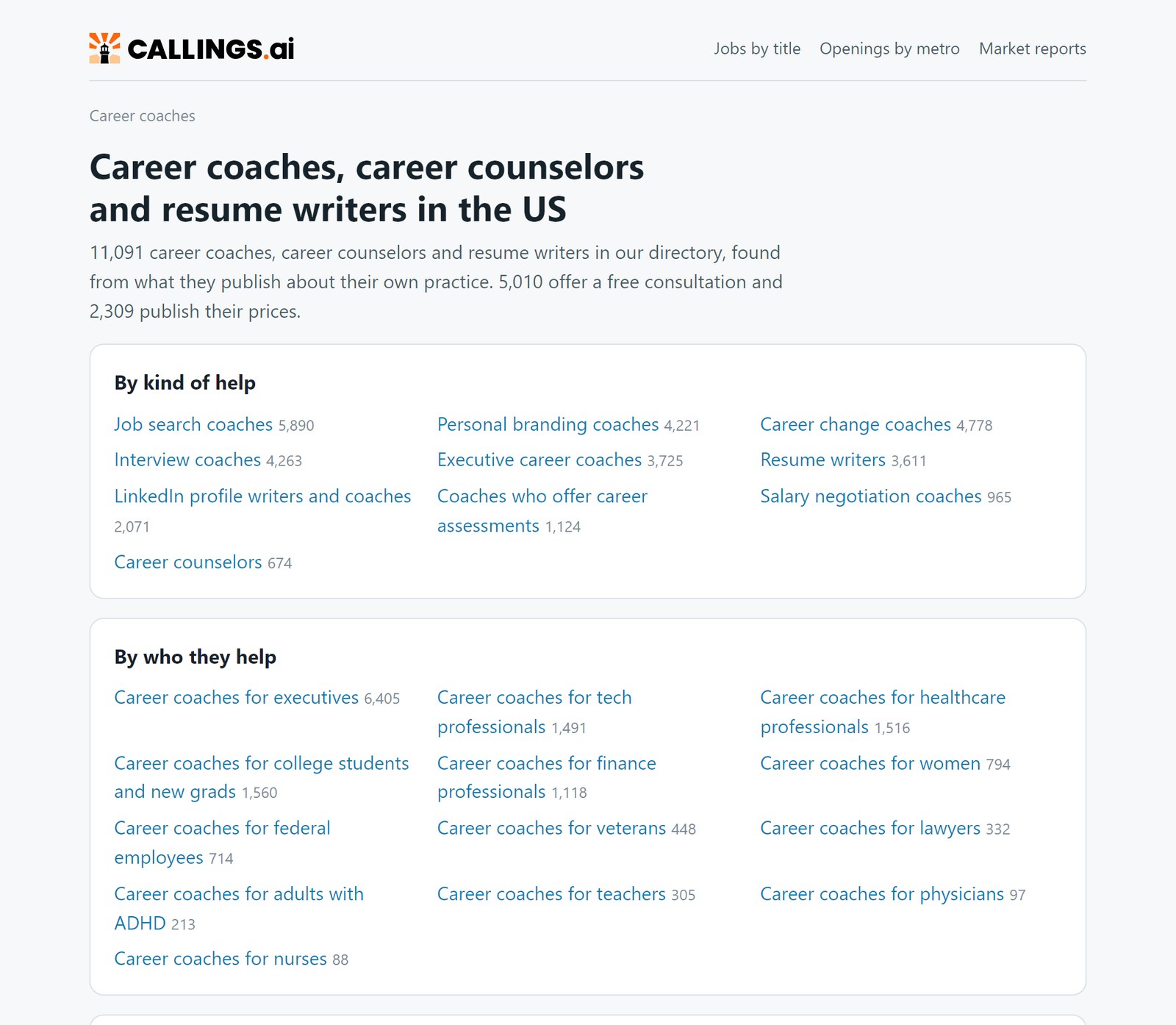
3. Our directory. We built callings.ai/career-coaches so you can browse every coach we found, in one place, in the ways people actually search:
- By kind of help: job search, career change, interviews, executive careers, resume writers, LinkedIn profiles, personal branding, salary negotiation, career assessments and career counselors.
- By who they help, from executives and new grads to nurses and federal employees.
- By place, in 37 metro areas so far, including New York, Los Angeles, Chicago, Atlanta, Dallas, San Francisco, Washington, DC, Boston, Seattle, Denver, Houston, Phoenix, Miami and Austin.
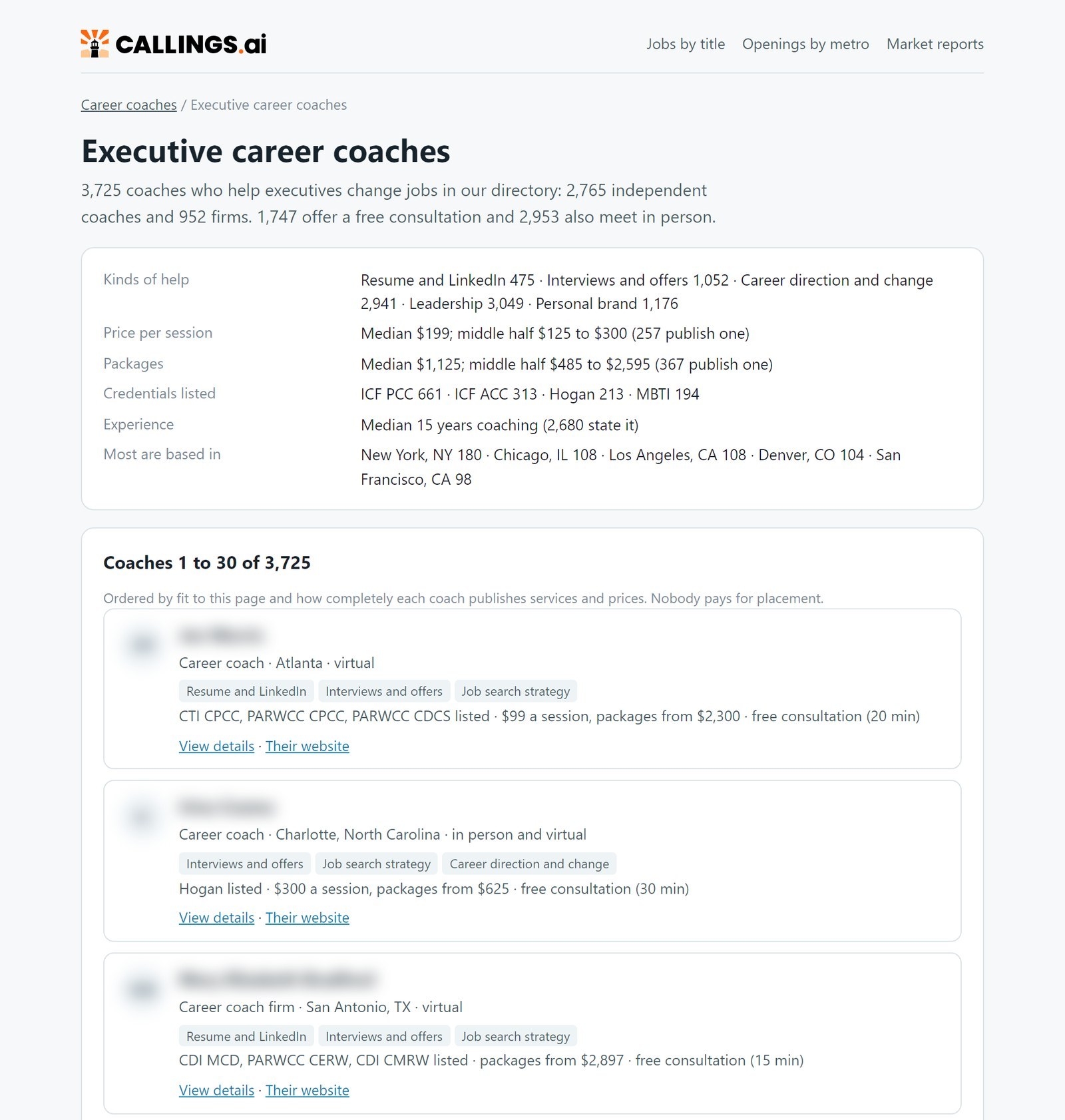
Every coach page shows only what the coach publishes about their own practice: the kind of coach, where they are, their services with what’s included and the prices they publish (with the date we read them), the credentials they list, their process and background. To that we add our own context: how their price and experience compare with similar coaches (only when there are at least 20 to compare with), questions worth asking them, and similar coaches. There are no ratings, no photos, no overall score and no paid placements.
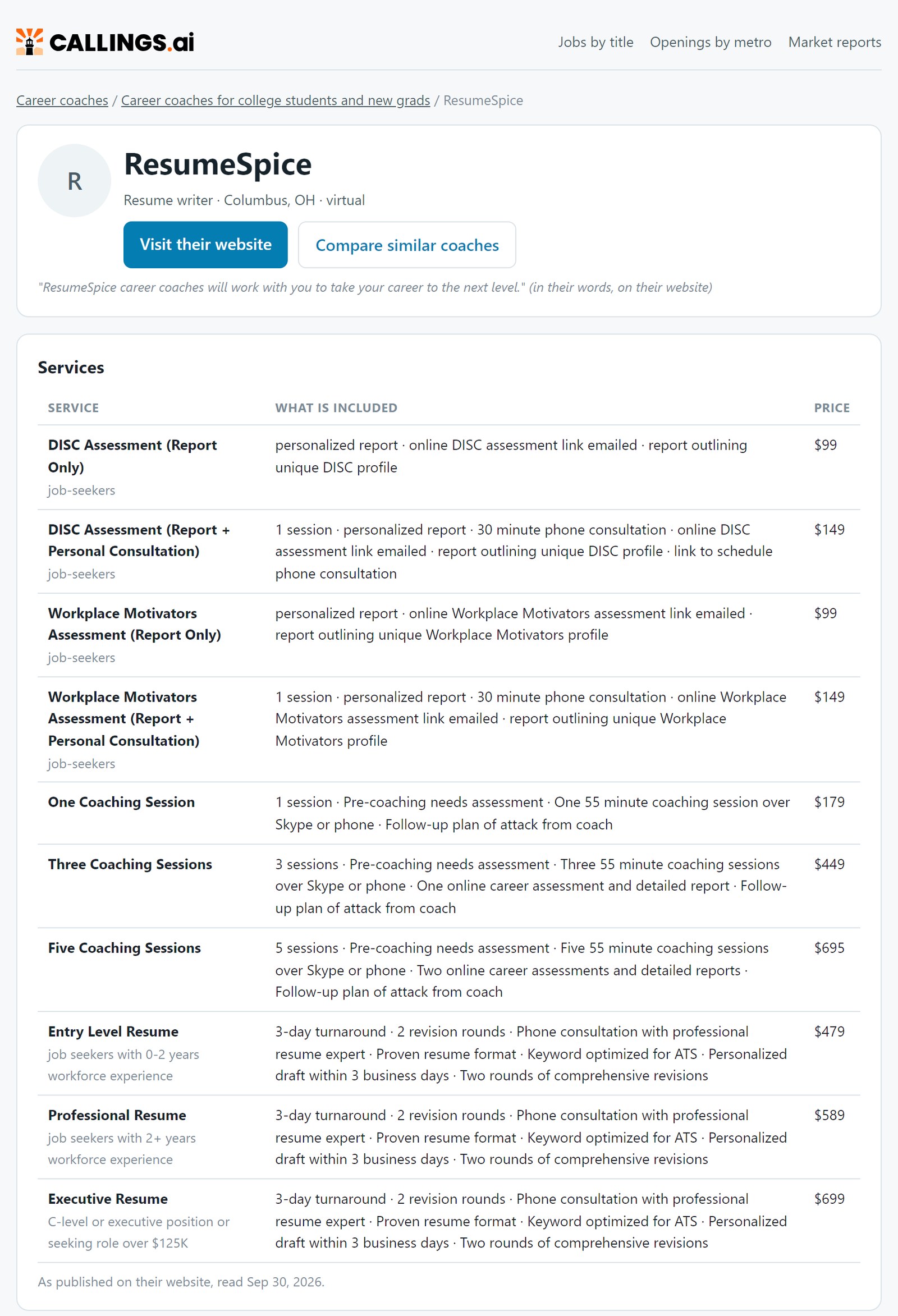
Further down, every page lists the questions worth asking that coach, each with the reason we suggest it, and what they publish or leave out:
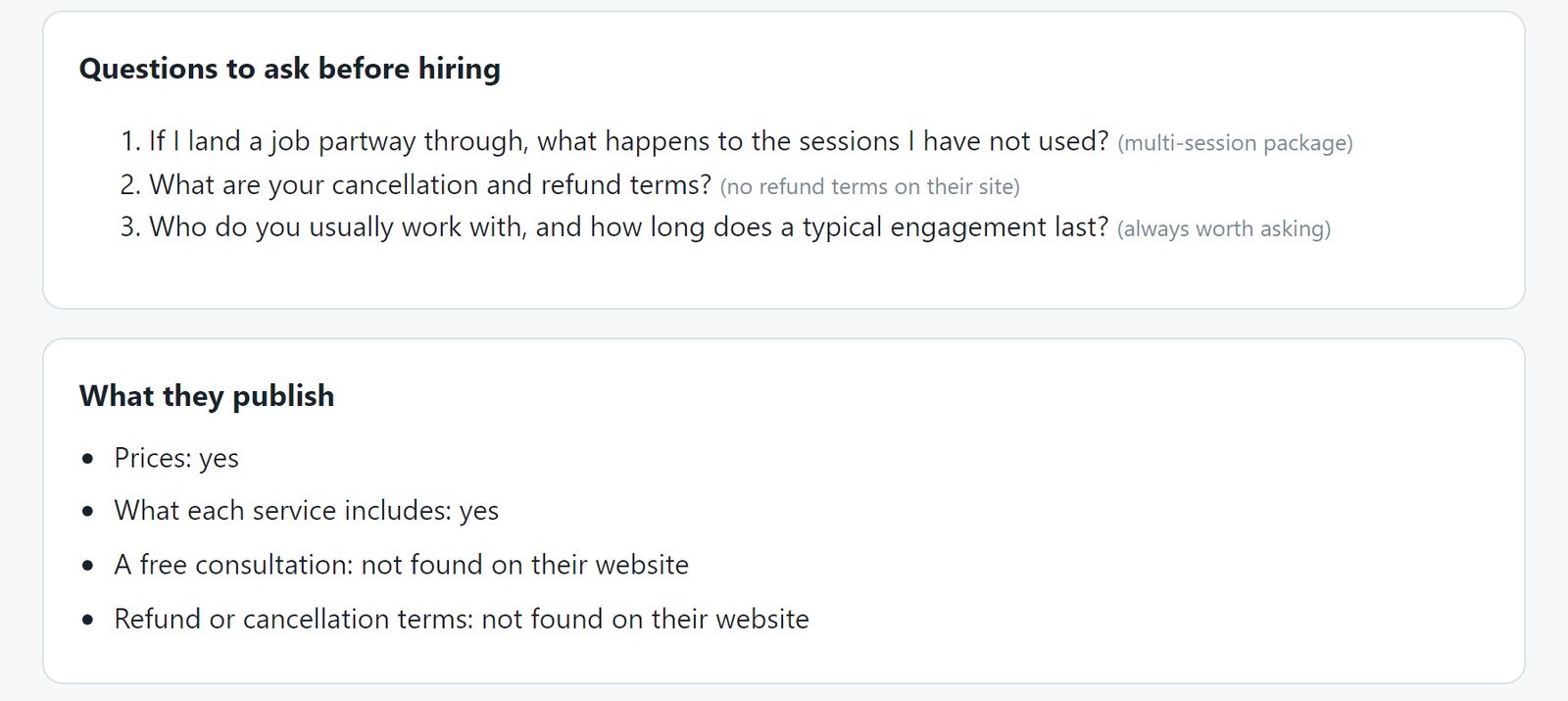
How Callings helps you find and vet a coach
Inside Callings, the directory becomes personal. Everything below is in Networking > People > Coaches, and it’s described in full in our Coaches documentation.
Seven coaches picked for your background
The first time you open the Coaches tab, we read your resume and pick seven coaches, resume writers and programs. It takes a few seconds, once. The seven are a mix, not seven of the same: each one fills a different kind of help (job search strategy, resume and LinkedIn, interviews and offers, direction and career change, leadership, personal brand, group programs), and the mix follows your background. Someone early in their career gets more group programs and a career counselor; directors and executives get executive career and leadership coaches; if your job searches point away from your resume, you get two coaches for changing careers. Within each kind, we pick the coach whose own focus best matches your target roles, industry and level, and we prefer two or three near where you live when they fit almost as well as the best remote coach. You never see two coaches from the same practice.
Keep puts a coach on your list for good. Ignore removes them, and the next coach for the same kind of help takes the seat.
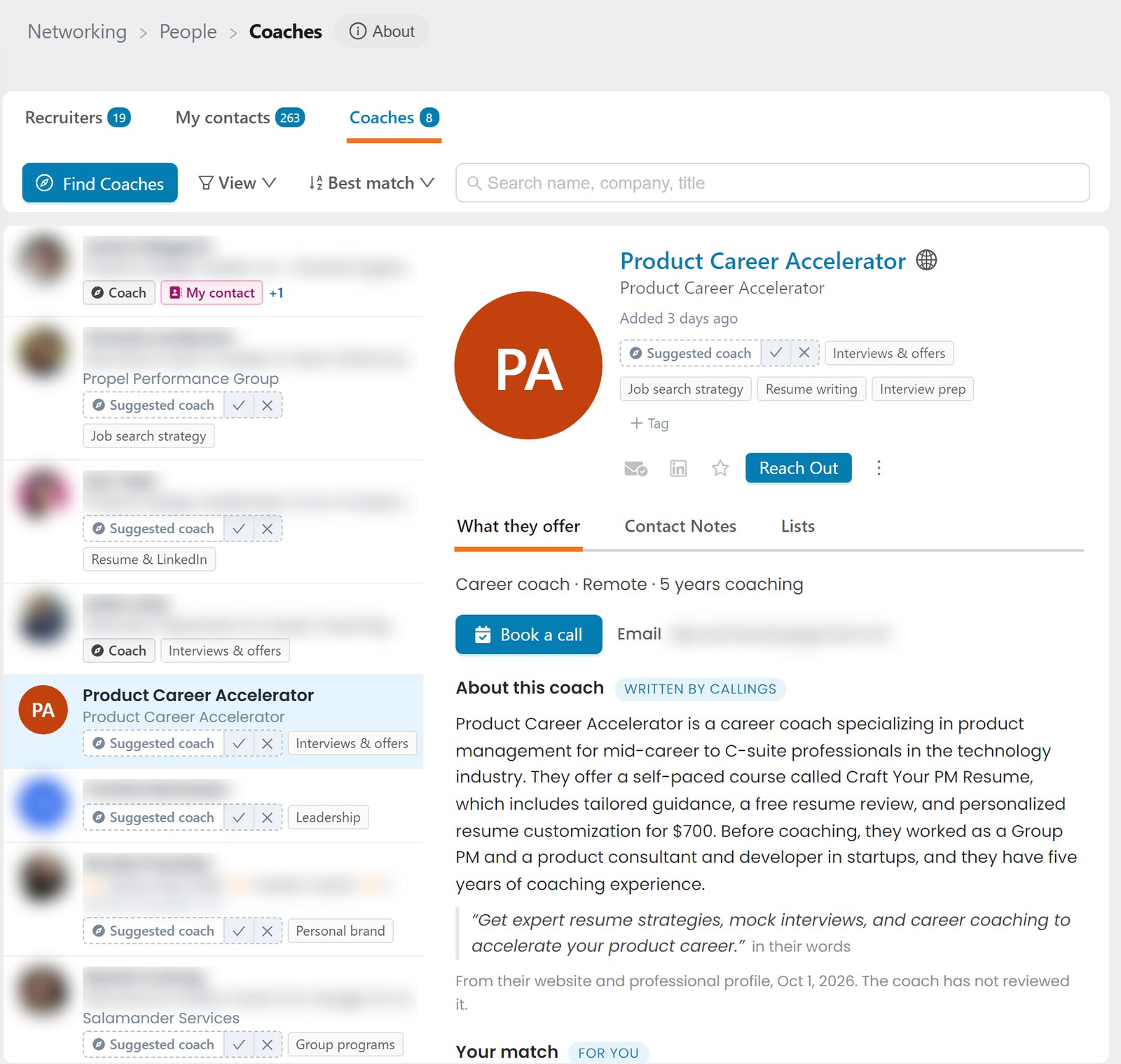
A record for every coach, and a match report for you
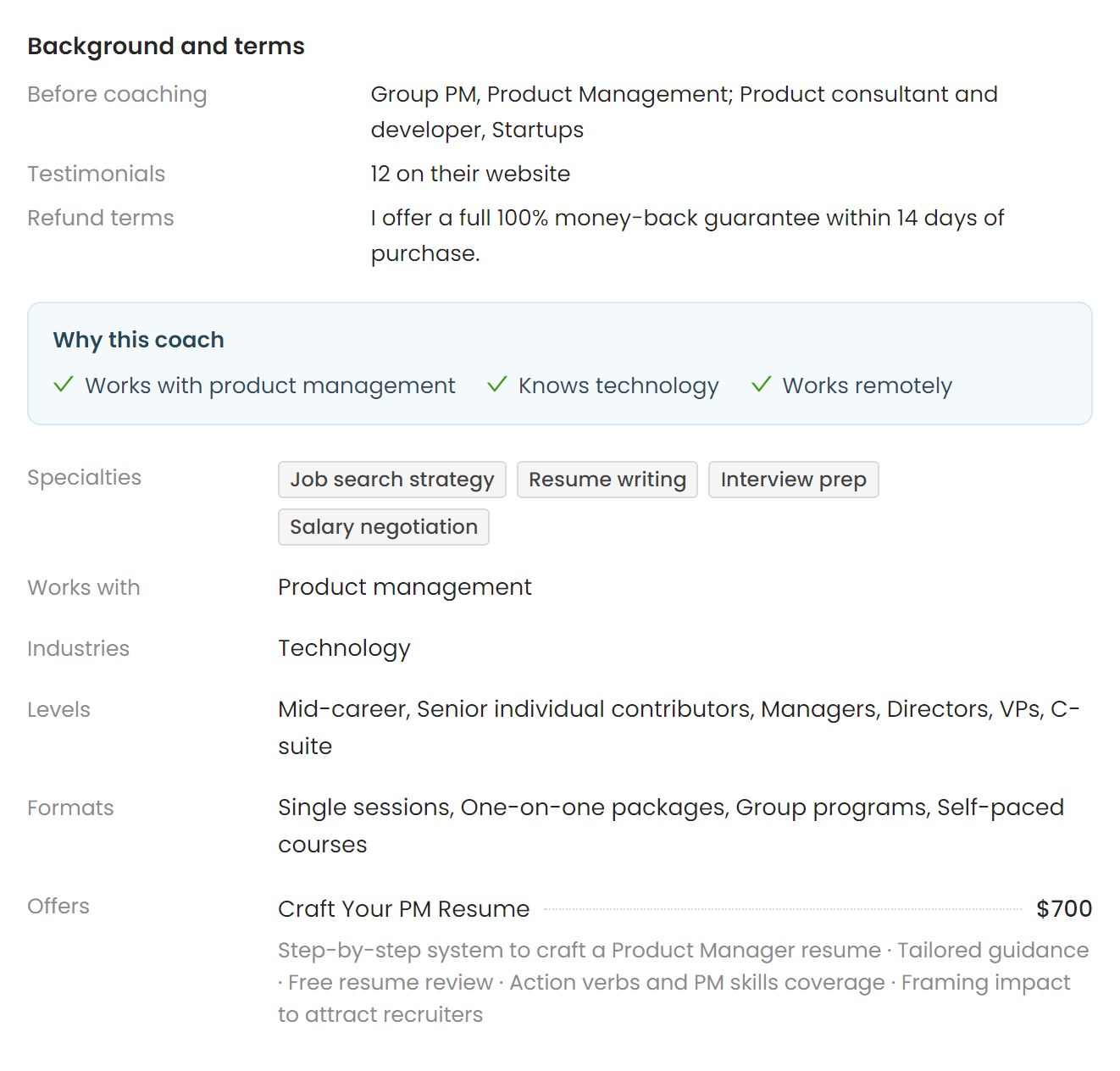
Open a coach and you get their record: who they are and how they work, a short summary we write from their website and professional profile (dated, and clearly marked as written by Callings), their services and prices with what each one includes, their background, the assessments they use, their refund terms, and a warning when a coach promises a job or interviews.
Then comes your match report. It’s written for you, from your profile and the services the coach publishes, in three parts: What fits, Worth checking and Ask them. Every point has to rest on a fact from both sides; anything we can’t tie to a fact is left out. It isn’t a rating, and the coach never sees it. It’s ready a few seconds after you first open the coach, and you can update it when your profile or their services change.
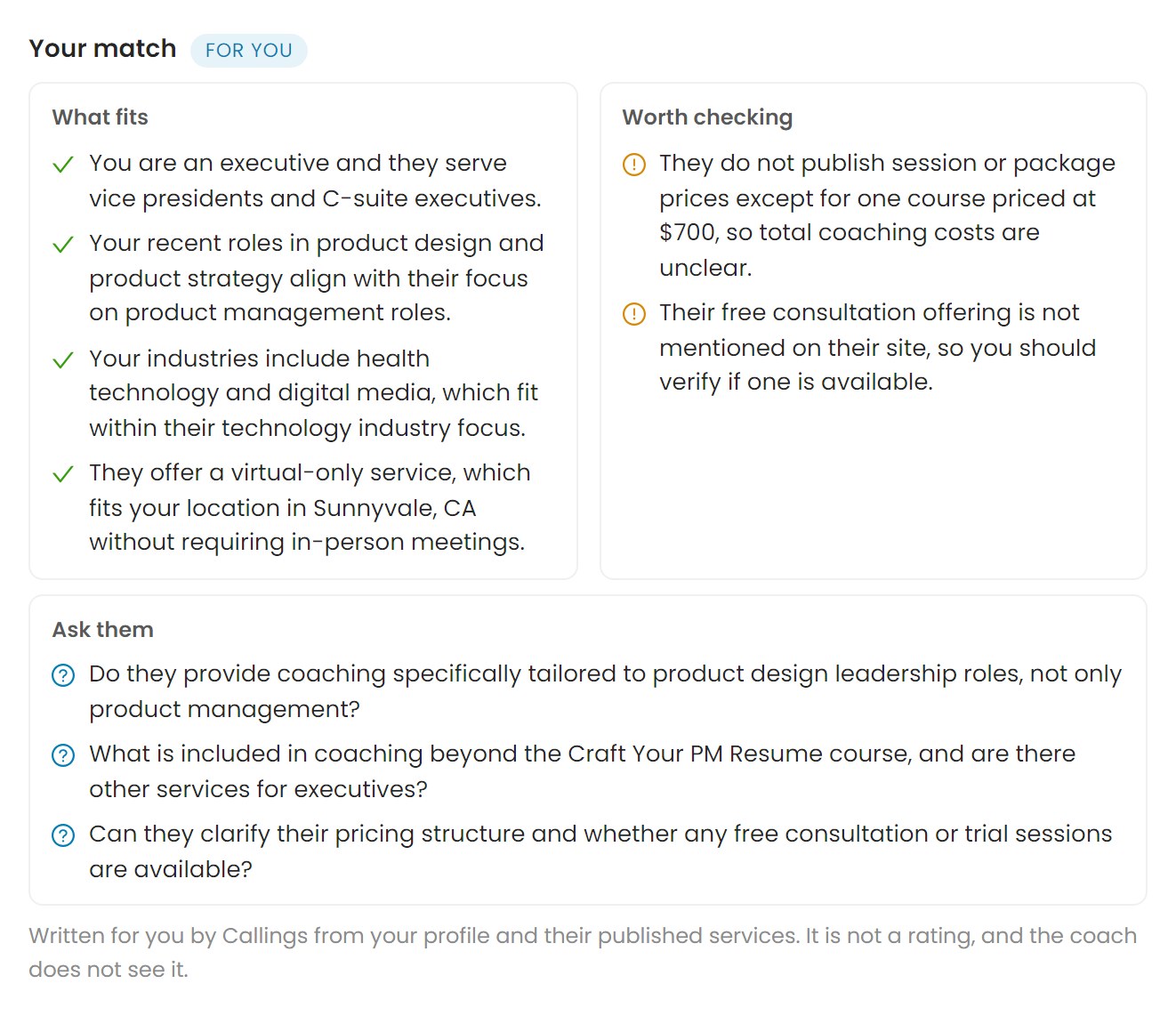
Bring the “Ask them” questions to the free consultation. They come from the same gaps this guide tells you to look for: no published price, no refund terms, a package that may outlast your search.
Find Coaches: search in your own words
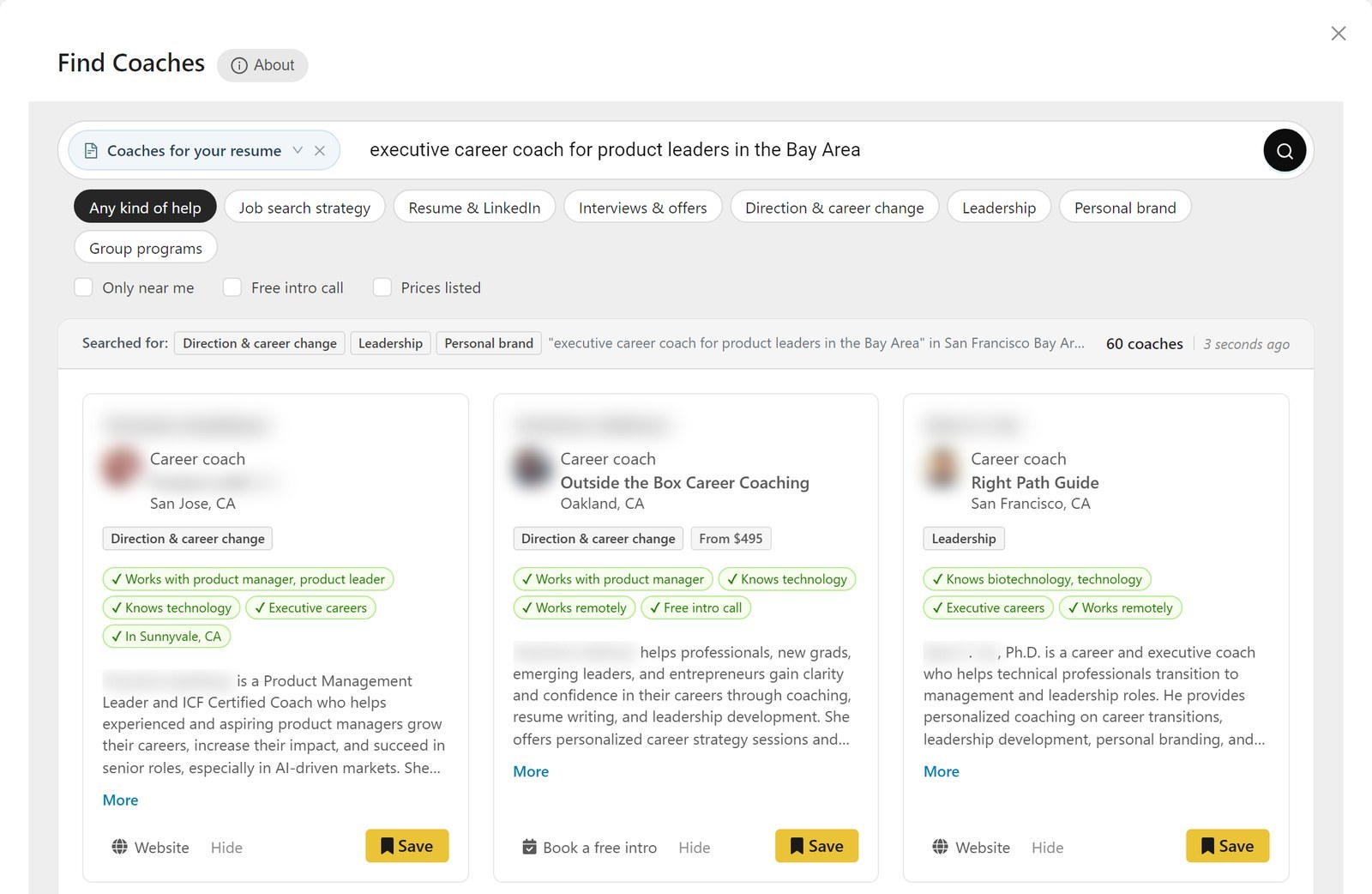
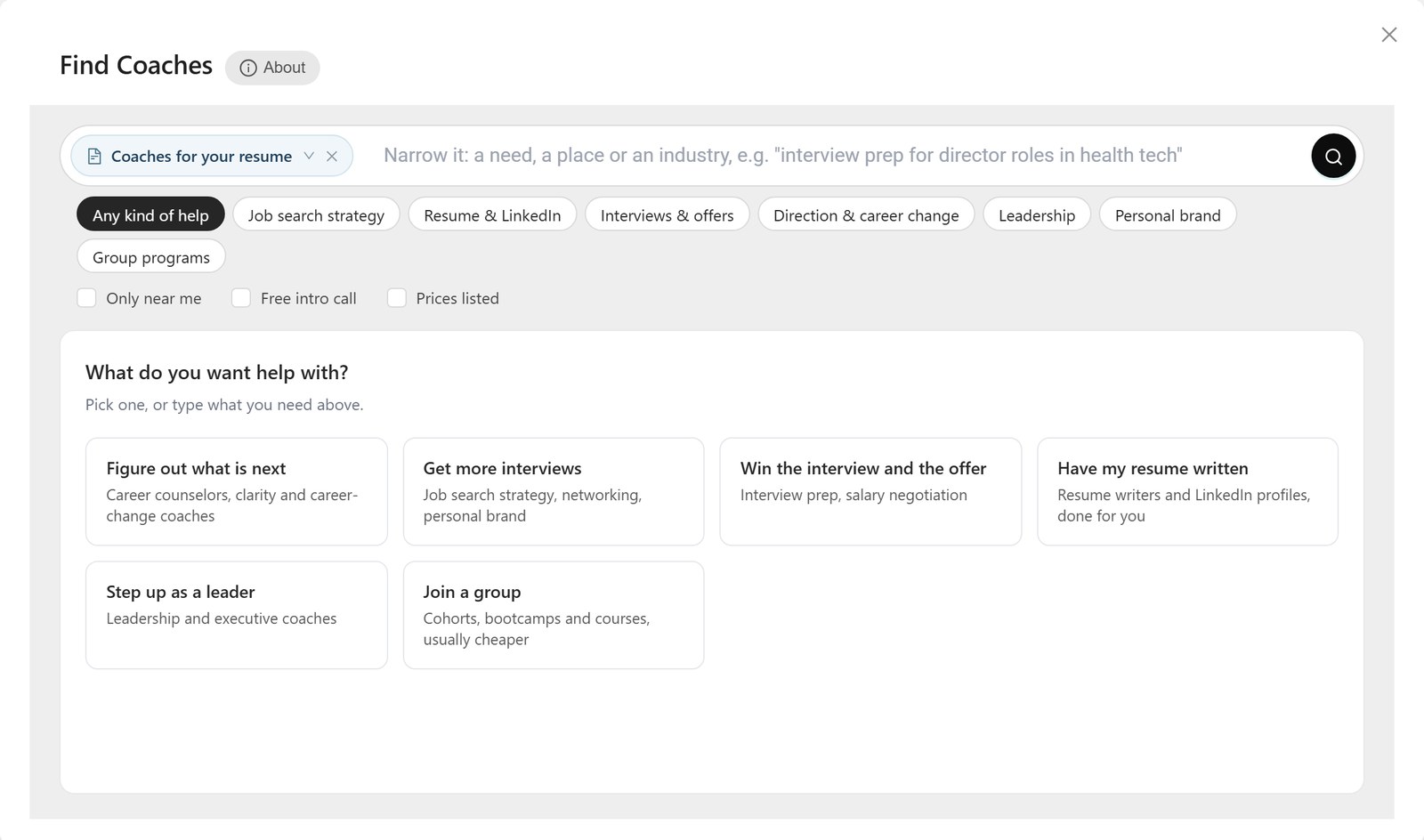
Find Coaches searches the whole directory. Type what you need the way you’d say it, such as “executive career coach for product leaders in the Bay Area”, and the search reads the kind of help, the place and the level from your words. With your resume attached, coaches are also ranked on the roles, industry and level they serve against yours. Chips filter by kind of help, and Only near me, Free intro call and Prices listed narrow the results further. Not sure what you need? Pick a goal, such as Have my resume written, and it searches for you.
Reach Out: an inquiry, not a networking note
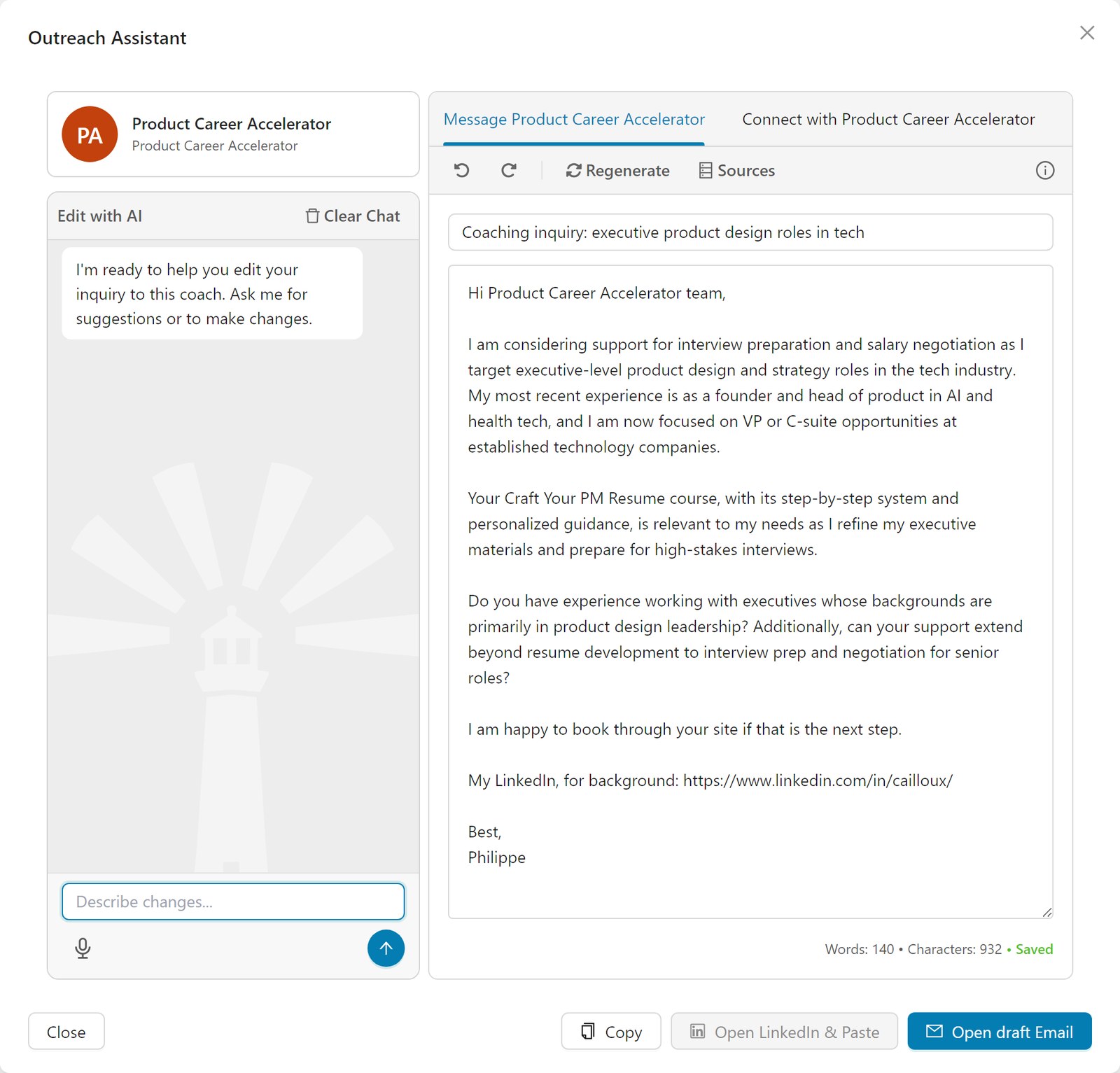
When you’re ready, Reach Out drafts an inquiry about hiring the coach, built the way a coach needs it: what you want help with, where you are and where you’re heading in two or three sentences, one concrete thing from their services that fits your situation, one or two questions their website leaves open (your match report’s questions come first), and the next step, which is their free consultation or booking page when they have one. The draft never mentions Callings or your match report. Nothing is sent until you send it yourself.
What’s free
| Feature | Plan |
|---|---|
| The public directory at callings.ai/career-coaches | Free, no account needed |
| Seven suggested coaches, Keep and Ignore | Free |
| Each coach’s record and your match report | Free |
| Find Coaches (search the whole directory) | Unlimited Membership |
| Reach Out (the drafted inquiry) | Unlimited Membership |
The Unlimited Membership costs $29.99 a month, $119.99 for 6 months or $179.99 a year. Coaches don’t know you looked at them: nothing reaches a coach unless you contact them yourself.
How we built the directory
Because this page leans on our data, here’s how we got it.
- Sources. Coaches’ own websites first, then public professional profiles and a few public directories. We skip any site that asks crawlers not to read it.
- Who gets in. A coach, a firm or a program that sells career help to individuals, with its own website or public professional profile to prove it. 11,091 met the bar as of September 30, 2026.
- What we keep. What a coach publishes about their practice: services, what each includes, prices with the date we read them, a free consultation only when they say so, refund terms, the assessments they use. Credentials are matched against a glossary of 61 credentials, each checked with the body that issues it.
- What our public pages never show: photos, reviews or ratings, email addresses or phone numbers, a summary we reworded from someone’s bio, an overall score, a paid placement.
- Keeping it current. When a coach’s website stops working, we try to find where it moved before we take the listing down.
- Corrections. Every public page has a link for a coach to ask us to update or remove their listing.
Mistakes to avoid
- Hiring “a coach” before naming the problem. The kind of help matters more than the coach.
- Paying for a long package before a single session. Use the free consultation, then a single session if they sell one.
- Choosing by title, or by credential alone. Ask who they usually work with.
- Buying a resume rewrite when the problem is targeting. If no interviews come at all, check that you’re aiming at roles you match before rewriting anything.
- Skipping help that’s already paid for: outplacement, your college career center, an American Job Center.
- Signing without written terms. Price, scope, cancellation, refunds, confidentiality.
- Believing a guarantee. Nobody controls an employer’s hiring decision.
- Letting someone else’s voice replace yours. Edit every draft until it sounds like you. You’re the one who will be in the interview.
- Expecting the coach to run the search. They bring structure and judgment; the outreach and applications are still yours.
- Staying when it isn’t working. Give it a few sessions, say what isn’t working, and leave if nothing changes.
Checklist
Before you look
- ☐ The problem, in one sentence
- ☐ Resume, LinkedIn profile, 3 to 5 target postings, your applications and their results
- ☐ A budget and a time frame
- ☐ Outplacement, alumni services, American Job Center and library checked
- ☐ The do-it-yourself steps tried
Shortlisting
- ☐ Three coaches who offer the kind of help you need
- ☐ Who they usually work with matches your level, field and move
- ☐ Credentials checked with the issuer, not the coach’s site
- ☐ Prices published, or a free consultation offered
In the free consultation
- ☐ Your one-sentence problem
- ☐ Total price and what it includes
- ☐ What happens if you land a job partway through
- ☐ Cancellation and refund terms
- ☐ Two former clients you can talk to
- ☐ Do you want the next call?
Before you pay
- ☐ Everything above in writing, including confidentiality
- ☐ No job, interview or placement guarantee
- ☐ A single session first, if they sell one
During the engagement
- ☐ Your work between sessions done
- ☐ Every draft reads like you
- ☐ Progress checked against the problem you started with
Frequently asked questions
What does a career coach do?
A career coach helps with one part of your career or job search: choosing a direction, planning the search, your resume and LinkedIn profile, interviews, negotiation, leadership or how you present yourself. Most specialize, so the kind of help matters more than the title.
How much does a career coach cost?
In our directory, a single career coaching session costs $150 at the median, a career coaching package about $700 (typically 6 sessions over 12 weeks), and an executive career coaching package about $2,400. A resume costs $199 for entry level, $313 mid-career and $499 for executives. See the full tables.
Is a career coach worth it?
It can be, when the coach addresses what’s actually slowing you down: at a $90,000 salary, a $700 package pays for itself if it moves your start date forward by about 3 days. When the problem is elsewhere, it won’t help. See the calculation.
What’s the difference between a career coach and a career counselor?
“Career coach” is an unregulated title: anyone can use it. A career counselor is often a trained counselor, sometimes licensed by a state board, and more likely to use formal assessments. See which titles are regulated.
Can a career coach get me a job?
No. A coach works for you and is paid by you; an employer decides who it hires. Recruiters are paid by employers to find candidates. Be wary of anyone who sells you access to jobs or guarantees an offer.
Should I hire a resume writer or use AI?
If you’re staying in the same field and level, a strong base resume tailored to each posting usually does the job, with or without AI. Hire a writer when you’re changing field or level, returning after a long break, or many applications brought no interviews. Either way, the final version has to sound like you.
Is career coaching tax-deductible?
Not for employees and job seekers, from 2018 on: the deduction for job search costs was suspended by the 2017 tax law, and the suspension became permanent in 2025 (26 U.S.C. 67(h)). Self-employed people should ask a tax professional. Outplacement paid by an employer can be tax-free (IRS Publication 15-B).
Will my employer pay for a coach?
Sometimes. Leadership coaching is often paid for by employers, and outplacement is often part of a severance package. Ask HR, and ask about a professional development budget.
Are there free career coaches?
Yes. American Job Centers have career counselors on staff, many colleges help their alumni, 78% of public libraries offer job and career services, and veterans have several free programs. 45% of coaches in our directory offer a free first conversation. See free help.
How long does career coaching take?
A resume takes about 4 days plus revisions, interview coaching about 3 sessions, a career coaching package about 6 sessions over 12 weeks, and executive coaching about 8 sessions over 24 weeks. The ICF says coaching engagements typically last 4 to 6 months.
What credentials should a career coach have?
None is required. The most common in our directory are the ICF’s PCC and ACC, PARWCC’s CPRW for resume writers, and state counseling licenses for counselors. Check any credential with the body that issued it. See the credentials table.
Does my coach need to be local?
Rarely. 99.6% of the coaches in our directory work by video. Choose local if you want to meet in person or need someone who knows your regional market.
Do coaches pay to be listed on Callings?
No. Coaches don’t pay to be listed or to rank, and there are no paid placements.
I’m a coach and I’m listed. How do I update or remove my listing?
Use the link at the bottom of your page in the directory. It opens our contact form with your page attached.
Official resources
Find help
- American Job Center finder, or call 1-877-US2-JOBS
- CareerOneStop, sponsored by the U.S. Department of Labor
- Rapid Response services for laid-off workers
- O*NET Interest Profiler
- State vocational rehabilitation agencies
- Veterans: TAP, VA career counseling (Chapter 36), Veteran Readiness and Employment
Check a coach or counselor
- ICF Credentialed Coach Finder and Verify a Coach
- ICF Code of Ethics
- NCDA Search for Career Help and credential holders
- NBCC certification verification
- CCE credential holder search
Protect yourself
Data
- BLS Occupational Outlook Handbook: School and Career Counselors and Advisors
- ICF Global Coaching Study
Last word
In A Field Guide To Feedback, I wrote that “collecting opinions is easy. Knowing which voices are close enough to the problem to matter is the real job.” Choosing a career coach is the same job. There are thousands to choose from. The right one has worked on your problem, with people like you, recently, and will tell you plainly what they see.
So here is my advice, feature or not: name the problem in one sentence, use the free help first, talk to three coaches who do that kind of work, get the price and the terms in writing, and walk away from anyone who guarantees the outcome.
If you want a head start, browse the directory, or open the Coaches tab in Callings and read your match reports before your first call.
If something on this page is wrong, out of date, or missing a resource you’ve found useful, please send me a note. I’d rather fix the page than have you rely on something that’s no longer true.
Good luck with your search!
Philippe
Update log
- October 1, 2026: First version. Prices and counts from the Callings coach directory as of September 30, 2026 (11,091 coaches, 2,309 with published prices); credentials, laws and free programs checked on the official pages the same day.