Unemployment Work Search Requirements by State: The 2026 Guide
By Philippe Cailloux · · 39 min read

Every state asks you to look for work. No two ask the same way
Some of our members asked us for something I hadn’t thought of: a way to keep the work search log their unemployment office asks for, and to make sense of the work search requirements behind it. One of them asked within half an hour of signing up. It made sense. If you’re claiming unemployment and using Callings, you’re already tracking every job you apply to. Why type it all again into a state form every week?
Before building anything, I wanted to know exactly what the states ask for. So I read the rules: the federal law first, then the official pages, claimant handbooks and forms of all 50 states and the District of Columbia. Then I had every state’s rule checked a second time against its agency’s own pages, because the first pass turned up handbooks that disagreed with their own websites.
What I found is that there is no national rule, only one federal sentence. Everything else is decided state by state: how many activities a week (from one in Maine and New Jersey to five in Florida, Kentucky and Oregon), what counts, whether you type each one into a claim site or keep a log for an audit, and how long you must keep it. Some states even change the number by county.
This page is my notes, organized so you can find your state quickly: the basics of claiming, the federal layer, the work search rule for every state with a link to the official page, benefit amounts and durations, the mistakes that cost people benefits, and the feature we built from all of it.
For information only, as of September 29, 2026. I’m not a lawyer, and this isn’t legal advice or official guidance from any agency. Unemployment rules change, sometimes more than once a year, and your state’s claimant handbook and the letters it sends you always have the final word. Before you rely on anything here, follow the link to your state’s official page.
Full disclosure: Callings is my product, and the last part of this page describes a feature we built. The research stands on its own: every rule links to the agency that wrote it, and I’ve tried to write the page I would want to read if I were filing a claim this week.
Last updated: September 29, 2026. I’ll do my best to keep this page current as states change their rules, as readers point out what I got wrong, and as the feature evolves. Changes are listed in the update log at the bottom.
At a glance
| Question | Short answer |
|---|---|
| Who can claim? | People who lost their job through no fault of their own, earned enough in their base period, and are able, available and looking for work |
| Where do I file? | With the state where you worked, usually online. Start with CareerOneStop’s benefits finder |
| How much? | A share of your past wages, up to a state maximum between $235 (Mississippi) and $1,208 (Washington) a week |
| For how long? | Up to 26 weeks in most states; 12 to 24 weeks in 16 states |
| What is “work search”? | The activities you do each week to find a job (applications, interviews, job fairs, workshops) and the record you keep of them |
| How many a week? | From 1 to 5 depending on the state, and some set no number at all |
| How do I report it? | Either you enter each activity when you certify, or you keep a log and show it if asked. Many states want both |
| What happens if I don’t? | The week can be denied, and money already paid becomes an overpayment you have to repay |
Table of contents
- How unemployment insurance works in the US
- Who can claim, how much, and for how long
- The federal layer: where work search requirements come from
- What “work search” means in practice
- Work search requirements by state
- Unemployment benefits by state: amounts and weeks
- Mistakes that cost people their benefits
- What we built: the Work Search Log
- A weekly checklist
- Frequently asked questions
- Official resources
How unemployment insurance works in the US
Unemployment insurance (UI) is a federal-state partnership. Federal law, mainly the Social Security Act and the Federal Unemployment Tax Act, sets the frame: who must be covered, a few benefit rules, how the program is funded. Inside that frame, each state designs its own program: who qualifies, how much you get, for how long, and what you must do each week to keep getting it. Employers pay for it through payroll taxes; only three states also collect from workers.
That split explains almost everything confusing about unemployment. There is no national claim site, no national form and no national work search number. You deal with your state, under your state’s rules, and the U.S. Department of Labor (DOL) sits behind them making sure the states meet the federal minimums.
Who can claim, how much, and for how long
Who can claim
The details are state law, but every state starts from the same three tests:
- You lost your job through no fault of your own, as your state defines it. A layoff almost always qualifies; quitting or being fired for misconduct usually needs a closer look.
- You earned enough in your “base period”, in most states the first four of the last five completed calendar quarters before you file. Each state sets its own minimum.
- You are able to work, available for work, and actively looking for work, every week you claim. That third test is what this article is about.
Where to file
File with the unemployment program of the state where you worked, says DOL, which is not always the state where you live. The fastest way to find the right site is CareerOneStop’s Unemployment Benefits Finder: pick the state and it links you to its claim page. DOL says the first payment generally arrives two to three weeks after you file, so file in the first week you are out of work.
How much
Your weekly benefit is a percentage of what you earned over a recent 52-week period, up to a state maximum. The maximums are far apart. In DOL’s July 2026 comparison of state laws, confirmed on the state sites, the lowest maximum is $235 a week in Mississippi and the highest is $1,208 a week in Washington; Massachusetts pays up to $1,105 plus $25 per child. The full list is in the benefits by state table below.
How long
Up to 26 weeks in most states, but not all. As of September 2026, checked on each state’s own site: Arkansas, Florida, Louisiana, North Carolina and Tennessee pay up to 12 weeks; Georgia 14 (Alabama too, by DOL’s figures); Iowa, Kansas, Kentucky and Oklahoma 16; Missouri and South Carolina 20; Arizona and Montana 24. Massachusetts can go to 30. In many of these states the number is tied to the state unemployment rate, so it moves with the economy: Georgia’s range is 14 to 26, North Carolina’s 12 to 20. Within the maximum, your own number of weeks can also depend on your past wages.
When unemployment is high, the federal-state Extended Benefits program can add up to 13 weeks (20 in some states). As of DOL’s trigger notice effective September 27, 2026, no state is triggered on.
The waiting week
Most states don’t pay for your first eligible week. It still counts, and you still certify for it, which means you still do your work search for it. In DOL’s latest comparison of state laws (as of January 2023), eight states had no waiting week: Connecticut, Delaware, Georgia, Iowa, Maryland, Michigan, New Jersey and Wyoming.
Certifying: the weekly (or biweekly) claim
After the first claim, you ask for each week’s payment by certifying: answering a short set of questions online or by phone, every week in most states, every two weeks in some (California, Florida, Illinois, Kentucky and Texas, among others, and Michigan until November 9, 2026). One of those questions is always, in some form, did you look for work?
Two rules catch people out:
- Report work in the week you do it, not the week you are paid. DOL’s guidance is plain: report your gross earnings for the week you worked “even though you have not yet been paid.” Every state lets you earn a little without losing the whole week.
- You certify after the week ends. Almost every state counts weeks from Sunday to Saturday, so on Sunday you certify for the week that just ended. New York is the exception: its week runs Monday to Sunday, and a certification made on a Sunday is for the week ending that day.
Taxes
Unemployment benefits are taxable income. Your state sends you a Form 1099-G in January. You can ask it to withhold federal income tax with Form W-4V, at exactly 10% (“no other percentage or amount is allowed”), or pay estimated tax yourself. If you don’t, plan for the bill in April.
If you are denied: appeals
Federal law requires every state to offer a fair hearing before an impartial tribunal. The deadline to ask for one is short and varies by state, from 7 to 30 days after the notice. Read every letter the day it arrives, and appeal in writing before the date on it even if you are still gathering documents.
Overpayments, identity checks and fraud
- An overpayment is money paid for a week you weren’t entitled to, and you’ll be asked to repay it. Many states can waive an overpayment that wasn’t your fault; as of 2023, Delaware, Kentucky, Mississippi, Missouri, Nebraska, New Mexico, New York, Oklahoma, Texas and West Virginia had no waiver at all.
- Identity checks are now routine. Many states verify you through Login.gov (with an in-person option at post offices, under DOL’s 2026 guidance) or a private service such as ID.me. Use only the link on your state’s official site.
- If someone filed a claim in your name, report it to that state, then follow DOL’s steps for UI identity theft, including IdentityTheft.gov.
The federal layer: where work search requirements come from
One sentence of federal law
Since 2012, federal law has required every state to make work search a condition of benefits. Section 303(a)(12) of the Social Security Act says it in one sentence:
“as a condition of eligibility for regular compensation for any week, a claimant must be able to work, available to work, and actively seeking work.”
That’s the whole federal rule. It doesn’t say how many contacts, what counts, or how you prove it. DOL’s guidance to the states says that because federal law doesn’t define “actively seeking work,” states “have some discretion to establish a reasonable definition.” Fifty-one reasonable definitions later, here we are.
Why states take it so seriously
DOL measures every state’s payment accuracy each year. In the year from July 2024 to June 2025, about 13.2% of UI benefits were paid improperly, and the single largest cause of overpaid dollars was work search: 36.6% (DOL, leading causes). Adding up DOL’s state-by-state figures, that is about $1.67 billion in one year, ahead of misreported earnings (29%) and questions about why a job ended (16%).
A work search overpayment doesn’t take bad intent. A week with two contacts in a state that asks for three, a log that was never kept, or an audit letter answered too late is enough for a state to deny the week and ask for the money back. The fix is boring, and it works: keep the record every week, in the form your state wants.
RESEA: the appointment you can’t skip
Many states pick claimants, often those most likely to use up their benefits and recently separated veterans, for Reemployment Services and Eligibility Assessment (RESEA): a one-on-one meeting at an American Job Center that “typically includes … a review of the claimant’s work search activities” and help with a reemployment plan. Once you are selected, it is mandatory, and skipping it can stop your benefits. Bring your work search record.
Federal programs for special situations
| Program | Who it’s for | Good to know |
|---|---|---|
| UCFE | Federal civilian employees | Paid under the law of the state of your last official duty station; have your SF-8 and SF-50 ready |
| UCX | Veterans leaving active duty | Honorable separation required; bring your DD-214 |
| DUA | People who lost work to a declared major disaster and don’t qualify for regular UI | Up to 26 weeks after the disaster declaration |
| Extended Benefits | Claimants who used up regular benefits in a high-unemployment state | No state triggered on as of September 27, 2026 |
| Trade Adjustment Assistance | Workers who lost jobs to foreign trade | In phase-out since July 1, 2022: no new petitions are certified unless Congress reauthorizes it |
Federal workers had a reminder in late 2025: during the funding lapse from October 1 to November 12, 2025, furloughed employees could claim UCFE, and DOL’s Q&A warned that back pay must be reported and can create an overpayment. It also noted that many states waive or defer work search for furloughed workers, which is one of the few cases where the requirement doesn’t apply.
What “work search” means in practice
Reading 51 sets of rules one after the other, the differences jump out first. But most of what you need to know is common ground.
What counts as an activity
Every state counts applying for a job. Almost every state also counts some of these:
- a job interview
- contacting an employer about openings (in person, by email, online; Vermont doesn’t count phone calls)
- a job fair or hiring event
- a workshop or class at your state’s job center (American Job Center, CareerSource, WorkSource, Workforce Solutions…)
- registering on your state’s job bank, or posting your resume on a job board
- a networking event or a meeting with a professional association
- a civil service exam, a union hiring hall, a staffing agency
The limits are where states differ: Pennsylvania wants two applications among its three; Arkansas counts one job fair a week at most; Vermont doesn’t count phone calls or browsing job boards; Georgia and Utah want new employers; South Carolina counts only searches made inside its own job site. That’s why the state table has a notes column.
What states want to know about each activity
The forms look different, but they ask for the same handful of facts. Across the state logs I read, these come up again and again:
| Field | Example |
|---|---|
| Date | Tuesday, September 22 |
| Type of activity | Application, interview, job fair, workshop |
| Employer or organization | Pioneer Freight |
| Address, website or phone | pioneerfreight.com |
| Person contacted | John Smith, recruiter (or “none”) |
| How | Online, email, in person, phone, mail, fax |
| Position | Logistics Coordinator |
| Result | Submitted, interview, not hiring, no response, hired |
If you keep those eight facts for every activity, you can fill in almost any state’s form, or answer any audit, from your own notes.
Two ways states collect it
This is the difference that matters most day to day:
- Keep a record, show it if asked. You answer “yes, I looked for work” when you certify, and you keep a log that the state can ask for at any time, often for a year or more afterwards. New York, Pennsylvania, New Jersey, Texas, Washington, Illinois and California work this way. Some publish an official log form; several (New York, Pennsylvania, Texas and Washington among them) accept your own record as long as it has the same information.
- Enter each activity when you certify. You type every contact into the claim site as part of the weekly or biweekly claim: Florida’s Reconnect, North Carolina’s MyNCUIBenefits, Michigan’s MiWAM, Georgia’s MyUI and many more. What you entered is the record, but most of these states also tell you to keep your own copy for audits.
A few states do something else: Maryland has you log activities in its job site, which then shows them when you certify; South Carolina’s job site records your searches for you.
Weeks, deadlines and audits
- The week. Every state counts Sunday to Saturday, except New York, which counts Monday to Sunday. Activities count in the week you do them.
- Certify after the week ends. You can’t certify for a week that isn’t over. Missing the window can cost the week, so treat it like a bill with a due date.
- Register with the job bank. Many states require you to register on their job site within days or weeks of filing: 3 business days in Delaware, 10 days in Virginia, 30 days in Pennsylvania. It often counts as an activity too.
- Audits. States pick claimants at random and ask for proof. Keep confirmation emails, screenshots of submitted applications, event badges and names. Connecticut asks you to keep records for three years, Pennsylvania can ask for two.
- Your letter wins. The rules here are the general ones. Your county (in Texas and Florida), your union membership, a temporary layoff with a return date, or approved training can change your requirement. What your state tells you, in writing, is what applies.
Work search requirements by state
This table is generated from the same data the Work Search Log uses, re-checked against each agency’s own pages on September 29, 2026. “Enter” means you type each activity into the claim site when you certify; “Keep” means you keep a record and show it if the state asks. The number is your state’s general rule: your county, your claim or your letter can change it.
| State | Activities a week | Report | Certify | Official page |
|---|---|---|---|---|
| Alabama | 3 contacts | Enter | Weekly | ADOW |
| Alaska | 2 | Enter | Weekly | DOLWD |
| Arizona | 4 contacts | Enter | Weekly | DES |
| Arkansas | 5 | Enter (Launch) | Weekly | Division of Reemployment |
| California | No set number | Keep | Every 2 weeks | EDD |
| Colorado | No set number | Enter (MyUI+) | Weekly | CDLE |
| Connecticut | 3 | Enter (ReEmployCT) | Weekly | CTDOL |
| Delaware | 1 contact | Enter | Weekly | Delaware DOL |
| District of Columbia | 2 contacts | Keep | Weekly | DOES |
| Florida | 5 contacts (varies by county) | Enter (Reconnect) | Every 2 weeks | FloridaCommerce |
| Georgia | 3 | Enter (MyUI) | Weekly | GDOL |
| Hawaii | 3 contacts | Enter | Every 2 weeks | DLIR |
| Idaho | 5 | Enter | Weekly | IDOL |
| Illinois | No set number | Keep | Every 2 weeks | IDES |
| Indiana | 2 | Keep | Weekly | DWD |
| Iowa | 4, at least 3 applications | Enter (IowaWORKS) | Weekly | IWD |
| Kansas | 3, at least 1 application | Enter | Weekly | KDOL |
| Kentucky | 5 | Enter | Every 2 weeks | Kentucky UI |
| Louisiana | 5 | Enter (HiRE) | Weekly | Louisiana Works |
| Maine | 1 | Enter (ReEmployME) | Weekly | MDOL |
| Maryland | 3 | Enter (the Maryland Workforce Exchange) | Weekly | MD Labor |
| Massachusetts | 3 | Enter | Weekly | DUA |
| Michigan | 3 | Enter (MiWAM) | Every 2 weeks | UIA |
| Minnesota | No set number | Keep | Weekly | UI Minnesota |
| Mississippi | 3 contacts, at least 1 application | Enter | Weekly | MDES |
| Missouri | 3 | Enter (UInteract) | Weekly | Missouri DES |
| Montana | 1, at least 1 application | Enter (UI Claimant Center) | Weekly | Montana DLI |
| Nebraska | 5, at least 2 applications | Enter (NEworks) | Weekly | NDOL |
| Nevada | No set number | Enter | Weekly | DETR |
| New Hampshire | No set number | Enter | Weekly | NHES |
| New Jersey | 1 contact | Keep | Weekly | NJDOL |
| New Mexico | 2 contacts | Keep | Weekly | NMDWS |
| New York | 3 | Keep | Weekly | NYSDOL |
| North Carolina | 3 | Enter (MyNCUIBenefits) | Weekly | DES |
| North Dakota | No set number | Keep | Weekly | JSND |
| Ohio | 2 | Enter | Weekly | ODJFS |
| Oklahoma | 2 | Keep | Weekly | OESC |
| Oregon | 5 | Enter (Frances Online) | Weekly | OED |
| Pennsylvania | 3, at least 2 applications | Keep | Weekly | L&I |
| Rhode Island | 3, at least 1 application | Keep | Weekly | DLT |
| South Carolina | 2 | Keep | Weekly | DEW |
| South Dakota | 2 | Enter | Weekly | DLR |
| Tennessee | 4 | Enter (Jobs4TN) | Weekly | TDLWD |
| Texas | 3 (varies by county) | Keep | Every 2 weeks | TWC |
| Utah | 4 new employers | Enter | Weekly | DWS |
| Vermont | 3 contacts | Enter | Weekly | VDOL |
| Virginia | 2 contacts | Enter | Weekly | VEC |
| Washington | 3 | Keep | Weekly | ESD |
| West Virginia | 4 | Keep | Weekly | WorkForce WV |
| Wisconsin | 4 | Enter | Weekly | DWD |
| Wyoming | 2 contacts | Keep | Weekly | DWS |
The fine print, state by state
The details that don’t fit in a table, in the agencies’ own terms.
- Alabama (ADOW): 3 contacts a week. Report them with each weekly claim, and log in to AlabamaWorks (or visit a Career Center) at least once a week. Renew your AlabamaWorks registration every 90 days. Job bank: AlabamaWorks.
- Alaska (DOLWD): 2 a week. 1 a week if you live more than 55 road miles from a job center. Job bank: AlaskaJobs.
- Arizona (DES): 4 contacts a week. Make at least one job contact on each of 4 different days of the week. Job bank: Arizona Job Connection. Keep your record for 2 years.
- Arkansas (Division of Reemployment): 5 a week. No more than one job fair counts each week. Job bank: Launch.
- California (EDD): No set number. No weekly number: EDD asks at each certification whether you looked for work, and recommends keeping a record. Post a resume on CalJOBS within 21 days. Job bank: CalJOBS.
- Colorado (CDLE): No set number. No set minimum: CDLE recommends 3 to 5 activities a week, and may audit them. Job bank: Connecting Colorado. Keep your record for 2 years.
- Connecticut (CTDOL): 3 a week. At least 1 of the 3 must be a contact with an employer. Official log: Work Search Record (UI-230). Job bank: CTHires. Keep your record for 3 years.
- Delaware (Delaware DOL): 1 contact a week. It must be a new contact each week. Enter it when you request benefits, keep your Work Search Log too, and register on Delaware JobLink within 3 business days of filing. Official log: Work Search Log. Job bank: Delaware JobLink.
- District of Columbia (DOES): 2 contacts a week. Contacts must be verifiable, and DOES may ask for your record during or after your benefit year. Do not apply twice to the same job. Official log: Work Search Log. Job bank: DCNetworks.
- Florida (FloridaCommerce): 5 contacts (varies by county) a week. 3 in counties of 75,000 people or fewer. One in-person visit to a CareerSource center counts for the whole week. The same employer cannot count 3 weeks in a row unless it said it is hiring. Job bank: Employ Florida.
- Georgia (GDOL): 3 a week. 3 new activities on 3 or more days each week (2026 claimant handbook). Employer contacts must be employers you have not contacted before. Submit them online in MyUI; DOL 2798 is the only paper form accepted. Official log: DOL 2798. Job bank: WorkSource Georgia.
- Hawaii (DLIR): 3 contacts a week. Kauai County residents affected by Hurricane Lowell are exempt for now. Job bank: HireNet Hawaii.
- Idaho (IDOL): 5 a week. Official log: Work Search Log. Job bank: IdahoWorks.
- Illinois (IDES): No set number. IDES looks at the quality of your search rather than a number. Registering on IllinoisJobLink is required. Official log: Work Search Record (ADJ034F). Job bank: IllinoisJobLink. Keep your record for 1 year.
- Indiana (DWD): 2 a week. Official log: Work Search Activity Log. Job bank: Indiana Career Connect. Keep your record for 6 months.
- Iowa (IWD): 4, at least 3 applications a week. Reapplying to the same job at the same employer within 6 weeks does not count. Job bank: IowaWORKS.
- Kansas (KDOL): 3, at least 1 application a week. A resume sent to an employer counts as the application. Some KDOL guides ask for 2 applications: follow your letter. Job bank: KANSASWORKS.
- Kentucky (Kentucky UI): 5 a week. At least 3 of the 5 must be job applications or interviews, and your records can be audited. Keep your record for 1 year after your claim ends.
- Louisiana (Louisiana Works): 5 a week. Claims filed before January 4, 2026 need 3 a week. Keep a detailed record: you may be asked for proof. Job bank: HiRE.
- Maine (MDOL): 1 a week. Keep proof of each activity: they are audited at random. You also need an active Maine JobLink account and resume; browsing it does not count. Job bank: Maine JobLink.
- Maryland (MD Labor): 3 a week. At least 1 of the 3 must be a direct job contact. Log them in the Maryland Workforce Exchange; BEACON shows them when you certify. Job bank: the Maryland Workforce Exchange.
- Massachusetts (DUA): 3 a week. Report them in your weekly online claim, and keep a written record in case DUA asks. The paper log is only for claims filed by phone. Official log: Work Search Log (Form 1750). Job bank: MassHire JobQuest.
- Michigan (UIA): 3 a week. At least 3 unique work searches each week since July 19, 2026 (it was 1). Keep a written record too. From November 9, 2026, MiUI replaces MiWAM and you certify every week. Official log: Work Search Activity Worksheet (UIA 6507). Job bank: Michigan Works!.
- Minnesota (UI Minnesota): No set number. No set number: you must actively look for suitable work every week, and you may be selected for an audit. Official log: Work Search Record. Job bank: CareerForce. Keep your record for your benefit year and any extension.
- Mississippi (MDES): 3 contacts, at least 1 application a week. Contacts must be employers with full-time work. Keep your record: MDES may ask for it. Official log: Work Search Record. Job bank: Mississippi Works.
- Missouri (Missouri DES): 3 a week. Visit MoJobs or a Missouri Job Center at least once a month. Job bank: MoJobs.
- Montana (Montana DLI): 1, at least 1 application a week. Apply to an employer that is hiring, and not the same one two weeks in a row unless it is a different position. Job bank: MontanaWorks. Keep your record for 3 years.
- Nebraska (NDOL): 5, at least 2 applications a week. Entries cannot be added after you submit the weekly claim. Job bank: NEworks.
- Nevada (DETR): No set number. No set number: DETR asks for several different activities each week, entered with your weekly claim. Your DETR letter may give you a number. Official log: Work Search Activity Record. Job bank: EmployNV. Keep your record for 2 years.
- New Hampshire (NHES): No set number. No set number: NHES asks for the search a reasonable person would make, and your local office may set a number for you. Contact new employers each week. Official log: Work Search Log (NHES 0162). Job bank: the NH Works Job Match System.
- New Jersey (NJDOL): 1 contact a week. At least 1 different employer each week (claimant guide PR-94, July 2026; the old BC-514 log said 3). Online claims are weekly; phone claims are every two weeks. Official log: Work Search Record.
- New Mexico (NMDWS): 2 contacts a week. The 2 contacts must be with different employers. Official log: Work Search Log. Job bank: New Mexico Workforce Connection. Keep your record for up to 5 years.
- New York (NYSDOL): 3 a week. Each week needs 3 new activities, logged by the end of the week in JobZone or on the WS5. Send it only if NYSDOL asks. Official log: Work Search Record (WS5). Job bank: NYS Job Bank. Keep your record for 1 year.
- North Carolina (DES): 3 a week. One of the three may be a reemployment activity. Job bank: NCWorks. Keep your record for 2 years (recommended).
- North Dakota (JSND): No set number. Job Service assigns your weekly number of job contacts: your letter gives it. Post a resume on ND Workforce Connection within 10 days. Official log: Job Contacts Record (SFN 58789). Job bank: ND Workforce Connection.
- Ohio (ODJFS): 2 a week. Give the details of each activity on your weekly claim, and keep your log too. Official log: Work-Search Log (JFS 20130). Job bank: OhioMeansJobs. Keep your record for 18 months.
- Oklahoma (OESC): 2 a week. You can also log them in EmployOklahoma. Official log: Work Search Form (OES-622). Job bank: EmployOklahoma. Keep your record for 2 years.
- Oregon (OED): 5 a week. At least 2 of the 5 must be direct contacts with employers. Register on iMatchSkills within 14 days of filing. Official log: Record of Weekly Work Seeking Activities (Form 2554). Job bank: iMatchSkills.
- Pennsylvania (L&I): 3, at least 2 applications a week. Apply for 2 jobs and do 1 other work search activity each week, from your third week of benefits. Register with PA CareerLink within 30 days of filing. Official log: Work Search Record (UC-304). Job bank: PA CareerLink. Keep your record for 2 years.
- Rhode Island (DLT): 3, at least 1 application a week. You do not send your log when you certify; DLT asks for it if you are audited. Official log: Work Search Activity Log. Job bank: EmployRI. Keep your record for 1 year.
- South Carolina (DEW): 2 a week. Only job searches made in SC Works Online Services count: read 2 job postings there each week while signed in, and it records them for you. Keep this log as your own record. Job bank: SC Works Online Services.
- South Dakota (DLR): 2 a week. The same employer counts again only for a different position or after 30 days, and calling a business to ask if it is hiring does not count. Official log: Job Search Tracking Sheet. Job bank: SDWORKS.
- Tennessee (TDLWD): 4 a week. Searches on Jobs4TN, Indeed or LinkedIn count. Job bank: Jobs4TN.
- Texas (TWC): 3 (varies by county) a week. Your local workforce board sets the number for your county, from 1 to 5. Harris, Dallas, Travis and Bexar counties ask for 5. Use the number in your TWC letter, and register on WorkInTexas.com within 3 business days. Official log: Work Search Activity Log (BN900E). Job bank: WorkInTexas.com. Keep your record for your benefit year, or as long as you receive benefits if that is longer.
- Utah (DWS): 4 new employers a week. Contacts must be new (an employer you have not contacted before, or a newly listed opening) and for full-time work. Job bank: jobs.utah.gov.
- Vermont (VDOL): 3 contacts a week. Each contact must be an application or a request for work. Phone calls, browsing job boards and posting a resume do not count, and the same contact cannot repeat within 5 weeks. Official log: Work Search Report (B-82). Job bank: Vermont JobLink.
- Virginia (VEC): 2 contacts a week. Contacts must be with different employers. Register on the Virginia Workforce Connection within 10 days of filing. Job bank: Virginia Workforce Connection. Keep your record for 1 year after your benefit year begins.
- Washington (ESD): 3 a week. Your own log is fine if it has everything the ESD log asks for. Official log: Job search log (EMS 10313). Job bank: WorkSource. Keep your record for 30 days after your benefit year ends, or after your last payment if that is later.
- West Virginia (WorkForce WV): 4 a week. Activities must be new each week. Keep proof of each one; you may be asked to send it. Official log: Work Search Activity Log. Keep your record for your benefit year plus 6 months.
- Wisconsin (DWD): 4 a week. Enter them on your weekly claim and keep proof: DWD audits work searches. Official log: Work Search Action Log (UCB-12-E). Job bank: Job Center of Wisconsin. Keep your record for 1 year.
- Wyoming (DWS): 2 contacts a week. Official log: Weekly Work Search Log. Job bank: HireWYO.
Unemployment benefits by state: amounts and weeks
Maximums are for new claims as of September 29, 2026, taken from each state’s own site where it publishes one, otherwise from DOL’s July 2026 comparison. Your own amount depends on your past wages, and most people get less than the maximum. “Now” is the current number of weeks in states that set it by their unemployment rate. The last column links to the page where you file a claim.
| State | Max weekly benefit | Max weeks | Waiting week | File a claim |
|---|---|---|---|---|
| Alabama | $275 | 14 to 20, by the unemployment rate | Yes | Claimant Portal |
| Alaska | $370 ($442 with children) | 16 to 26 | Yes | myAlaska |
| Arizona | $320 | 24 now (26 when unemployment is 5% or more) | Yes | CACTUS |
| Arkansas | $451 | 12 | Yes | EZARC |
| California | $450 | 26 | Yes | myEDD |
| Colorado | $804 or $884, by formula | 26 | Not confirmed | MyUI+ |
| Connecticut | $721 ($796 with dependents), frozen until October 2028 | 26 | No | ReEmployCT |
| Delaware | $450 | Up to 26 | No | Internet Claims System |
| District of Columbia | $444 | 26 | Yes | DC Networks |
| Florida | $275 | 12 now, by the unemployment rate | Yes | Reconnect |
| Georgia | $365 | 14 now (14 to 26, by the unemployment rate) | No | MyUI |
| Hawaii | $868 | 26 | Yes | UI claims website |
| Idaho | $624 | 10 to 20 now (range 10 to 26) | Yes | iUS |
| Illinois | $628 ($748 or $859 with dependents) | 26 | Yes | IBIS |
| Indiana | $390 | Up to 26 | Yes | Uplink |
| Iowa | $644 (up to $790 with dependents) | 16 (26 if your employer closed) | No | IowaWORKS |
| Kansas | $663 | 16 now (16 to 26, by the unemployment rate) | Yes | KansasUI.gov |
| Kentucky | $746 | 16 now (16 to 24, by the unemployment rate) | Yes | UI claims portal |
| Louisiana | $282 | 12 now (12 to 20, by the unemployment rate) | Yes | HiRE |
| Maine | $649 (more with dependents) | Up to 26 | Yes | ReEmployME |
| Maryland | $430 | 26 | No (DOL) | BEACON |
| Massachusetts | $1,105 (plus $25 per child) | 26 to 30 | Yes | Unemployment Services for Workers |
| Michigan | $530 ($614 from January 2027) | 14 to 26 | No | MiWAM (MiUI from November 9) |
| Minnesota | $948 | Up to 26 | Yes | UI Minnesota |
| Mississippi | $235 | Up to 26 | Yes | ReEmployMS |
| Missouri | $320 | 20 | Yes (paid as your last payment) | UInteract |
| Montana | $805 | Up to 24 | Yes | Claimant Center |
| Nebraska | $582 | Up to 26 | Yes | NEworks |
| Nevada | $657 | Up to 26 | Not confirmed | Claimant Self Service |
| New Hampshire | $427 | 26 | Yes | Workforce Connect |
| New Jersey | $905 | Up to 26 | No | File a new claim |
| New Mexico | $624 ($674 with dependents), DOL figure | 14 to 26 (DOL) | Yes | NM Workforce Connection |
| New York | $869 | 26 | Yes | NY.gov account |
| North Carolina | $350 | 12 now (12 to 20, by the unemployment rate) | Yes | MyNCUIBenefits |
| North Dakota | $800 | 12 to 26 | Yes | UI ICE |
| Ohio | $624 (up to $842 with dependents) | Up to 26 | Yes | OHID sign-in |
| Oklahoma | $649 | 16 | Yes | OESC Claimant Portal |
| Oregon | $902 | Up to 26 | Yes | Frances Online |
| Pennsylvania | $605 ($613 with dependents) | 18 to 26 | Yes | UC Benefits System |
| Rhode Island | $777 ($971 with dependents) | Up to 26 | Yes | UI Online |
| South Carolina | $350 | 20 | Yes | MyBenefits |
| South Dakota | $575 | Up to 26 | Yes | RA Benefits Portal |
| Tennessee | $325 | 12 now (12 to 20, by the unemployment rate) | Yes | Jobs4TN e-Services |
| Texas | $605 (a new maximum is due in October) | Up to 26 | Yes (paid later if you return to work or use up your benefits) | Unemployment Benefit Services |
| Utah | $806 | 10 to 26 | Yes | UI Benefits |
| Vermont | $751, DOL figure | Up to 26 | Not confirmed | Claimant e-Services |
| Virginia | $478 (claims since July 5, 2026) | 12 to 26 | Yes | Customer Self Service |
| Washington | $1,208 | Up to 26 | Yes | eServices |
| West Virginia | $662 | 26 | Yes | Claimant portal |
| Wisconsin | $370 | Up to 26 | Yes | Claimant Portal |
| Wyoming | $671 | Up to 26 | No | WYUI |
Not confirmed on a state page: New Mexico’s and Vermont’s maximums (the figures shown are DOL’s), Vermont’s, Colorado’s and Nevada’s waiting week, Maryland’s lack of one (DOL’s figure), and Idaho’s current number of weeks. Changes already announced: Michigan moves from MiWAM to MiUI on November 9, 2026, with weekly certification, and its maximum rises to $614 in January 2027; New York’s claim system is replaced from November 2, 2026, with 9 to 12 days of downtime; Texas and Minnesota usually set a new maximum in October; Alaska’s maximum rises to $470 no earlier than January 2027; Arizona moves to 26 weeks if its unemployment rate reaches 5%.
Mistakes that cost people their benefits
None of these needs bad intent. Each is enough for a state to deny a week.
- Counting the wrong things. A phone call in Vermont, a call to ask whether a business is hiring in South Dakota, a second job fair in Arkansas, an employer you already contacted in Georgia, Utah or Virginia, browsing job boards anywhere that says browsing doesn’t count. Read your state’s notes in the table, then your handbook.
- Being one short. Three activities means three. Two applications and a vague “looked online” is two, and in several states browsing doesn’t count at all.
- Doing it in the wrong week. Five applications on Monday of week two don’t fix an empty week one. Weeks close on Saturday night (Sunday in New York).
- Keeping no record in a “keep” state. When you certify, “yes, I looked for work” is a statement. If you’re audited months later and have nothing to show, that week becomes an overpayment.
- Entering it late in an “enter” state. In Nebraska, for example, you can’t add activities once the weekly claim is submitted.
- Missing a mandatory appointment. A RESEA session, a job center orientation or a job bank registration deadline. They are part of staying eligible.
- Reporting pay in the week you were paid. Report gross earnings in the week you worked.
- Ignoring a letter. Appeal deadlines run 7 to 30 days. The letter with your number, your county or your audit request is the one that matters.
- Trusting a blog (even this one) over your letter. When they disagree, the letter wins.
What we built: the Work Search Log
Everything above is why the feature looks the way it does. The short version: states want the same handful of facts about each activity, in two different ways (a record you keep, or entries you type in), week by week (Sunday to Saturday, or Monday to Sunday in New York), and they want you to be the one who submits it. So the Work Search Log keeps that record for you, fills in what Callings already knows, asks for the rest, and hands it back to you in the form your state wants.
It’s free for every member, and off until you turn it on.
Where it fits in Callings
The log isn’t a separate app. It reads from the parts of Callings you are probably already using for your search:
| Part of Callings | What it feeds into the log |
|---|---|
| Job Tracker | Every job you mark as applied becomes an application in its week, with the day you applied, how you applied, who you contacted and the result so far |
| Job contacts | Interviews you schedule with a job’s contacts count once the day has passed |
| Events | An event you saved asks “Did you go?” after its day, and becomes an activity with one click |
| Settings | Your state, your weekly number, how often you certify and your reminder emails |
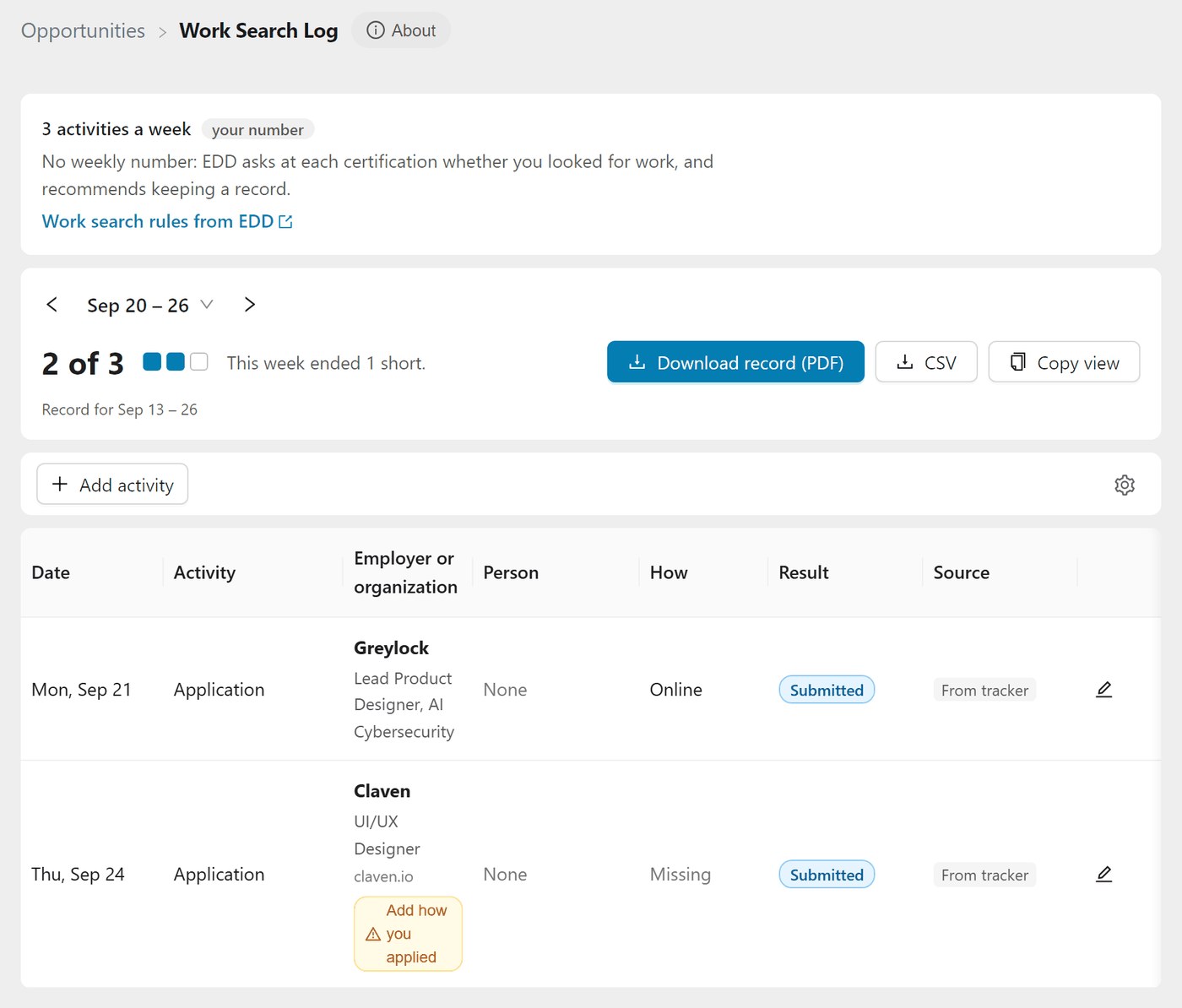
Once it’s on, Work Search Log appears in the side menu right under Job Tracker, and a small “This week 2 of 3” counter sits in the Job Tracker’s toolbar.
Step 1: Turn it on and set your state
Open Settings > Preferences > Unemployment work search and switch it on (or click Turn it on on the Work Search Log page). Then check three things:
- State. It starts from the state in your profile.
- Weekly number. It starts from your state’s rule. If your letter from the agency says something else, type the number from your letter.
- How often you certify. Every week or every two weeks, from your state’s rule, again overridable.
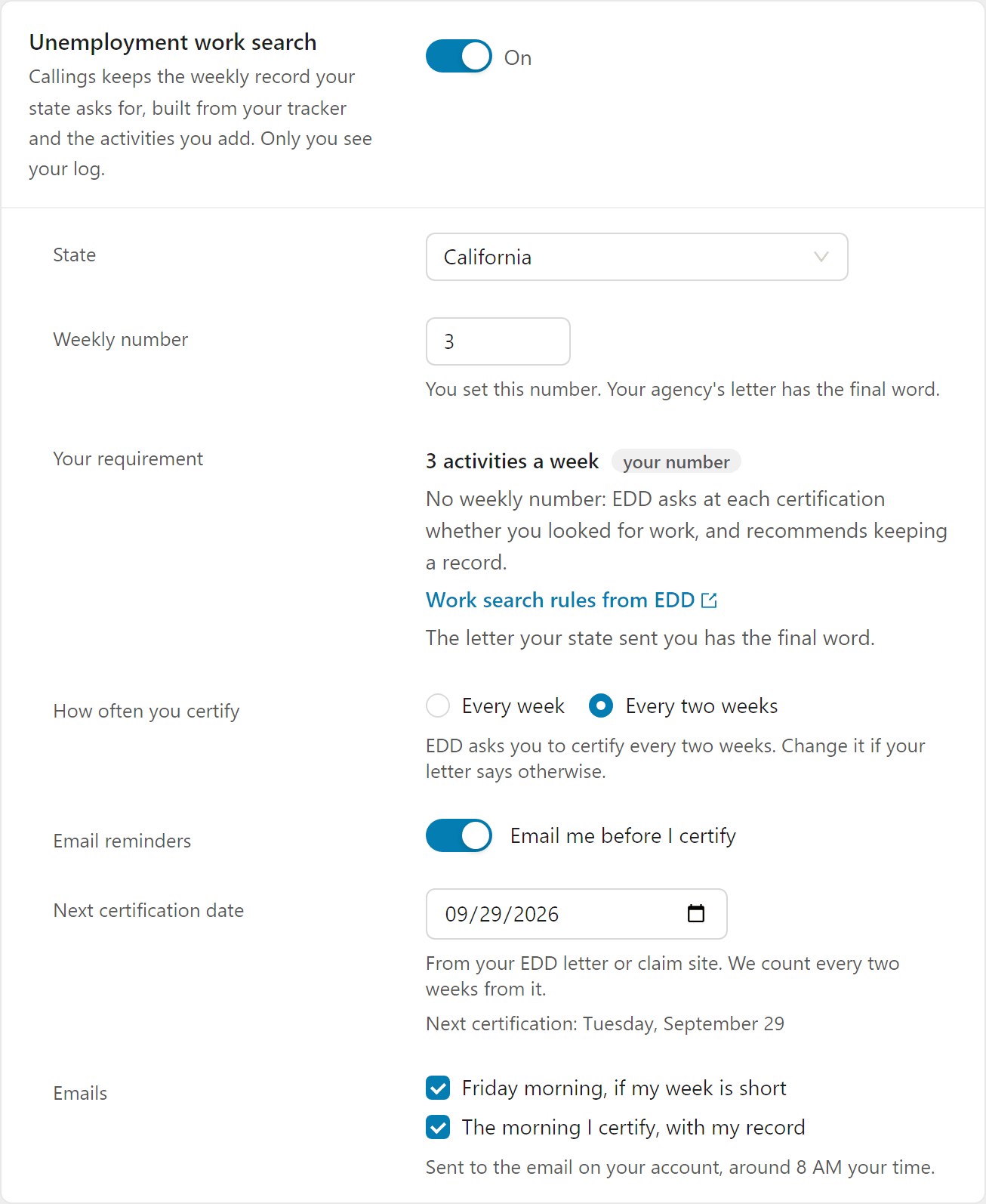
Why it works this way: the rules in this article are my best reading of each state’s official pages on September 29, 2026. Your letter is about you: your county, your claim, this year. When the two disagree, the letter wins, so the app never locks a number. Texas is the clearest case: the rule says 3, the board for your county may say 5, and only your letter knows.
Step 2: Apply as usual, and say how
When you mark a job as applied in the Job Tracker, a small panel asks How did you apply?
- Applied on: today, or the day you really applied. Future days are refused.
- How: online, email, in person, phone, mail or fax.
- Person contacted: one of the job’s contacts, someone else, or nobody specific.
- Result so far: submitted, interview, offer, hired, rejected, not hiring or no response.
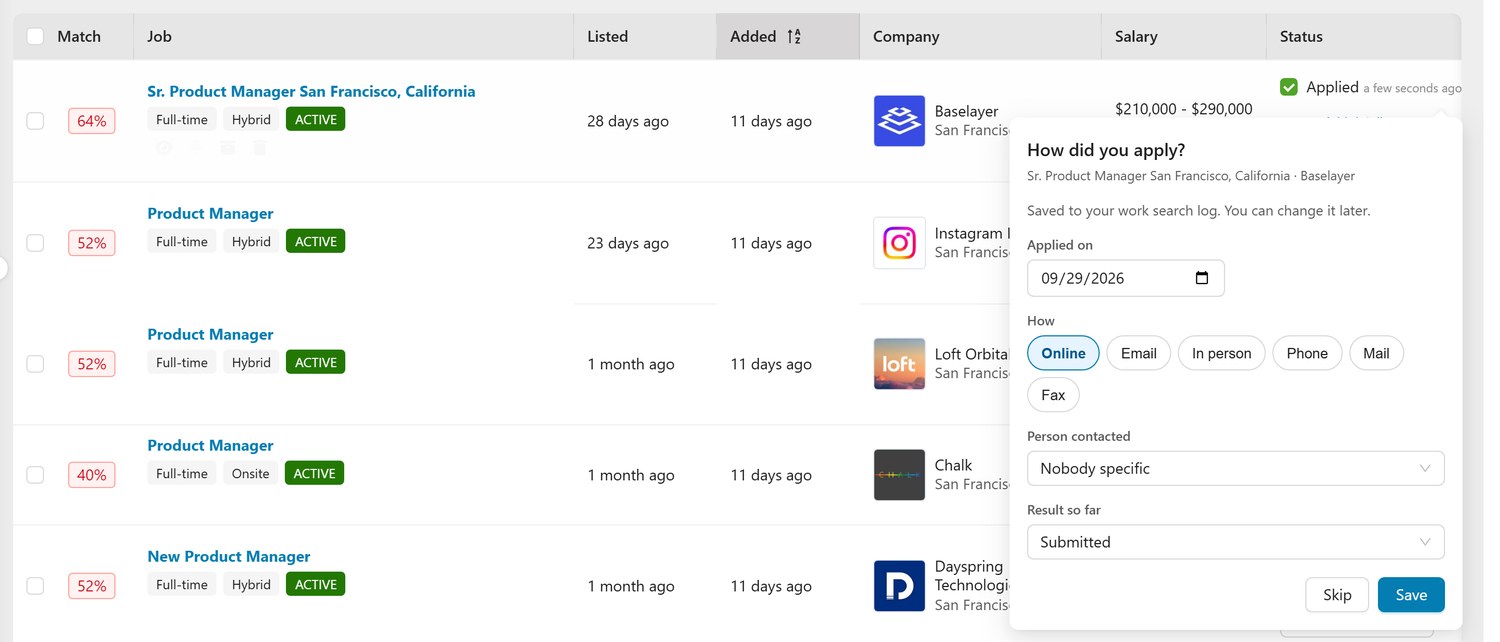
Why we ask at that moment: those four fields are the columns of almost every state form I read, and they are easiest to answer right after you apply. A week later, “was that one online or by email?” is a guess.
Why nothing is pre-selected: the tempting design was to default “How” to Online, since most applications are sent online. We didn’t. What you certify to your state must be true, and a default that is usually right is still wrong on the rest of your record. So until you choose, the entry carries an amber Add how you applied flag, and the log shows it on the row until you fix it. Skip still counts the application, with today’s date.
Why the date is editable: people apply at night and mark the job applied the next morning, or mark five jobs at once on a Sunday. The week an application falls in decides whether that week met the number, so the date has to be the day you really applied, not the day you clicked.
Step 3: Add everything that isn’t an application
Job fairs, workshops, networking events, registering on your state’s job bank, posting your resume, signing up with a staffing agency: choose Add activity on the log page and pick what you did. The form only asks what fits the activity. A job fair asks who you talked to and whether it was in person or online; a resume posted on a job board asks only for the board and its website. In states with a named job bank, registering on it starts with the job bank’s name filled in (WorkInTexas.com, Employ Florida, NCWorks…). Texas lists Workforce Solutions workshop, New York adds Civil service exam and Florida adds CareerSource appointment, because those states name them.
If you saved an event in Events and its day has passed, the log asks “Did you go?” and Yes, add it logs it for you.
Why: most states count more than applications, and the activities people forget to write down are exactly these. The event prompt exists because the moment you are most likely to forget a job fair is the week after it.
Step 4: Watch the week against your number
Weeks follow your state’s claim week: Sunday to Saturday everywhere except New York, where they run Monday to Sunday. The log opens on the current week, with the count against your number (“2 of 3”), and you can step back through the last 8 weeks. Each week shows Met, In progress, or how many it was short. In Pennsylvania, where at least 2 of the 3 must be applications, the week is only Met when both are true.
Step 5: Let it remind you before you certify
Two optional emails, around 8 AM your time:
- Friday morning, only if your week is short (Saturday morning in New York). The week still has two days left. A week that already meets your number gets no email.
- The morning you certify, with your record. A certification covers the week that ended before it (or the two weeks before it if you certify every two weeks), and in New York a Sunday certification is for the week ending that day. The email lists each of those weeks against your number, every entry, and anything still missing a detail.
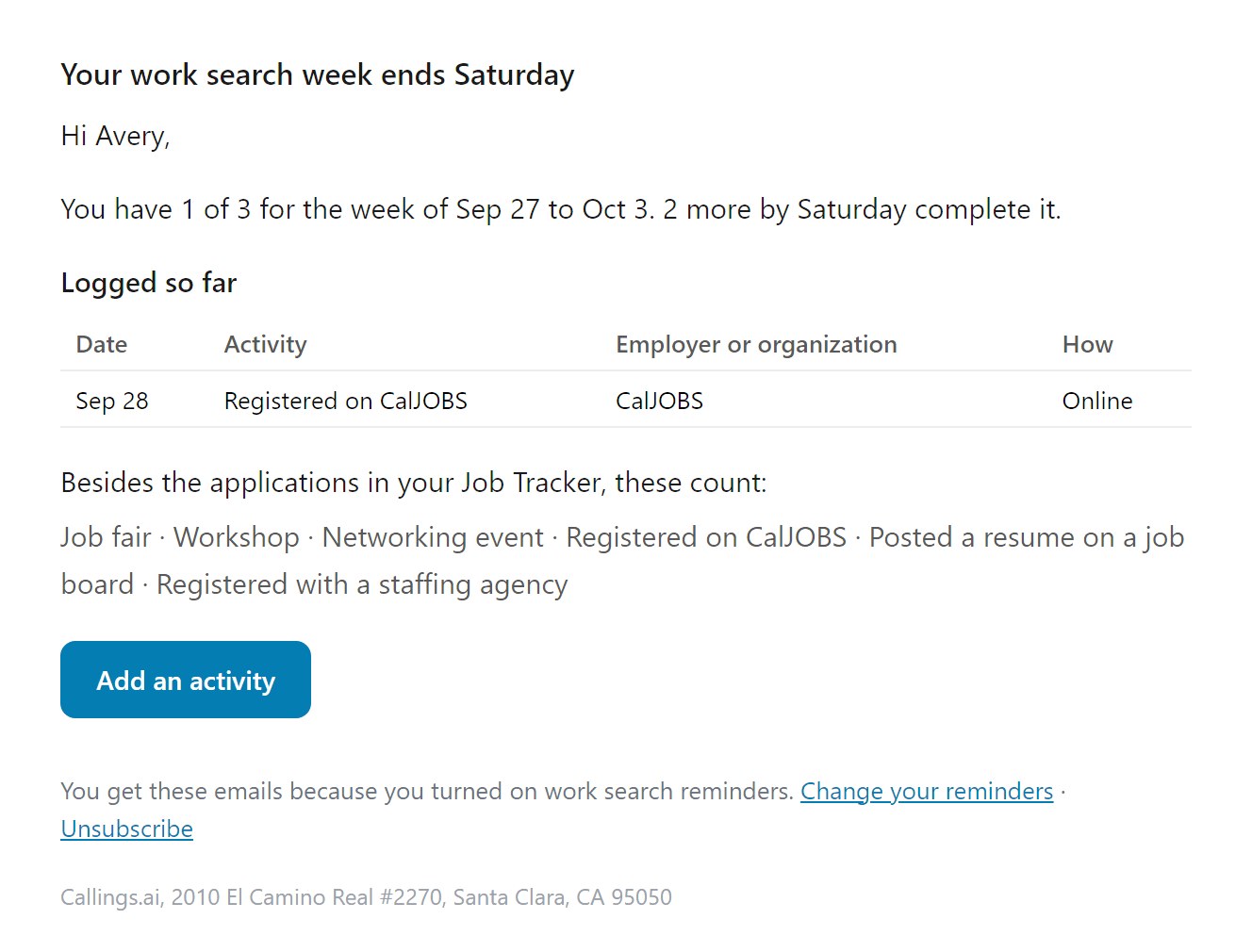
Why these two and nothing else: the only two moments that change the outcome are before the week closes (you can still do something) and the morning you certify (you need the record in front of you). Anything more is noise, and anything less is the problem people asked us to solve. Every email has an Unsubscribe link that stops the reminders without turning off the log.
Step 6: Get your record in the form your state wants
This is where the two kinds of states split:
- If your state asks you to keep a record (Texas, New York, Pennsylvania, Washington and others): Download record (PDF) gives you a Work Search Record for the claim period, one block per week with its count, the eight columns state forms ask for, and a signature line. A CSV with the same columns opens in any spreadsheet.
- If your state asks you to enter each contact when you certify (Florida, Georgia, North Carolina, Michigan and others): Copy for your state’s site opens one card per activity with a copy button on each field, in the order the claim site asks for them. You tick Mark as entered as you go.
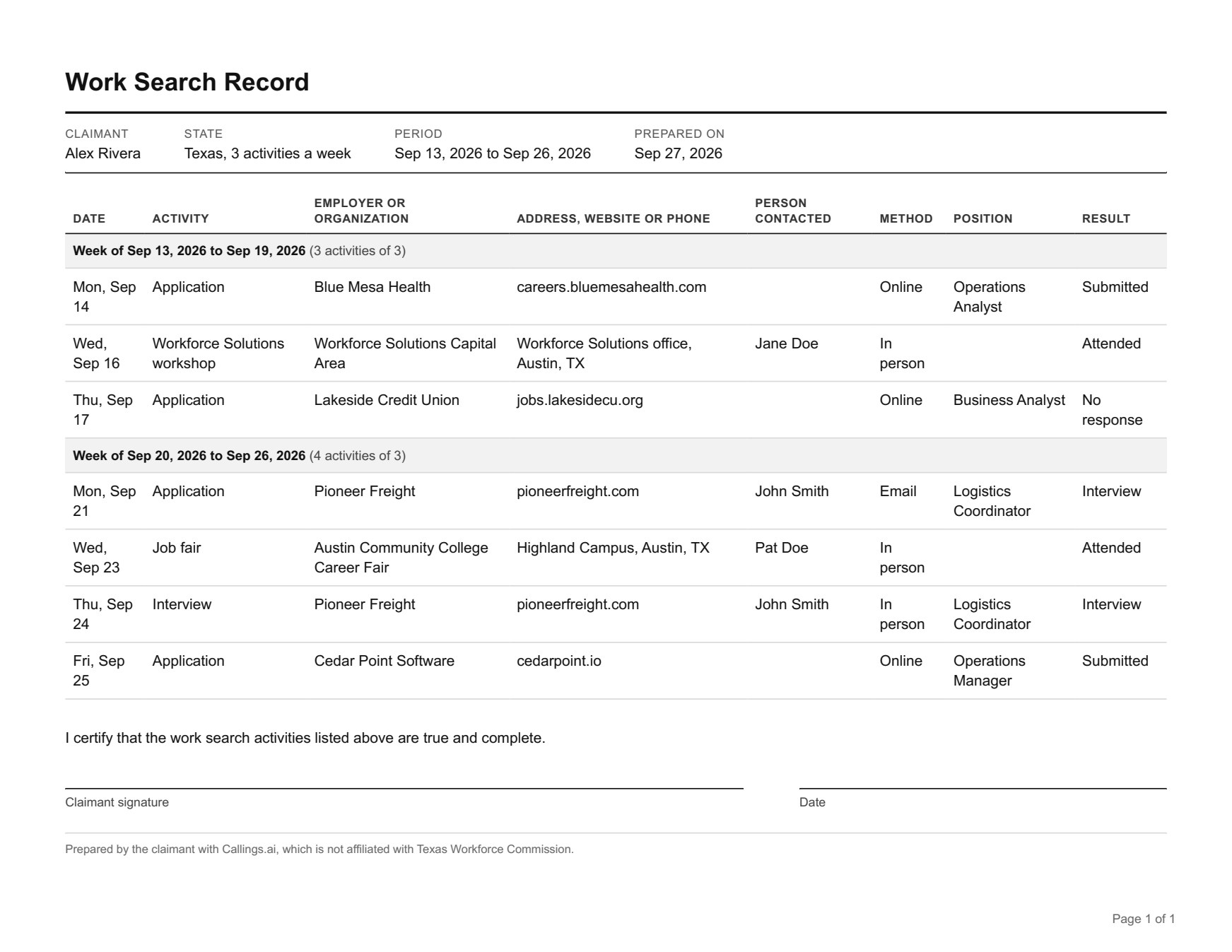
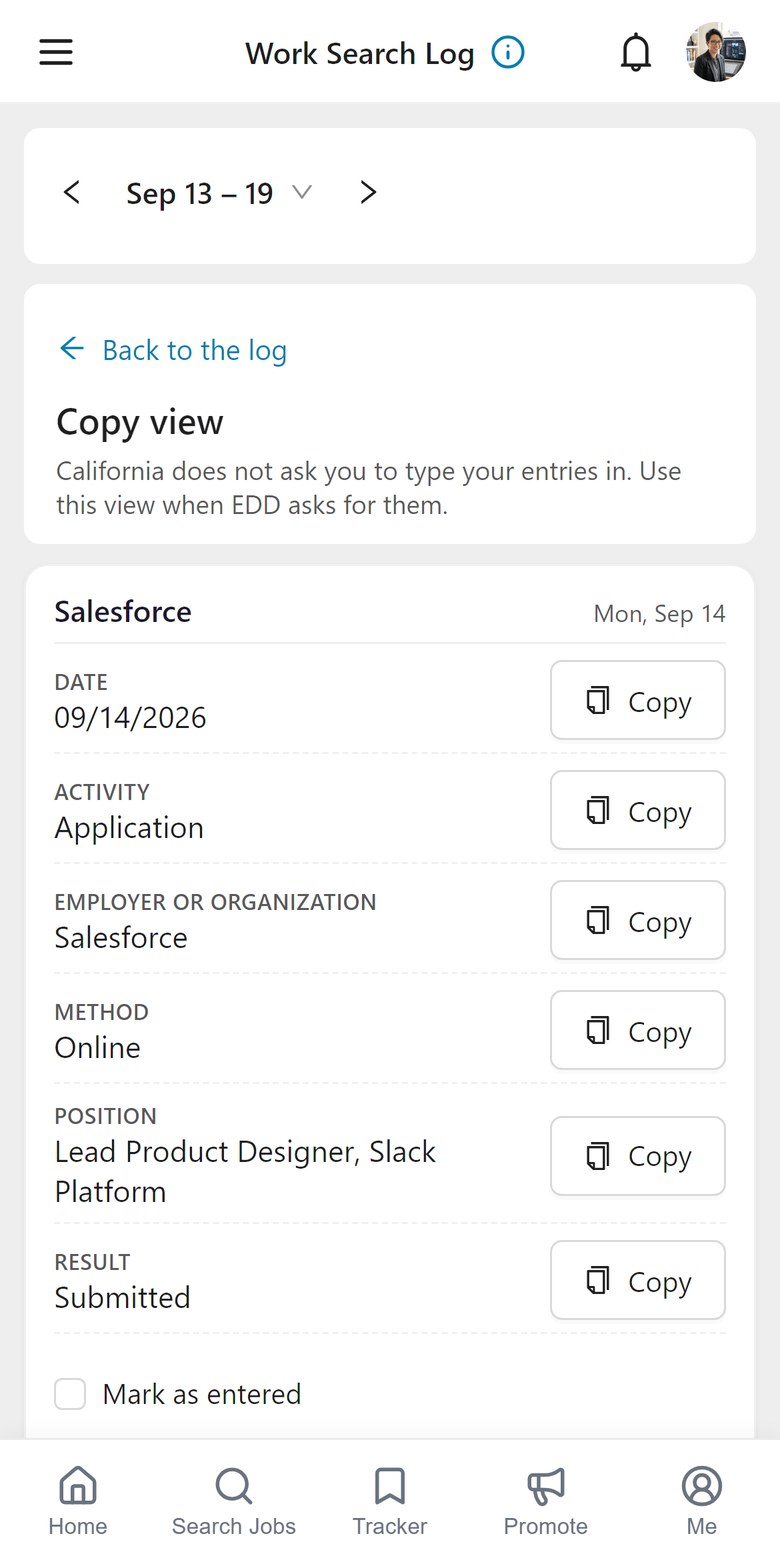
Why we don’t fill in the official form: some states publish their own log (New York’s WS5, Pennsylvania’s UC-304, Texas’s BN900E, Washington’s EMS 10313). All four also say, in their own words, that you don’t have to use it. New York: “You can also keep a similar written record instead of the Work Search Record form if it includes the required information.” Texas: “If you create your own log, it must include the same information that is on our version.” Pennsylvania and Washington say the same. Filling 51 forms that each change on their own schedule would trade a record that is always complete for one that is sometimes out of date. Georgia is the exception: it accepts only its own form (DOL 2798) on paper, so the log tells Georgians to use it as a reference and to enter their contacts online.
Why we never submit anything to your state: no state has an API or a bulk upload for work search records, and even if one did, what you certify is your statement, under penalty of law. The log prepares it; you file it.
What the log will not do
- Send anything to your state, an employer, or anyone else. Only you see your log and whether you use it. That includes organizations that pay for your Callings access.
- Ask for your Social Security number. The record has no field for it. If your state’s form asks, write it in yourself on paper.
- Keep an application after you delete the job. The log reads your applications live from the Job Tracker, so unmarking or deleting a job removes it. That’s why I recommend downloading your record at the end of each claim period, which is also what the states ask.
- Know your county. Where the number depends on your county (Texas, Florida’s smaller counties), type the number from your letter.
The decisions, in one table
| Decision | What we chose | Why |
|---|---|---|
| Where entries come from | Your Job Tracker, read live, plus activities you add | No double entry: the application you already tracked is the entry |
| Cost | Free, for every member | People on unemployment have lost their income, and a missed log can cost a week of benefits |
| On by default? | No, you turn it on | Whether you receive benefits is private; the product shouldn’t assume it |
| Rules | All 50 states and DC, every value editable | Rules differ by state and sometimes by county; your letter wins |
| How applied | Never pre-filled, flagged until you choose | What you certify must be true |
| Weeks | Your state’s claim week: Sunday to Saturday, Monday to Sunday in New York | A week that doesn’t match your state’s can put an activity in the wrong week |
| Output | PDF record, CSV, or a copy view in the order of your state’s site | States either keep records or take typed entries |
| Official forms | Not filled | Many states accept your own format with the same fields, and forms change |
| Submission | Never | No state accepts it, and the certification is yours |
| Social Security number | Never stored or printed | Nothing in the log needs it |
| Reminders | Friday if short, and the morning you certify | The two moments that change the outcome |
A weekly checklist
Once, when you file
- ☐ Claim filed with the state where you worked
- ☐ Registered on your state’s job bank, before its deadline
- ☐ Your state’s work search page and claimant handbook saved
- ☐ Your weekly number confirmed from your letter (and your county, in Texas or Florida)
- ☐ Tax withholding chosen (Form W-4V, 10%) or a plan for April
Every week
- ☐ Your number of activities done, of the kinds your state counts, inside the week
- ☐ For each: date, employer, address or website, person, how, position, result
- ☐ Proof saved: confirmation emails, screenshots, event names
- ☐ Earnings from any work reported for the week you worked
- ☐ Certified on time, after the week ended
Every claim period
- ☐ Your record downloaded or printed, and kept as long as your state asks
- ☐ Letters read the day they arrive; deadlines on your calendar
Frequently asked questions
Do I have to look for work every week I claim?
Yes, in every state, unless your state has waived it for you: for example during a temporary layoff with a return date, while in approved training, or as a union member who gets work through a hiring hall. Your state tells you in writing when that applies.
How many job contacts do I need a week?
It depends on the state, from 1 (Maine, New Jersey, Delaware, Montana) to 5 (Florida, Kentucky, Louisiana, Arkansas, Nebraska, Oregon, Idaho). A few states set no number and judge the quality of your search instead. See the table, then your letter.
Do I send my log to the state?
In “enter” states, you type each activity into the claim site when you certify, and that is your report. In “keep” states, you don’t send anything unless you’re asked, but you must be able to produce the record, sometimes for years.
Can I use my own spreadsheet instead of the state’s form?
In many states, yes, as long as it has the same information. Georgia is the notable exception: if you report on paper, it accepts only its own form (DOL 2798), and it prefers that you report online.
Does applying online count?
Almost everywhere. What doesn’t count in some states is browsing: looking at listings without applying or contacting anyone. South Carolina is the one to know about: only job searches made inside SC Works Online Services count toward its requirement.
I found a part-time job. Do I still have to look for work?
Usually yes, if you’re still claiming partial benefits. Report your earnings for the week you worked and keep up your work search unless your state says otherwise.
What if I miss my number one week?
That week can be denied. Answer the certification truthfully; saying you met the requirement when you didn’t turns a denied week into a false statement. Then meet it the next week.
How long should I keep my records?
As long as your state says: one year in New York and Rhode Island, two in Pennsylvania, three in Connecticut, “your benefit year plus six months” in West Virginia. When in doubt, keep them until a year after your claim ends.
Is there a federal work search requirement?
Only the principle: federal law says claimants must be “able to work, available to work, and actively seeking work.” Everything else is state law.
Does Callings send my work search to my state?
No. No state accepts records from an outside service, and what you certify is your statement. The Work Search Log prepares your record; you file it.
Is the Work Search Log free?
Yes, for every Callings member.
Official resources
Start here
- CareerOneStop Unemployment Benefits Finder: your state’s claim site
- American Job Center Finder: free in-person help near you, or call 1-877-US2-JOBS
- U.S. Department of Labor, unemployment insurance
Rules and data
- DOL fact sheet: how UI works
- Significant Provisions of State UI Laws, July 2026: benefit amounts and weeks, every state
- 42 U.S.C. 503(a)(12): the federal work search requirement
- UI payment accuracy: improper payments by state and cause
Special situations
- UCFE (federal employees), UCX (veterans), DUA (disasters), RESEA
- Taxes on unemployment benefits and Form W-4V
- Report unemployment identity theft
Last word
The members who asked for this weren’t asking for much: a way to stop typing the same applications twice, and some confidence that the record they hand their state is complete. Reading every state’s rules taught me why that confidence is hard to come by. The rules are scattered across websites, handbooks and forms that don’t always agree with each other, and they change every year.
So here is my advice, feature or not: find your state’s page in the table, read it once, set a weekly number you can’t miss, and keep the eight facts for every activity, every week. That record is what keeps a denied week from becoming a repayment months later.
If you use Callings, the Work Search Log will keep it for you, and it’s free.
If you find something on this page that doesn’t match your state’s official page or your letter, or a rule has changed since I wrote it, please send me a note through our contact form. I’d rather fix the page than have you rely on something out of date.
Good luck with your search!
Philippe
Update log
- September 29, 2026: First version. Work search rules for all 50 states and DC, re-checked against each agency’s own pages; benefit amounts and weeks from DOL’s July 2026 comparison and state sites.