How Soon Should You Apply for a Job? And Which Jobs to Apply to First
By Philippe Cailloux · · 37 min read

Apply in the first few days, starting with the jobs that fit you and the companies where you can reach someone inside
Many Callings members ask us the same question in different words: I have twenty jobs saved, so which ones should I apply to first? Some ask it about timing (is it too late, the posting is two weeks old?), some about fit (should I bother with a 65% match?), and some about people (should I wait until I know someone there?). Underneath, it’s one question: how soon should you apply for a job, and in what order?
Very early in the life of Callings, we added suggested introductions: people at the companies of the jobs you saved, so you could reach the people behind a job and not only its posting. Members tell us that reaching out leads to conversations, and that some of those conversations turn into internal referrals. The career coaches who join our webinars say the same thing, session after session: network, ask for informational interviews, and look for an internal referral. That’s why this page puts people ahead of timing.
We are now working on helping members focus on the right priorities each day: which jobs to apply to first, and which ones to let go. Before building it, I wanted to know what the research actually says about application timing, because the advice online is all over the place (“apply within the first hour!”, “apply within two weeks”, “never apply on a Friday”). This page is what I found, and the simple method we derived from it, which you can use today with a spreadsheet.
For information only, as of November 11, 2026. The research and our own data below describe averages across many employers and job boards. Your field, your level and your country can differ, and some employers (government, campus recruiting, executive search) run on fixed calendars of their own.
Full disclosure: Callings is my product, and part of this page describes features we built or are building. The research stands on its own: I’ve linked every study, and I’ve left out the vendor statistics that circulate online when I couldn’t trace them to a primary source. The numbers on how long postings stay up come from our own job listings database, and I explain how we measured them.
Last updated: November 11, 2026. I’ll keep this page current as new research comes out and as readers point out what I got wrong. Changes are listed in the update log at the bottom.
At a glance
| Question | Short answer |
|---|---|
| How soon should I apply for a job? | Within the first few days, as soon as you can send a good application. On one large job board, almost half of all applications went to postings less than 48 hours old, and with rolling review, teams start reading as applications arrive |
| Do I need to apply within the first hour? | No. Hiring managers usually read applications in batches. The advantage is days and weeks, not hours, and a rushed application can’t be tailored |
| Is it too late to apply after two weeks? | Not if you fit well and the job is still open. Check the employer’s own careers page first, and don’t let an old posting jump ahead of fresh ones |
| How long do job postings stay up? | About a month on employers’ own sites: in our job listings database, half of US postings were still up 30 days after they were posted, and a quarter after 60. LinkedIn postings came down faster, and on one job board the median was 7 days. The data, with charts |
| Should I wait for the deadline? | No. Many employers review applications as they arrive and can close early. A deadline only tells you when it’s too late |
| Does the day of the week matter? | There’s no solid evidence that it changes your odds. What matters is how long the job has been posted |
| What matters more than timing? | How well you fit, and whether you can reach someone inside. In 38 million applications from 2021 to 2024, 40% of referred candidates got an interview, against about 3% of people who applied on their own |
| Which jobs should I apply to first? | Rule out the ones you can’t or shouldn’t take, then rank the rest by fit, people and interest, then timing. The method is below, with a worked example |
| How do I do it by hand? | A spreadsheet with seven columns: see If you’re not using Callings. Callings does most of the upkeep for you: see What Callings does for you |
Where this fits in Callings
Callings is a platform for the whole job hunt, and deciding what to apply to is one moment of it. Several parts of the product feed the decision:
| Area of Callings | What it covers | What it brings to the decision |
|---|---|---|
| Opportunities: Find Jobs, Job Tracker, Target Companies | Finding roles, tracking them, the companies you’re aiming at | The Match % of every job (on your base resume, and on a tailored one), whether its posting is still open or was reposted, the date it was listed, its application deadline when it has one, and the companies you care most about |
| Networking: People, Events, Associations, Community | Your contacts, and the people Callings suggests you reach out to at each company | Who inside could introduce or refer you |
| My Plan | A short list of tasks each day | The day’s applications, follow-ups and notes to people, a few at a time |
Table of contents
- What the research says about application timing
- How soon should you apply for a job?
- Is it too late to apply to a job posted weeks ago?
- Should you wait for the application deadline?
- How long do job postings stay up?
- Should you reapply when a job is reposted?
- What’s the best time to apply for a job?
- What matters more than timing
- How to prioritize job applications
- A worked example
- If you’re not using Callings: do it in a spreadsheet
- What Callings does for you
- Mistakes to avoid
- Checklist
- Frequently asked questions
- Research cited
What the research says about application timing
The useful research on application timing comes from economists who got access to job board data at a scale no recruiter sees. Four findings matter for a job seeker.
Most applications arrive in the first two days
Steven J. Davis and Brenda Samaniego de la Parra built a database linking 125 million applications to job postings on Dice.com, a board for technical, engineering, finance and consulting jobs. Their 2024 NBER working paper, Application Flows, found that:
- Postings stay up for a short time: “often only two or three days, with a median of seven days.”
- Job seekers “display a striking propensity to target new postings, with almost half of applications flowing to openings posted in the past 48 hours.”
An earlier version of the same research, summarized by the University of Chicago in 2017, put numbers on the rush: 39% of applications went to jobs posted in the past 48 hours, and 54% to jobs posted in the past 96 hours.
So the crowd arrives early, and on a job board like Dice the window to apply is often measured in days. Employers’ own sites keep postings up much longer, as our own data shows, but the crowd still arrives in the first days.
The posting comes down before the job is filled
A posting coming down doesn’t mean the job is filled. SHRM’s 2025 recruiting benchmark puts the median time to fill (from the opening of the job requisition to the accepted offer) at about a month and a half, for executive and nonexecutive roles alike, and at 61 days for nonexecutive roles in extra-large organizations.
Put the two together with our own data (half of postings on employers’ sites stay up about a month) and you get the shape of most hiring processes: most applications in the first days, then weeks of screening and interviews with the people who applied then, often while the posting is still up. If you apply after the first batch has been read, you’re competing with candidates the team has already met.
Employers read in batches, or as applications arrive
Career offices describe two ways employers handle applications, and both reward applying early:
- Batches. Princeton’s career office says that while some organizations act on applications as they come in, “more commonly they collect a larger pool of applicants before screening resumes and scheduling interviews.” Its advice: apply “within two weeks of the date it was posted.”
- On a rolling basis. Yale School of Management’s career office explains that with rolling review, recruiters “review applications as they are submitted, instead of waiting until after the application deadline,” and that “if numerous qualified candidates apply before the deadline, the position may close early.”
Other job seekers rush to new postings
Andrey Fradkin, Monica Bhole and John J. Horton ran three experiments on a large online job platform, published in Management Science in 2025. Showing job seekers how old a vacancy was “increases application rates, especially to new vacancies,” and showing how many people had already applied redirected applications toward jobs with few applicants. In an interview with Boston University, Fradkin summed up the practical lesson: “Applying earlier is better.” He also added a caveat that matters: for “very skilled, niche, specific jobs, it’s not going to be the case that you have to apply right away.”
How soon should you apply for a job?
Within the first few days, as soon as you can send an application you’re proud of.
That last part matters as much as the first. Alison Green, who has answered hiring questions on Ask a Manager for years, took on the “apply within the first hour” advice in August 2025: most hiring managers “look at applications either in batches or all at once,” many “don’t even know exactly when a job is posted,” and “there’s no way you can customize your application if you’re racing to get it in within an hour.” Her conclusion: the advantage of applying early is about “the first week or two versus five weeks later, not hours.”
Readers who hire in tech pushed back in the comments with postings pulled after 24 to 48 hours because hundreds of applications arrived. Both things are true: the window can be short, and a generic application sent in an hour doesn’t help you. The way out is to be ready before the posting appears:
- Have your materials ready. A resume for each kind of role you target, a few paragraphs you can adapt for a cover letter, and the answers to the questions every application form asks.
- Hear about new postings the day they appear. Job alerts on the boards you use, the careers pages of your target companies, and the people you know there.
- Give yourself a deadline. For a job that fits you well, aim to apply within two or three days of its posting, and tailor it.
Is it too late to apply to a job posted weeks ago?
Not necessarily. But an old posting deserves a check before it gets your evening.
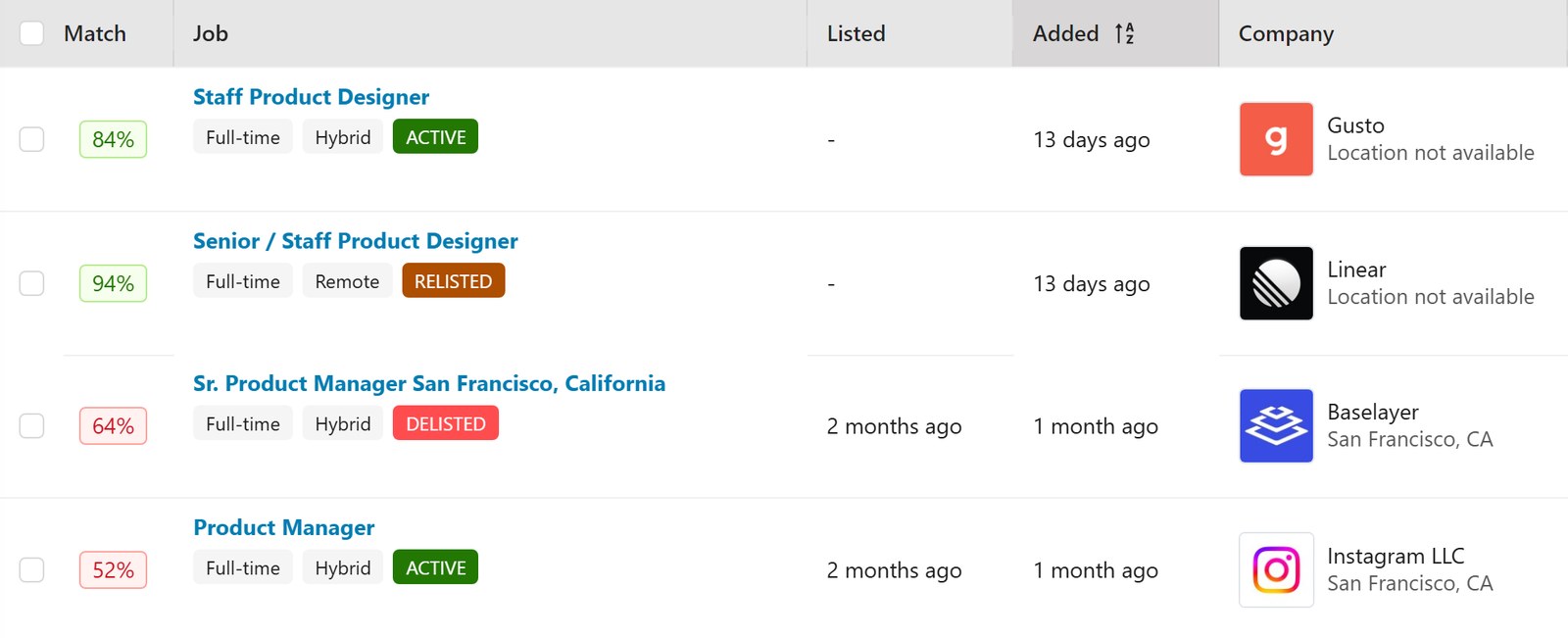
- Check that it’s really open. Look the job up on the employer’s own careers page. Job boards can keep a listing up after the employer has closed it, and the same role is sometimes reposted with a new date. (In Callings, the Listed date on a job’s timeline tells you how old the posting is, and its tag tells you whether it’s still ACTIVE, DELISTED or RELISTED.)
- Weigh it, don’t skip it. A job posted a month ago at a company you’d love, where you fit well, is still worth an application. It just shouldn’t jump ahead of a fresh posting that fits you as well.
- Use a person if you can. If the posting is old, the team may already have a shortlist. A short note to someone there (the hiring manager, a recruiter, a former colleague) can get your application read where the portal alone may not.
Should you wait for the application deadline?
No. With rolling review, applications are read as they come in, and a role can close before its deadline once enough strong candidates have applied. A deadline tells you when it’s too late, not when to apply.
A close deadline should move a job up your list, though: a job that closes in two days is more urgent than one that will be there next week. In the method below, a deadline within two days puts the job on today’s list. In Callings, a job’s deadline shows as Apply before on its timeline, when the posting sets one.
How long do job postings stay up?
Longer than the job board studies suggest, at least on employers’ own sites: half of the postings we followed were still up a month after they were posted. But the clock that matters for you isn’t the one on the posting. It’s the one on the first batch of applications.
The studies above measure one job board. To see how long postings stay up across employers, we turned to our own job listings database, which records when each posting appears and checks every day or two whether it’s still there.
How we measured
- The postings. A random sample of 142,000 US job postings that first appeared between June 1 and September 30, 2026, followed until they came down or until November 8, 2026: up to five months.
- The clock. A posting’s age counts from the date the employer posted it, when the posting gives one, and otherwise from the day it first appeared in our database. It stops on the last day the posting was still up.
- Where. The main numbers come from the 51,600 postings on the application systems employers use for their own careers pages (Workday, iCIMS, Greenhouse, ADP, UKG and the like). That’s where we can tell most reliably when a posting comes down: when we went back to the pages of postings we had recorded as gone, 91% were indeed closed. On smaller sites, only about three in four were, so I kept them out of the main numbers. For LinkedIn, we used a second sample, described below.
- The math. A posting still up at the end of the study counts as still up, not as gone, and a posting we first saw a few days after it was posted only counts from that age on. (For the statistically minded: a Kaplan-Meier survival curve with late entry.)
Half of postings were still up after a month
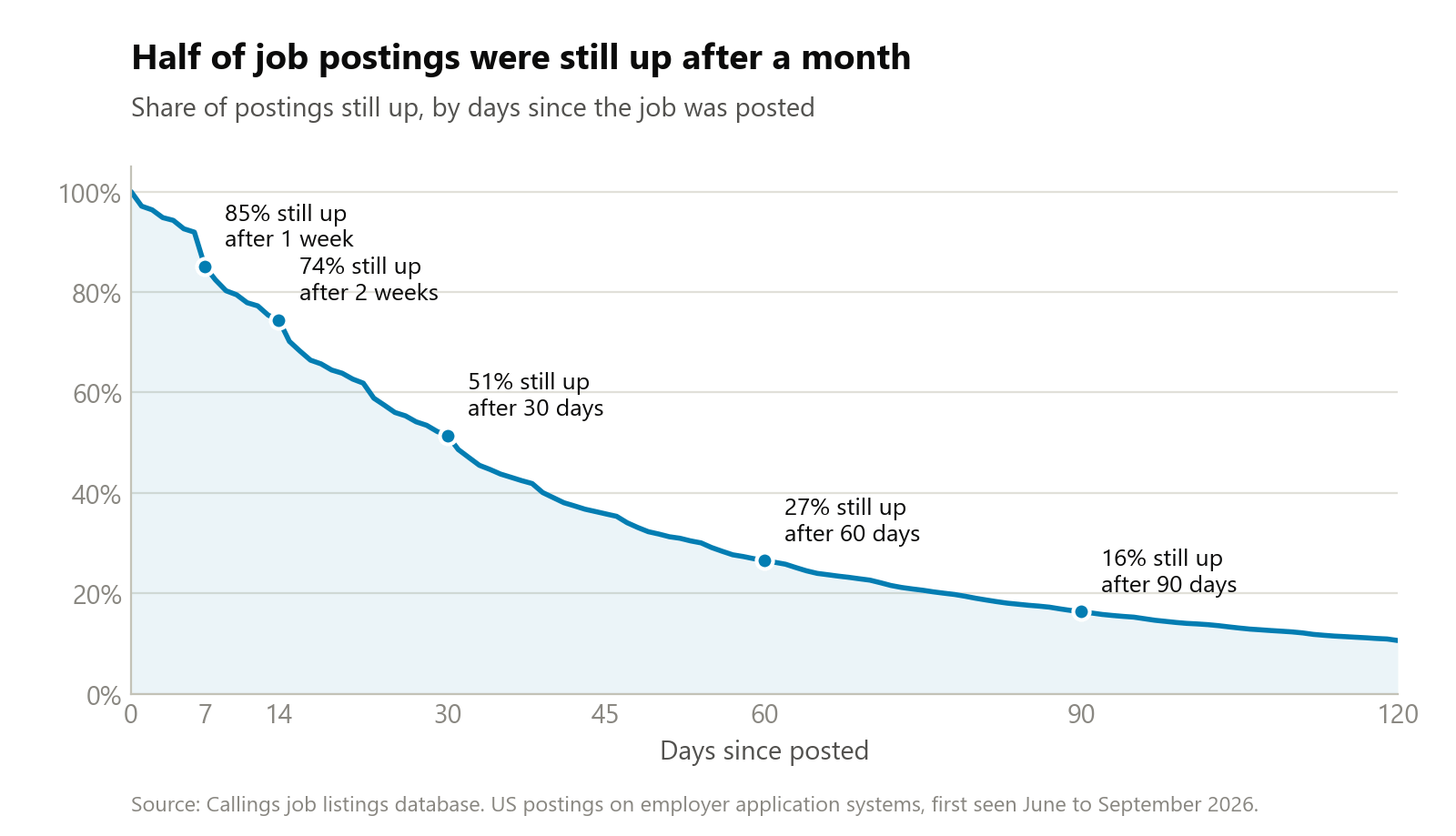
| Days since posted | Share of postings still up |
|---|---|
| 1 week | 85% |
| 2 weeks | 74% |
| 30 days | 51% |
| 60 days | 27% |
| 90 days | 16% |
| 120 days | 11% |
The median posting stayed up 30 days. The average is longer, about 52 days, because a minority stays up for months. As a check, we counted the postings open on a given day and divided them by the number of new postings per day, a second way of getting the same average: it came out at 51 to 54 days.
So a posting that’s still up says little about where the hiring stands. Most applications arrive in the first days, and with a median time to fill of about a month and a half, a posting that’s three or four weeks old may well have a team already interviewing the first batch.
Where you found it: employers’ sites, LinkedIn and job boards
Employers’ own sites keep postings up the longest: a median of 30 days, as above.
LinkedIn postings came down faster. Our long sample doesn’t follow LinkedIn postings reliably, so for this comparison we used a second sample: US postings that appeared from October 27 to 31, 2026, on LinkedIn and on employers’ application systems, followed over the same two weeks. After one week, 74% of the LinkedIn postings were still up, against 85% on employers’ systems. After two weeks, 59% against 71%.
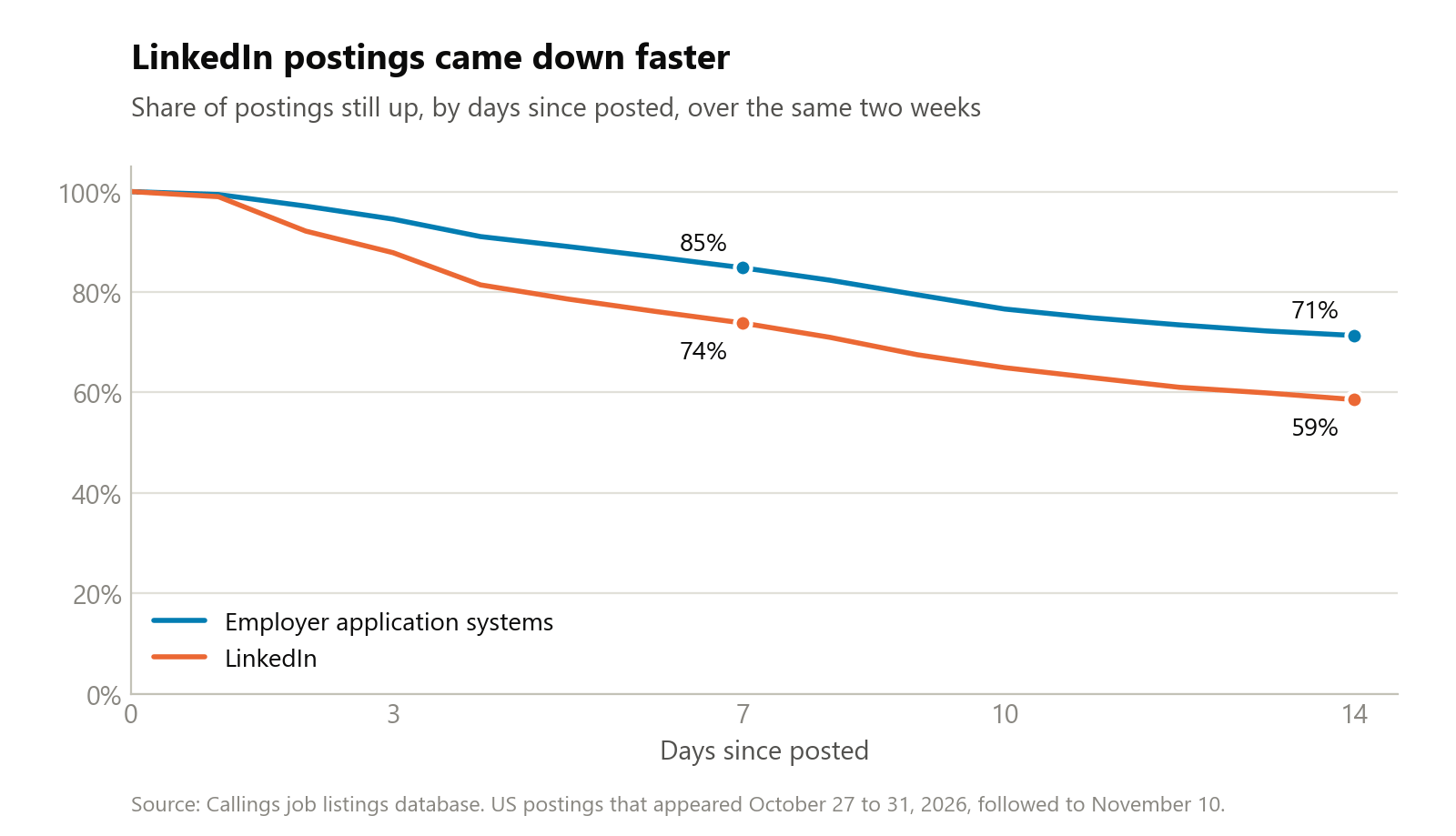
Job boards can be faster still. On Dice, the Application Flows study found postings stayed up “often only two or three days, with a median of seven days.”
Copies on small job sites come and go. Many small job sites and aggregators copy postings from elsewhere, and about one in five of the postings we saw on them was there for a single day. If you find a job on one of those sites, look for it on the employer’s careers page before you apply: if it isn’t there, the job may already be gone.
By field
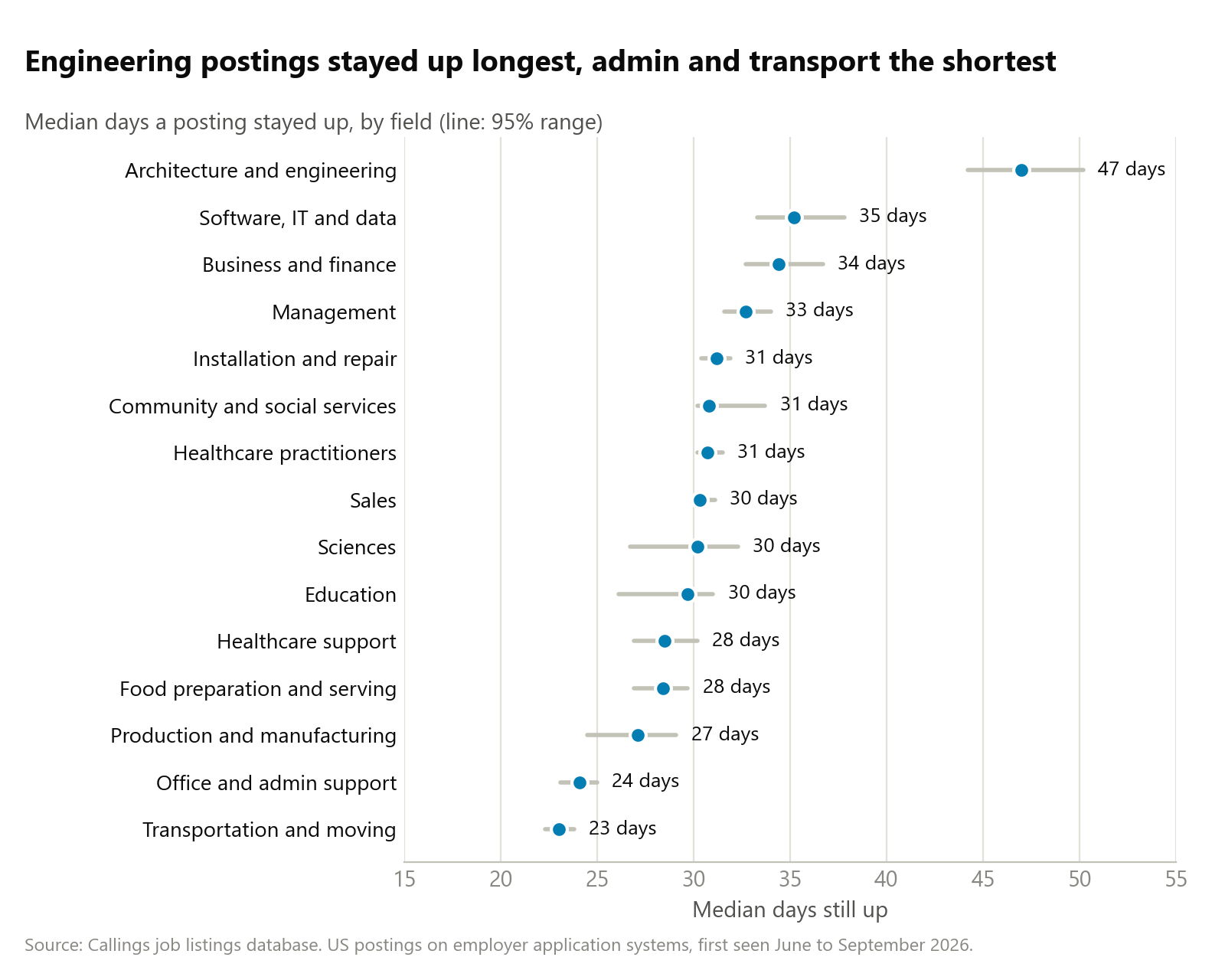
In the first week, every field looks about the same: 82 to 88% of postings were still up. The differences come later. After 30 days, 65% of architecture and engineering postings were still up, against 42 to 43% in office and administrative support and in transportation. At the median:
- Longest: architecture and engineering (47 days), software, IT and data (35), business and finance (34), and management (33).
- Most fields: 27 to 31 days, from production and manufacturing to sales and healthcare.
- Shortest: office and administrative support (24 days) and transportation (23).
Fields follow the US government’s occupation groups. The smaller ones moved by a few days from one month to the next, so I wouldn’t read much into a gap of two or three days.
By seniority and work arrangement
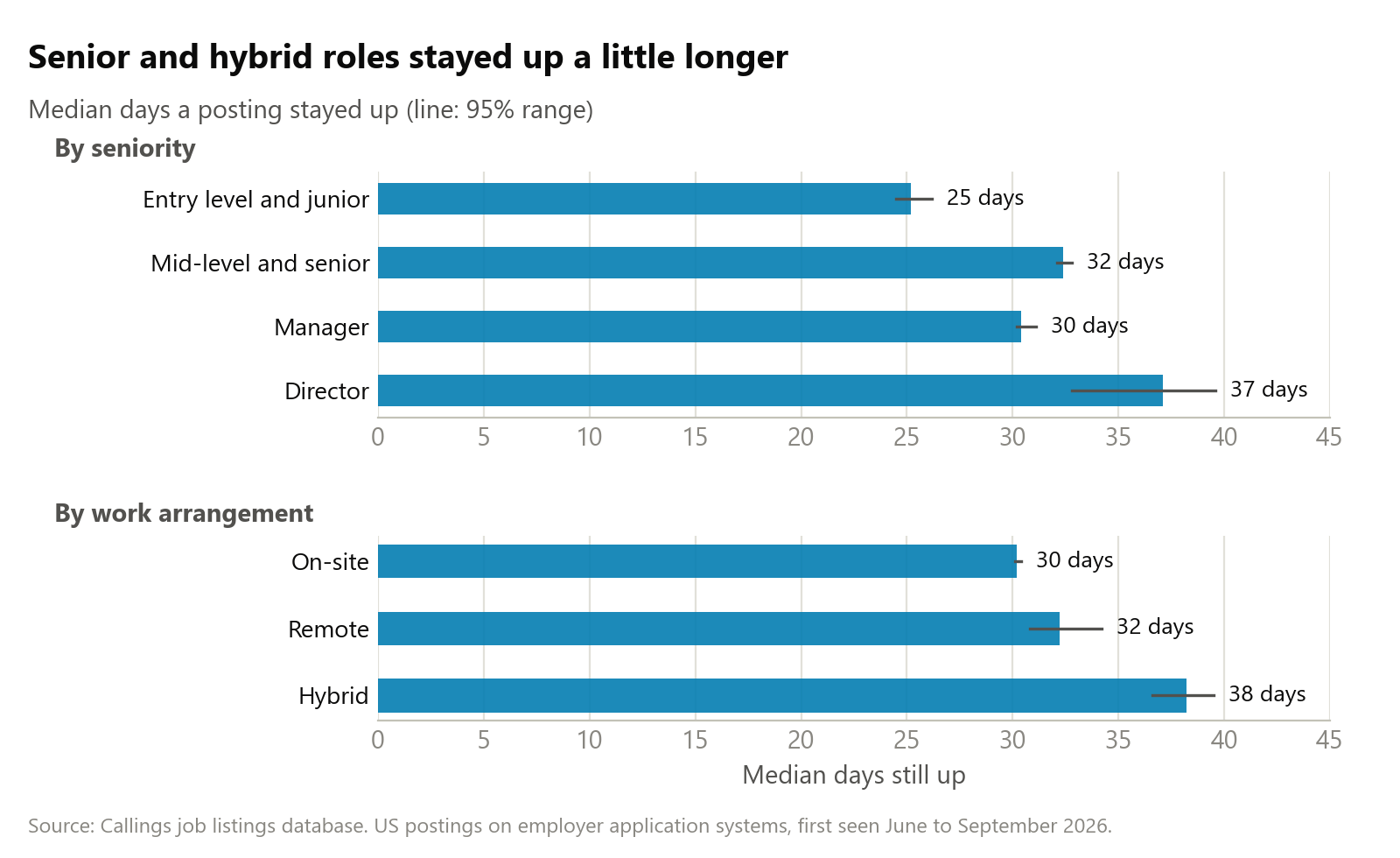
- Seniority. Entry-level and junior postings came down first (a median of 25 days), mid-level, senior and manager postings after about a month (30 to 32 days), and director postings after about five weeks (37 days, from fewer postings, so less precise).
- Hybrid. Hybrid postings stayed up the longest: a median of 38 days.
- Remote. In the long sample, postings tagged remote stayed up about as long as on-site ones (32 and 30 days). The second sample separates jobs that are fully remote from jobs that allow some remote work, and there the fully remote ones came down faster: after two weeks, 34% of fully remote LinkedIn postings were still up, against 60% of on-site ones, and 53% against 72% on employers’ systems. That fits the competition numbers in How crowded it is: remote jobs draw far more applicants per opening. If you’re after a fully remote job, don’t wait.
The same, month after month
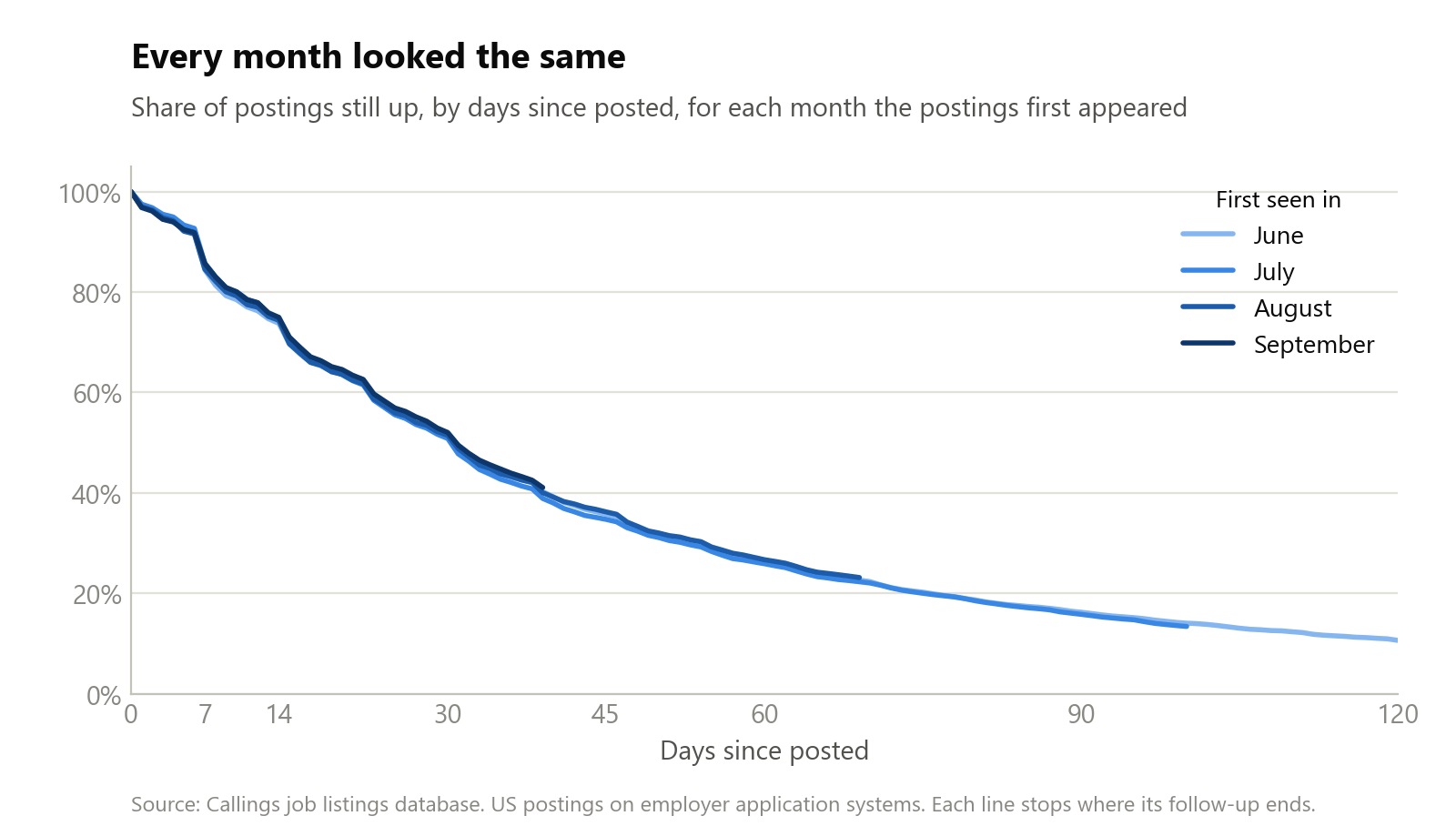
Postings that first appeared in June, July, August and September followed nearly the same curve: 84 to 86% still up after a week, 74 to 75% after two weeks, 51 to 52% after a month, and 26 to 27% after two months. Summer didn’t speed hiring up or slow it down, and the field, seniority and work arrangement patterns above held in each month. We haven’t covered the winter holidays yet, and fields that hire on a calendar (campus recruiting, schools, government) follow their own.
Outside the US, postings on employers’ application systems stayed up about as long in Canada, the UK and Australia (27 to 29 days at the median), and longer in Germany (about seven weeks).
What it means for you
- Apply in the first days anyway. A posting that’s still up a month later isn’t a job still waiting for applicants: much of the crowd applied in the first two days, and the team may be interviewing them.
- Don’t drop a job just because the posting is two weeks old. Three in four postings are still up at two weeks, and half at a month. Check it on the employer’s own careers page, and if you can, write to someone there.
- Check the employer’s site. If you found the job on LinkedIn or a job board, the employer’s own posting usually stays up longer, and it’s the one that tells you whether the job is still open.
- Past two months, ask before you invest. Only about a quarter of postings are still up after 60 days. If one you like is among them, a short note to someone at the company will tell you more than the posting.
That’s also why Callings keeps checking whether the jobs in your tracker are still listed, reading their posting pages, and tags them ACTIVE or DELISTED: you shouldn’t have to find out a job is gone after you’ve written the cover letter.
What these numbers don’t tell you
- When the job was filled. A posting comes down when the employer takes it down, which can be before the hire (once there are enough applicants), at the hire, or after it.
- The exact day. We check every day or two, so a closing date can be off by a day or two. And some of the postings we counted as gone were still up (about 9% on employers’ application systems); correcting for them adds about two days to the median.
- Reposts. About 7% of postings disappeared for a while and came back; we counted them as up the whole time. A job reposted as a new posting starts a new clock.
- LinkedIn over the long run. Our LinkedIn numbers cover two weeks so far.
Should you reapply when a job is reposted?
A repost usually means the role is still open: the first round didn’t produce a hire, the listing expired and was renewed, or the team is hiring a second person. How you handle it depends on where you stand:
- You never applied. Treat the repost as a fresh posting. It’s a new chance to be in the first batch.
- You applied and heard nothing. Don’t just send the same application again through the portal. Write to someone at the company (the recruiter, the hiring manager, a contact), mention that you applied and that you’re still interested, and apply to the new posting if the employer treats it as a new opening.
- You interviewed. Ask the recruiter where things stand before doing anything else.
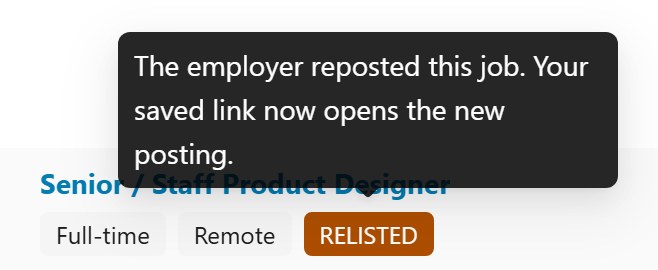
In Callings, a reposted job is tagged RELISTED, and hovering the tag tells you what changed.
What’s the best time to apply for a job?
There’s plenty of advice about the best day and hour to apply, and very little evidence that either changes your odds. What the data does show is when other people apply: in the earlier version of Application Flows, applications per posting were about 45% higher on Mondays and Tuesdays than on Fridays. That describes the crowd, not the result.
The variable that matters is how long the job has been posted. Apply to a two-day-old posting on a Friday rather than waiting for Monday.
The same goes for the time of day. The “apply between 6 and 10 a.m.” tip that circulates online traces back to a vendor analysis from around 2017 that I couldn’t verify, and a team that reads in batches won’t see the hour you clicked Submit.
The time of year matters only for fields that hire on a calendar: campus recruiting, government, academia and some programs open and close applications on fixed dates, and for them the calendar beats any rule of thumb. For everyone else, the clock that counts is the one that starts when the job is posted.
What matters more than timing
Timing decides whether your application is read. Two other things decide what happens next, and they matter more.
How well you fit
The best timing in the world won’t rescue an application that doesn’t fit the job. But “fit” doesn’t mean meeting every line of the posting. A Georgetown University career center newsletter put it this way: students often assume they need to meet “90-100% of the qualifications in a job ad to apply, but employers often exaggerate their job requirements,” and “if you don’t apply, you have 0% chance of getting that job.”
Two practical rules:
- Hard requirements are gates, not points. A license, a work permit for the country, a location you can’t move to: if you don’t meet them, no score makes the job worth it.
- The rest is a judgment of how well you fit. In Callings, that’s the job’s Match %: 80% and above in green, 70 to 79% in orange, below 70% in red. It’s scored on your base resume, and again on the tailored resume when you make one for the job, so you can see how much tailoring helps. Outside Callings, count how many of the posting’s main requirements you meet.
Whether you can reach someone inside
This is the biggest lever in the research, and the one most job seekers use last.
- Referred candidates get interviews. Ashby, whose recruiting software employers use to track their applicants, analyzed 38 million applications from 2021 to 2024. Referrals were only about 1% of applications, but 40% of referred candidates got an interview, against about 3% of people who applied on their own. Once interviewed, referred candidates were also more likely to get an offer (16% against 6%).
- And they get hired. Gem, another recruiting software company, looked at 165 million applications and 1.2 million hires from mid-2021 to mid-2025: referrals “convert at 11x the rate of inbound applicants.”
- And it doesn’t have to be a close friend. A five-year study of 20 million LinkedIn members, published in Science in 2022, found that “the greatest job mobility comes from moderately weak ties”: people you know, but not your closest circle. Events are one of the easiest places to meet them: see my guide to networking events.
Career coaches have taught this for years. Steve Dalton’s The 2-Hour Job Search (second edition, 2020), taught in many university career centers, builds a “LAMP list” of target employers ranked by whether you know people there (alumni or advocates), how motivated you are, and whether they have postings. Hiring managers would rather find a good candidate quickly than a perfect one slowly, and someone they trust saying your name is the quickest route there is. And that someone doesn’t have to be a friend already: a peer on the team, the hiring manager or the recruiter are all people you can find and write to, and an informational interview is how a stranger becomes an advocate.
How much you want it
Your own interest belongs in the ranking too. A job at a company on your target list, or a role you’d pin to the top of your tracker, is worth more of your time than a slightly better match you don’t care about. You’ll write a better application, and you’ll follow up.
How crowded it is
One more factor shapes your odds: competition. LinkedIn data reported by Fortune in January 2024 showed remote jobs were 10% of U.S. open roles in December 2023 but drew 46% of applications. Remote jobs aren’t a bad bet, but don’t fill your whole list with them.
How to prioritize job applications: which jobs to apply to first
Here’s the method we derived from the research. It sorts your saved jobs in four steps. You can run it by hand, on paper or in a spreadsheet, or let Callings do most of the upkeep (what Callings does for you). One principle runs through it: fit sets the order, people and your own interest lift a job, and timing decides which of the good ones you do today. Timing never rescues a weak fit.
Step 1: rule out the jobs you can’t or shouldn’t take
Before you rank anything, take these off the list:
- The posting has closed, or there’s nowhere to apply.
- The deadline has passed.
- The fit is too weak. If you meet only a few of the main requirements, an evening on this application is an evening taken from a better one.
- A hard requirement you can’t meet: an on-site job in a country or city where you can’t work, a license you don’t hold.
- A second job at the same company today. If two roles at one company fit, apply to the better one first.
Step 2: rate the fit
Give each remaining job a fit level:
| Fit | What it means | In Callings |
|---|---|---|
| Strong | You meet nearly all the main requirements | A green Match % |
| Good | You meet most of them, with a gap or two you can address | An orange Match % |
| Stretch | You meet some, and you’d need to make the case | A red Match % |
Step 3: note who you can reach and what you want
For each job, ask two questions:
- Is there someone there I can reach out to? It can be someone you know, or someone you find: a peer on the team, the hiring manager, the recruiter. Best: you’ve already written to them. Next best: you’ve found the right person but haven’t written yet.
- Do I care about this one? It’s at a company on your target list, or it’s a job you’d pin to the top.
A yes to either lifts the job above others with the same fit. And one rule overrides everything: if someone has offered to refer you, that job goes to the top of your list today.
Step 4: note the timing
Last, the timing, which fades fast because the crowd arrives early:
- Posted in the last few days, or closing within two days: do it today.
- Posted in the last week or two, or closing within ten days: do it this week.
- Posted more than a month ago: check the employer’s own careers page before you spend time on it.
- A job you keep putting off slides down your list. If it’s a strong one, give it a fixed evening rather than another postponement.
When you don’t know the posting date, use the date you found the job.
A worked example
Here are nine jobs a product manager might have saved this week. The companies and people are placeholders, so the details are invented, but the reasoning is the one above.
| Job | Fit | People there, your interest | Timing | Where it lands |
|---|---|---|---|---|
| Product Manager, Globex | Strong (87%) | Posted 2 days ago | Today | |
| Product Manager, Northwind Health | Good (75%) | On your target list | Posted yesterday | Today |
| Product Manager, Initech | Stretch (68%) | You wrote to Jane Doe there | Posted 6 days ago | Today |
| Head of Design, Contoso Studio | Strong (90%) | Posted 12 days ago | This week | |
| Product Owner, Fabrikam Care | Good (72%) | Deadline in 3 days | This week (tomorrow, it’s urgent) | |
| Product Lead, Tailspin Consulting | Strong (82%) | Posted 4 days ago, postponed twice | This week, on a fixed evening | |
| Senior Product Manager, Wingtip Software | Good (78%) | Posted 35 days ago | Check first | |
| Project Manager, Litware | Stretch (51%) | On site in Bogotá; you search in the U.S. | Ruled out | |
| Team Supervisor, Proseware | Stretch (53%) | Ruled out |
If you can do three applications today, they’re Globex, Northwind Health and Initech. A few things to notice:
- The person inside lifts a stretch job. Initech is the weakest fit of the three, but you’ve written to Jane Doe there. If she offers to refer you, it goes to the top.
- Your interest counts. Northwind Health is a good fit rather than a strong one, but it’s a company you’re aiming at, and it was posted yesterday.
- The best match isn’t first. Contoso Studio fits you best of all, but it was posted 12 days ago: still worth doing this week, after the fresh ones.
- The deadline moves up. Fabrikam Care closes in three days. Tomorrow it’s two days away, and that puts it on the list.
- The 35-day-old posting waits for a check. Look Wingtip Software up on its own careers page before you spend time on it.
- Litware and Proseware never enter the ranking. One is an on-site job in a country where you aren’t looking, the other is too weak a fit. Ranking them would only waste your attention.
If you’re not using Callings: do it in a spreadsheet
You can run the whole method by hand. It works, but be honest about the cost: for every saved job you’ll need its posting date and deadline, a fresh look at the employer’s careers page to see if it’s still open, a judgment of your fit, and a person at the company to write to. With twenty jobs saved, that’s an evening of upkeep before you write a single application. If that’s your setup, a spreadsheet keeps it manageable.
Here’s a simple points version. It’s not the only way to weigh things, but it keeps the principle: fit first, then people and interest, then timing.
| Column | What you type or compute | Points |
|---|---|---|
| A | Job and company | |
| B | Fit: strong, good or stretch | Strong 4, good 3, stretch 2 |
| C | People: wrote to someone there, found the right person but haven’t written, or no one yet | Wrote +2, found +1 |
| D | Interest: target company or would pin | +1 |
| E | Timing: posted in the last 3 days or closing within 2 days, posted in the last 10 days or closing within 10 days, or older | +2, +1, or 0 |
| F | Older than 30 days and not checked on the employer’s site, or postponed twice | −1 |
| G | Total | B + C + D + E + F |
In Google Sheets or Excel, with the points typed in columns B to F, the total in row 2 is =SUM(B2:F2). Sort by the total, largest first, and when two jobs tie, the better fit goes first. Delete the rows that fail step 1 before you sort.
For the example above, that gives Globex 6, Northwind Health 6, Initech 5, then Contoso Studio, Fabrikam Care and Tailspin Consulting at 4, and Wingtip Software at 2. Adjust the points to your field: if postings in your industry stay open for months, timing deserves less weight; if referrals rule your field, people deserve more.
Then keep it current: update the dates and the people columns as you go, and re-check the older rows once a week.
What Callings does for you
Callings was built to take that upkeep off your plate. Here’s the same method, step by step, and what Callings does at each one:
| Step | By hand | In Callings |
|---|---|---|
| Rate the fit | Read each posting and count the requirements you meet | Every job has a Match %, from a Job Fit Report that rates your match, your strengths and your gaps, on your base resume and on the tailored one |
| Know how old it is, and the deadline | Note the posting date, look for a closing date | Each job’s timeline shows when it was Listed and its Apply before date, when the posting sets one |
| Check that it’s still open | Revisit every careers page | Callings keeps track of whether each job you’ve saved is still listed, and tags it ACTIVE, DELISTED or RELISTED |
| Find the people | Search for someone at every company | For each job, Callings suggests specific people to reach out to, and helps you write to them |
| Mark your interest | A column in the sheet | Pin a job to the top of the tracker; keep your companies in Target Companies |
| Decide what to do today | Sort the sheet | My Plan gives you a few tasks each day: an application, a follow-up, a note to a person |
The fit, on your base resume and on a tailored one
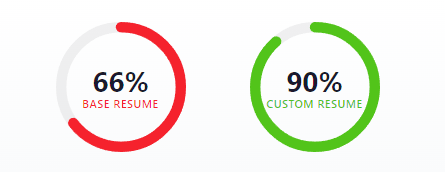
Every job in the Job Tracker has a Match %, and the table can be sorted by it. The Job Fit Report behind it rates your match from 0 to 100, in green (80% and above), orange (70 to 79%) or red (below 70%). When you’ve made a tailored resume for the job, the report shows your Base Resume score and your Custom Resume score side by side, so you can see how much tailoring changed your fit before you apply.
The timing, read for you
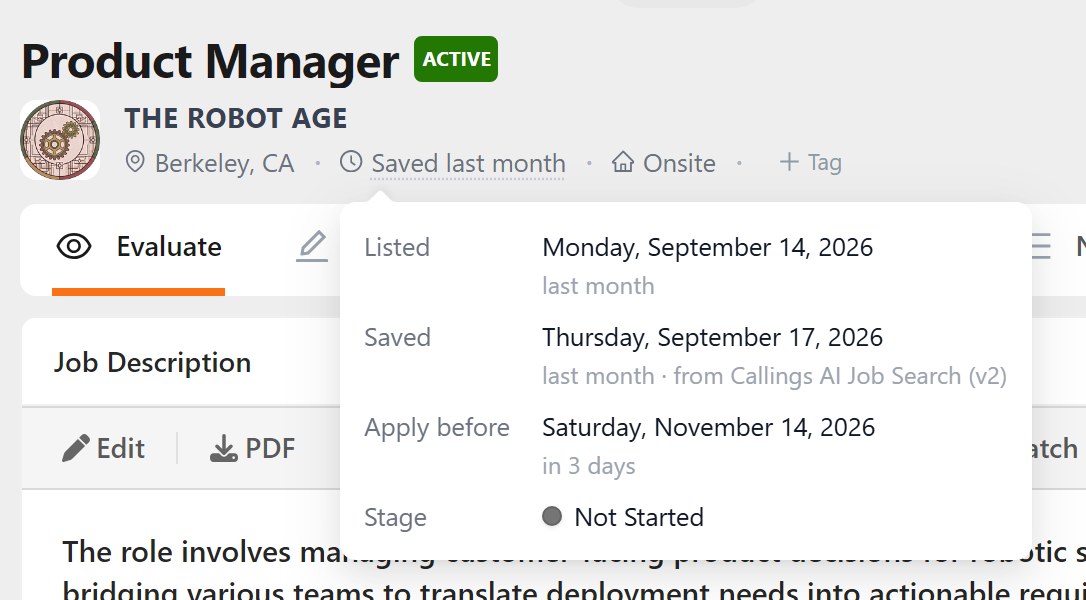
Each job’s page carries a timeline of its dates: Listed (when the employer posted the role, or Unknown when the posting carried no date), Saved, Applied, and Apply before, the application deadline, when the posting sets one. That’s the “days since posted” and “days until the deadline” of the method, without the bookkeeping.
Whether the job is still listed
Callings keeps track of whether each job you’ve saved is still listed, so you don’t spend an evening tailoring an application for a job that isn’t available anymore. A tag next to each job’s title says ACTIVE (the posting is still open), DELISTED (the employer took it down, it expired, or its page says the job is no longer available) or RELISTED (the job is still open, but on a new posting: the employer posted the same role again). Callings follows jobs saved from its listings on the job boards it reads, and reads the posting page of the jobs you see when you open your tracker, at most twice a day per job. Hovering a RELISTED tag tells you what changed: when the employer reposted the job on a job board, Apply shows the new link and the date of the repost; when the link you saved now opens the new posting, the tag says so.
The people to reach out to
You don’t need to know someone at a company already. For each job, Callings suggests specific people to reach out to, in the job’s networking targets: usually three to seven, among the team members in similar roles, the senior peers and managers, and the recruiters. They’re picked for how relevant they are to the role and for what you have in common, such as a school, a former employer or a mutual connection, with a link to each profile. You can also look up your own LinkedIn connections at the company, and draft the note to each person with Custom Outreach. Once you’ve written to someone, the contact shows it, which is the “wrote to someone there” of the method.
Introductions were one of the first things we built, and they’re still where I’d start.
Your interest, and your day
You can pin your top jobs so they stay at the top of the tracker, and keep the companies you care most about in Target Companies.
My Plan gives you a few tasks each day, such as applying to a job, following up on an application or writing to someone, so the method turns into a short list you can finish.
What we’re working on is putting it all together: ranking the applications in your daily plan along the lines of this method, so the jobs at the top are the ones that fit you, where you’ve reached someone or that you care about, and that were posted recently. Closed postings leave your list, and an aging job becomes a simple question: keep it or archive it.
Mistakes to avoid
- Racing to apply in the first hour with a generic application. You gain nothing on a team that reads in batches, and you lose the tailoring.
- Letting a great job sit for two weeks “until I have time.” The shortlist may be made by then. Block an evening for it this week.
- Waiting for the deadline. With rolling review, the job can close first.
- Applying to everything that’s fresh. Freshness multiplies fit; it doesn’t replace it.
- Applying cold when there’s someone you could write to. Find one person at the company, a peer, the hiring manager or the recruiter, and write to them first, or at the same time.
- Sending three applications to one company in one day. Pick the role you fit best, and mention your interest in the others to a person if you can.
- Ignoring hard requirements. No ranking makes a job worth it if you can’t legally work where it is.
- Never re-checking old postings. A 35-day-old listing may be closed, or reposted with a new link. (In Callings, the tag on each saved job tells you whether it’s still listed.)
Checklist
- ☐ My resumes, cover letter paragraphs and standard answers are ready before the next posting appears
- ☐ Job alerts and target companies’ careers pages tell me about new postings the day they appear
- ☐ I’ve ruled out jobs that are closed, past their deadline, too weak a match, or impossible for me (location, work permit, license)
- ☐ Each remaining job has a fit level, a note on who I know there and whether I care about it, and its timing
- ☐ My top jobs today are the highest priority, at most one per company
- ☐ Jobs with a deadline in two days or less are on today’s list
- ☐ For each of today’s jobs, I’ve found one person at the company and written to them, first or at the same time
- ☐ Postings older than 30 days are checked on the employer’s own careers page
- ☐ Every application I send today is tailored to its job
Frequently asked questions
How soon should you apply for a job after it’s posted?
Within the first few days, and ideally within two or three days for a job that fits you well. On one large job board studied by economists, almost half of all applications went to postings less than 48 hours old. Postings often stay up much longer (a month at the median on employers’ own sites, in our data), but teams start reading as applications arrive. You don’t need to apply within the first hour: what counts is being in the first batch the team reads, with an application tailored to the job.
Is it bad to apply on the first day a job is posted?
No, as long as the application is good. The risk of the first day isn’t the timing, it’s the rush: an application sent in an hour is usually generic. If you’re ready (resume, cover letter paragraphs, answers), the first day is fine.
Is it too late to apply for a job posted two weeks ago?
Often not. In our data, three in four postings on employers’ sites were still up two weeks after they were posted, and Princeton’s career office recommends applying within two weeks of the posting date. After that, check the employer’s own careers page to make sure the job is still open, and if you can, write to someone at the company so your application gets read.
Should I apply to a job posted more than 30 days ago?
If it’s still open on the employer’s site and you fit it well, yes: about half of postings are still up after 30 days. Just don’t let it jump ahead of fresh postings that fit you as well. Hiring takes about a month and a half from opening to accepted offer at the median, so a month-old posting may be in its final rounds, or may have been reposted because the first round didn’t work out.
Does applying early really increase your chances?
The research shows that most applications arrive in the first days and that many employers read in batches or as applications arrive, which is why career offices and economists recommend applying early. What’s less well measured is the size of the advantage: the often-quoted multipliers (“eight times more likely”) come from old or untraceable vendor analyses, so I’ve left them out.
What is the best day of the week to apply for a job?
There’s no reliable evidence that the day changes your odds. Most people apply early in the week (about 45% more applications per posting on Mondays and Tuesdays than on Fridays, in one large study), but what matters is how long the job has been posted, not the day you send your application.
Should I wait until I have a referral before applying?
Don’t wait long. Write to your contact and apply within a few days either way, and tell your contact once you’ve applied so they can put in a word for you. A referral is the biggest boost in the research, but a fresh posting won’t wait for it.
How long do job postings stay up?
About a month on employers’ own sites. In our job listings database, half of US postings on employers’ application systems were still up 30 days after they were posted, a quarter after 60 days, and about one in six after 90. LinkedIn postings came down faster (59% still up after two weeks, against 71% on employers’ systems over the same weeks), and on Dice, a job board, the median posting stayed up seven days. Hiring itself takes about a month and a half from opening to accepted offer at the median, so a posting can stay up while interviews go on.
Should you reapply when a job is reposted?
If you never applied, yes: treat it as a fresh posting. If you applied and heard nothing, write to someone at the company before you reapply, and say you’re still interested. If you interviewed, ask the recruiter where things stand first.
Should I apply to several jobs at the same company?
Apply to the one you fit best first. Recruiters at a company often see all your applications, and several at once can make your interest look unfocused. If two roles genuinely fit, mention the second one to a person there rather than sending a second application the same day.
Should I apply if I don’t meet all the requirements?
Usually yes, if you meet the hard requirements (license, work permit, location) and most of the rest. Postings often list more than a team strictly needs. In the Callings Job Tracker, a match of 70% or more is a good match; a red match deserves a second look at the requirements before you spend an evening on it.
What if the deadline is weeks away?
Apply as if there were no deadline: within the first days, if the job fits. With rolling review, applications are read as they arrive, and the job can close early.
How many jobs should I apply to per day?
Fewer than you think, and better ones. The method on this page gives you an order, not a quota: work down your list until you’ve sent the applications you can tailor properly today. For most people that’s a few a day, not dozens. (If you’re on unemployment benefits, your state may also require a number of work search activities each week: see my guide to work search requirements by state.)
How does Callings decide which jobs to show me first?
Today, the Job Tracker can be sorted by Match %, and My Plan suggests a few jobs to apply to each day from the jobs you’ve saved. We’re working on ranking those daily applications along the lines of this page: fit first, then the people you know and the companies you care about, then timing.
Research cited
- Application timing and posting durations on Dice: Steven J. Davis and Brenda Samaniego de la Parra, Application Flows, NBER Working Paper 32320, 2024; the earlier version summarized by the University of Chicago, 2017
- How long postings stay up on employers’ sites and LinkedIn: Callings job listings database, US postings first seen June 1 to September 30, 2026 and followed to November 8, 2026, plus a second sample of postings from October 27 to 31, 2026 followed to November 10 (method in How long do job postings stay up?)
- Applying early and applicant counts: Andrey Fradkin, Monica Bhole and John J. Horton, Competition Avoidance vs. Herding in Job Search, Management Science, 2025, and the interview with Fradkin by Boston University, 2025
- Time to fill: SHRM 2025 Recruiting Benchmarking
- Batches and rolling review: Princeton University Center for Career Development; Yale School of Management Career Development Office, 2025
- Applying within the first hour: Alison Green, Ask a Manager, August 2025
- Requirements: Georgetown University Cawley Career Education Center
- Referred candidates’ interview and offer rates: Ashby, Talent Trends Report: Referrals, May 2025
- Referral hire rates: Gem, 2026 Recruiting Benchmarks Report
- Weak ties: Science, 2022, summarized by the MIT Initiative on the Digital Economy
- The LAMP list: Steve Dalton, The 2-Hour Job Search, second edition, 2020
- Remote jobs and applications: LinkedIn data reported by Fortune, January 2024
Last word
The question “which jobs should I apply to first?” has a better answer than “the newest ones.” Apply early, yes, but to the jobs that fit you, at the companies you care about, and wherever you can, with someone inside you’ve reached out to.
In From Applying To Being Found, I wrote that “in a market full of polished sameness, being found matters more than applying well.” Ranking your applications is how you make sure the ones you do send count.
So here’s my advice, feature or not: tonight, list the jobs you’ve saved, rule out the ones you shouldn’t take, and rank the rest. Apply to the top three this week, and write to one person at each company.
If something on this page is wrong, out of date, or missing a study you’ve found useful, please send me a note. I’d rather fix the page than have you rely on something that’s no longer true.
Happy job hunting!
Philippe
Update log
- November 11, 2026: Added our own data on how long job postings stay up (142,000 US postings followed for up to five months, by field, seniority, work arrangement and month, with five charts), and updated the answers that relied on a single job board’s numbers.
- November 10, 2026: First version. Research and career office pages checked the same day.