People
People is your personal CRM for the job search: everyone you meet in one place, ready to reach out to. People you added yourself, recruiters, contacts attached to jobs in your tracker, and contacts at your target companies all live in one list, which you switch between with the tabs and narrow with the search box.
Find it under Networking > People.
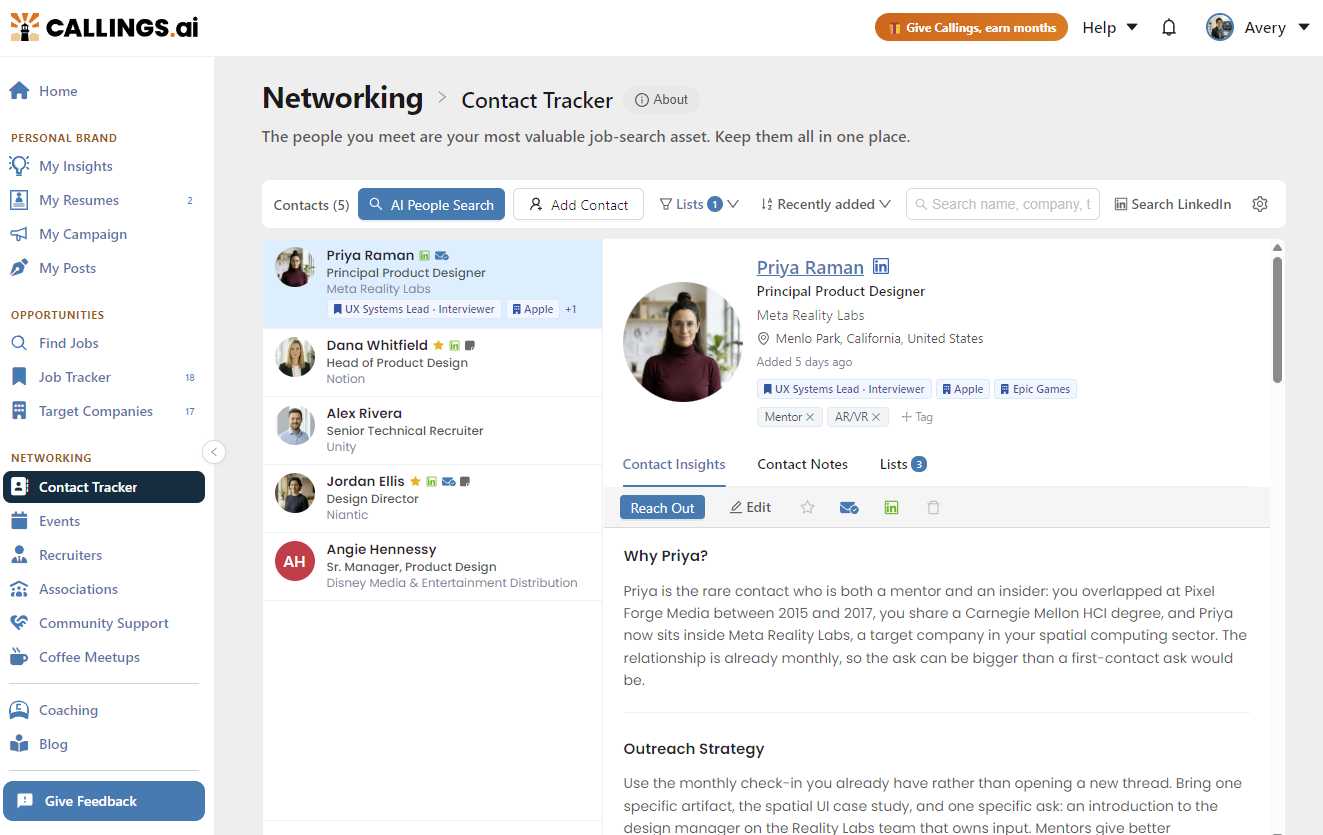
The Layout
The page is a two-pane workspace under a tab strip and a toolbar:
| Area | What it holds |
|---|---|
| Tabs | Who the page is showing, with a count on each |
| Toolbar | Add and find people, plus everything that narrows the list |
| Left pane | The people themselves, one row each |
| Right pane | The selected person's record: insights, notes, and lists |
Selecting a row opens that person on the right. The first row opens automatically, so the record pane is never empty beside a full list.
The Tabs
The tabs decide who the page shows. There are five, and one is open at a time:
| Tab | Who is in it |
|---|---|
| All | Everyone, whichever lists they are in. Somebody in three lists still appears once |
| My contacts | People you added yourself: the form, a LinkedIn URL, the browser extension, AI People Search |
| Recruiters | Recruiters you kept, plus any the recruiter search proposed, plus anyone you filed as a recruiter from their record. See The Recruiters tab |
| Job contacts | People attached to a job in your Job Tracker. Anyone interviewing you is here too, with an Interviewer chip on their row; type interviewer in the search box to see only them |
| Company contacts | People attached to a company on your Target Companies list |
A person can be in several lists at once: a recruiter can sit on a tracked job and be someone you added yourself. Each tab counts only the people in it, and All is where you see everyone together.
The page opens on My contacts, so a new account starts empty until you add someone. It remembers the tab you left it on.
The Toolbar
| Control | What it does |
|---|---|
| AI People Search | Describe who you want to meet in plain words and get real people back. See AI People Search |
| Add Contact | Paste a LinkedIn URL and we fill in the profile, or enter the details yourself |
| Group | Collects the list under the job or company each person is attached to. See Grouping |
| Show | The two switches for people the list normally hides. See The two switches |
| Sort by | Recently added, Name, or Company. The Recruiters tab adds Best match, and a grouped list is sorted by group instead |
| Search | Free text plus filter chips. See Searching and Filtering |
| Search LinkedIn | Describe anyone in plain words and we open the matching LinkedIn people search |
On the Recruiters tab the first three buttons change to the ways of finding recruiters; everything after them stays the same. AI People Search and Add Contact are not offered on Job contacts or Company contacts: people arrive on those tabs by being attached to a job or a company, so somebody added there would land on a different tab than the one you are looking at.
The list has no page numbers. It loads twenty people at a time and fetches the next twenty as you reach the bottom.
Grouping
On Job contacts and Company contacts the list is grouped when you arrive, because everyone on those tabs is there through a job or a company, and that is usually how you want to work them: one job at a time.
A grouped list shows the jobs or the companies first, each with the company logo, the number of people attached to it and a few of their faces. Click one to open it and see just those people; All groups at the top takes you back.
- The Group checkbox turns it off and on, and each tab remembers its own answer. Turning it off on Job contacts leaves Company contacts grouped.
- While a list is grouped, Sort by orders the groups: Recently active (where you last added somebody), Name, or Most contacts. Turn grouping off and it goes back to ordering people.
- The header reads something like "17 groups, 102 people". Those are two separate counts. Somebody attached to three of your tracked jobs appears under all three, so the numbers on the groups add up to more than the number of people, and that is correct.
- All, My contacts and Recruiters are not grouped: nobody on those tabs got there through a job or a company. Sorting by Company is the closest equivalent there, and it orders people by where they work.
The two switches
The Show menu holds two switches for people the list normally hides:
- Include suggested adds the people we proposed for your jobs, companies and recruiter searches. They show with a dashed tag and Keep / Ignore buttons until you decide.
- Include archived brings back anyone you archived.
Both add people rather than filtering them out, which is why they are switches and not filter chips. When either is on, the Show button says so.
The Recruiters tab
Recruiters are contacts like everyone else here, so they get the same rows, the same record and the same notes. What the tab adds is the ways of finding them and the match grade behind them.
| Control | What it does |
|---|---|
| Find Recruiters | Search external recruiters and search firms against a resume, or with words of your own ("healthcare recruiters in Chicago") |
| Add Manually | Add a recruiter from a LinkedIn URL, or type their details |
| My LinkedIn Connections | Opens a LinkedIn search of your own connections, filtered to recruiters and search firms |
The first time you open the tab we read your primary resume and look for external recruiters and search firms that place people in your field. That runs once; after it, the tab is just your list.
In-house company recruiters are covered separately, on each job in your tracker. This tab is about agencies, search firms and independent headhunters.
Match grades
A recruiter surfaced by the search carries a grade for how well they fit your background: Top match, Excellent fit, Strong fit or Good fit. Where the pool is thin for your field we also show recruiters who matched on one axis only, labelled Industry match or Role match so you can see why they are there.
Sort by > Best match puts the list in that order. Recruiters you added by hand have no grade (there is no resume comparison behind them) and stay at the top.
Open a recruiter and their record carries a What they place section: the kind of firm they work for, the industries and specialties they recruit in, and the levels they place at. Reach Out on a recruiter drafts recruiter-specific outreach: an email, a LinkedIn message and a connection note.
Searching and Filtering
The search box is also the filter control. Type a name, company or title to search, or click it to add filter chips:
| Chip | Shows |
|---|---|
| Favorites | People you starred |
| Reached out | People you have already contacted |
| Not yet reached out | The people still waiting on a first message |
| Connected on LinkedIn | People you are connected to |
| Has notes | People you have written a note on |
Every chip narrows the list, and they combine with whichever tab is open.
Filtering by tag
Type tag: followed by a value to filter by one of your own tags, for example tag:Mentor. Tags with spaces need quotes: tag:"Conference 2026". Matching ignores case, and the box suggests tags you already use as you type.
Tags
Tags are your own labels on a person, free-form rather than a fixed list. Add them when you add or edit someone, or straight from the header of their record, under their name. Anything works: Mentor, Conference 2026, Warm intro, Follow up in Q1.
Tags replace the old Group dropdown. Existing group values were carried over as tags, so nothing was lost, and you can now rename or delete them.
Reading a Row
Each row shows the person's name, their title, and their company on its own line, plus small markers:
| Marker | Meaning |
|---|---|
| Star (gold) | A favorite |
| LinkedIn (green) | Connected on LinkedIn |
| Envelope (blue) | You have reached out |
| Note (grey) | You have written a note on this person |
Under the name, chips show the context a person came with. The icon says which list, the text says which record:
- A bookmark plus a job title: attached to that job in your tracker.
· Intervieweris added when they are interviewing you for it. - A building plus a company name: attached to that target company.
- A person plus Recruiter: one of your recruiters, with their match grade beside it.
Click a chip to open the record it names: a company chip opens that target company, a job chip opens the job's networking tab, and a job chip marked · Interviewer opens the job's Interview tab with that person selected, ready for interview prep. When someone has more than two, a +N opens their Lists tab.
The Record
The right pane opens with the person's name, role, company, location, when you added them, and their tags. Under the tabs sits an action bar: Reach Out to draft a message, then edit, favorite, mark reached out, mark connected on LinkedIn, and delete. The same actions live on each row's Menu in the list, so you can work through the list without opening anyone.
Contact Insights
An AI read of the person: their networking profile, how easy they are to reach, what they value, and a suggested angle for your first message, plus their work history. On a recruiter it also carries What they place.
Contact Notes
Everything you have written about this person. Notes you write are yours; the AI's outreach drafts and research are kept separately and do not count toward the notes marker on the row.
Lists
Which lists this person is in. All four are switches:
- My contacts and Recruiters you set directly. Filing someone as a recruiter puts them on the Recruiters tab and switches their outreach drafts to recruiter wording.
- Job contacts and Company contacts follow what the person is attached to. Each row names every one of them, as the same chips you see under their name, and clicking those chips opens a picker: tick the jobs (or the target companies) they belong on, all in one pass. Each ticked job carries an Interviewer checkbox for when that person is interviewing you, which shows on the job's chip.
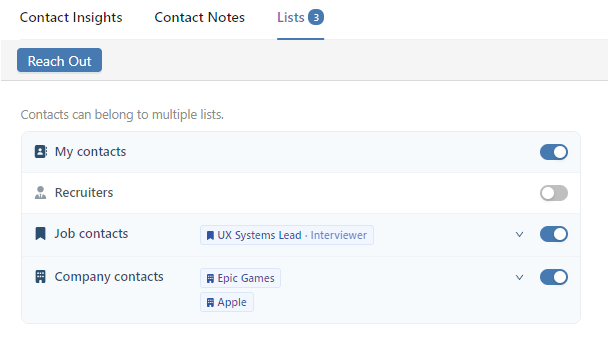
Turning one of the two picker switches off removes them from every job or company at once, so it asks first and tells you how many.
AI People Search
AI People Search finds real people from a sentence, without you filling in a form. Describe who you want to meet the way you would ask a friend, and your own details are used only when your sentence refers to them.
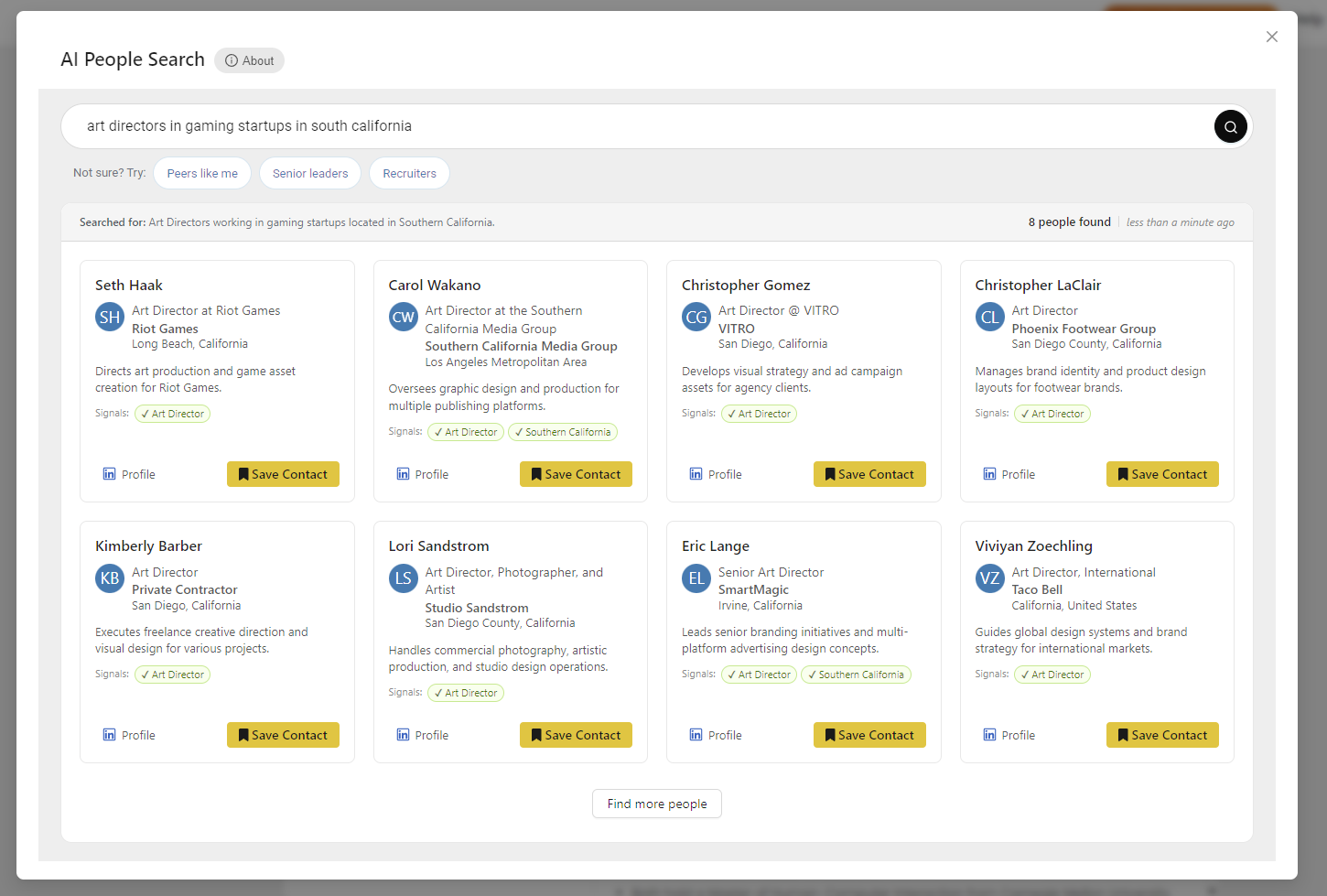
What you can ask for:
- A person by name: "Jane Doe", "Jane Doe at Stripe"
- A kind of person: "heads of design at healthcare startups in Boston"
- People relative to you: "peers like me", "someone who could hire me", "recruiters who place people with my background". Worked out from your resume, so you never spell out your own titles.
- People for a job you're tracking: "the hiring manager for the Product Manager job at Apple". Your Job Tracker supplies the real title and company.
- People who share your history: "alumni who work at Apple", "anyone senior at IBM who worked where I used to". From the schools and employers on your resume.
The Searched for line above the results says how your sentence was read and names anything of yours that was used. If it looks wrong, reword it and search again.
Find more people runs the same search again and adds anyone new. Changing the wording gives you a fresh set instead. Your last search is kept, so reopening comes back to where you left off.
Save Contact adds someone to My contacts with their LinkedIn profile filled in, ready for notes and outreach.
Reaching Out
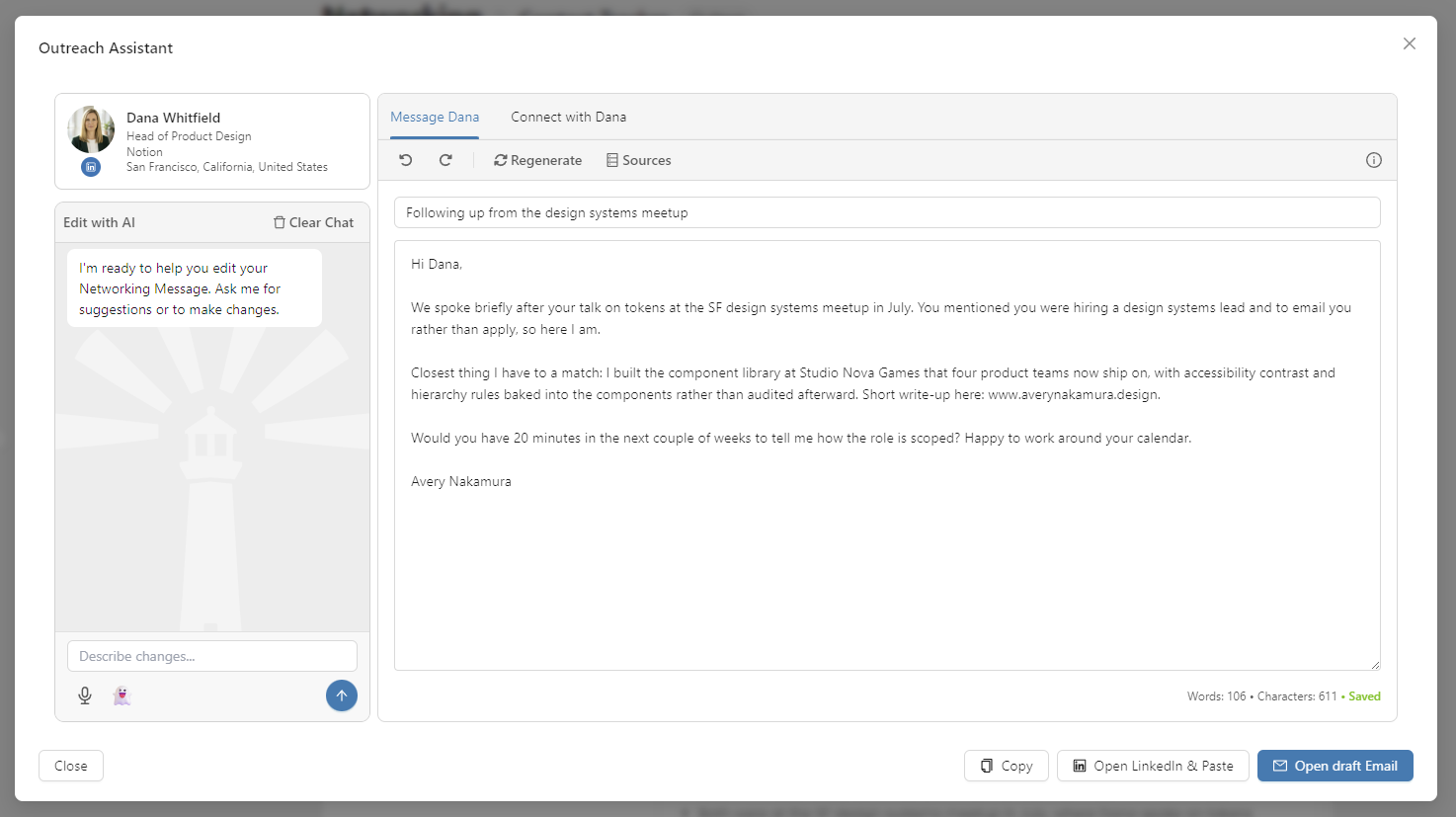
Reach Out on a record drafts a personalized message using what we know about them and about you. Recruiters get their own draft, written for a headhunter rather than a peer. For messages outside this page, or for anyone not in your list, use Custom Outreach.
Frequently Asked Questions
Q: Which parts need a subscription?
A: The features that look people up or write for you: adding a contact from a LinkedIn URL, AI People Search, Find Recruiters and Add Manually on the Recruiters tab, Email Lookup, Contact Insights, and Reach Out. Adding and editing people by hand, tags, lists, notes, search, and Search LinkedIn are free.
Q: What happened to the Recruiters page?
A: It is the Recruiters tab here. Your recruiters were always contacts, and everything on the old page came with them: your notes, your favorites, who you had reached out to, the match grades, the recruiter search, and the recruiter outreach drafts.
Q: Why does the count on a tab not add up to the count on All?
A: Because the lists overlap. A recruiter who also sits on a tracked job is counted on both tabs and once on All.
Q: I filed someone as a recruiter. Did that change anything else?
A: They joined the Recruiters tab, and their outreach drafts switch to recruiter wording. They stay in every other list they were already in.
Q: What happens when I turn off Job contacts or Company contacts on a record?
A: They are detached from every job (or every target company) at once. The switch asks first and tells you how many attachments it is about to remove.
Q: Where do suggested people go when I ignore them?
A: The suggestion is dropped from the job or company that proposed it, and the person stays out of your lists. Turning on Include suggested in the Show menu shows the whole proposed pool, decided or not.
Related
- Recruiters: the recruiter search in full
- Networking Targets: contacts suggested for one specific job, from inside that job's page
- Custom Outreach: draft a message for any recipient and any channel
- Target Companies: the companies whose contacts land in Company contacts