Market Fit Report
The Market Fit Report is a comprehensive AI-generated career intelligence report that analyzes your professional profile against current and emerging market conditions. It provides a strategic view of your career as a dynamic asset, showing where you fit today, where opportunities lie tomorrow, and how to position yourself for long-term success.
Unlike job-specific reports that focus on a single role, the Market Fit Report takes a macro view of your entire career. It examines your historical market fit, forecasts your alignment with future trends, identifies risks you may not be aware of, and delivers actionable recommendations for career positioning.
Why This Report Exists
Most job opportunities never get posted. Research consistently shows that 70-85% of jobs are filled through networking, referrals, internal promotions, and industry relationships, not through applications to open job listings. Only 15-30% of positions are ever publicly advertised on job boards.
And it gets worse: of those visible listings, roughly 30% are "ghost jobs": postings that aren't real openings, are already filled, or exist only to collect resumes for future needs. This means the actual accessible job market through traditional applications is even smaller than it appears.
Learn more about the hidden job market: - Job Seekers: Four Reasons To Embrace The Hidden Job Market, Forbes - The Hidden Job Market in Tech: Your Complete Career Guide to Unadvertised Job Openings, CIAT
This creates a fundamental challenge: How do you find a job that doesn't officially exist?
If you're like most professionals, you've spent years focused on excelling at your job, not learning how to search for one. When you suddenly need to find a new role, you're navigating unfamiliar territory:
- Where's my relevance? What do I actually bring to the market?
- What does the market need? And how do I connect who I am to what's in demand?
- How do I learn about a market I don't know? Beyond my company and maybe some competitors, it's all a bit nebulous.
- What is market positioning? Terms like "hidden market" and "market fit" are things you only learn from expensive coaches or extensive reading.
The Market Fit Report is designed to answer these questions. It's anchored in macro-economics, geopolitics, policy trends, and job market evolution for your specific background and location. It provides the market intelligence that professionals typically only access through career coaches, but personalized to your resume, your experience, and your situation.
Accessing the Market Fit Report
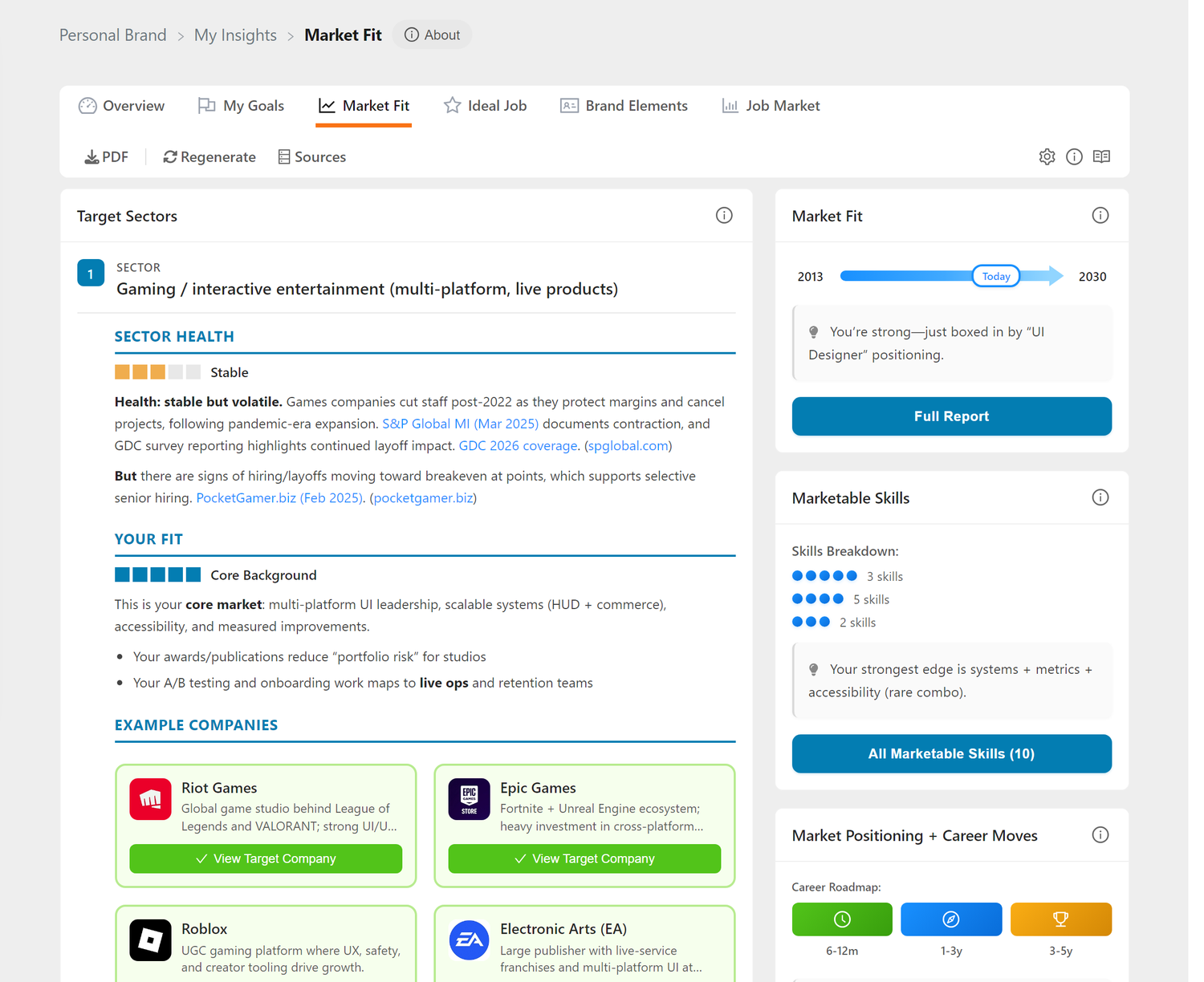
The Market Fit Report is located in My Profile → My Insights. From the My Insights landing page, click the View Market Fit button on the Market Fit card to access your report.
First-time users: You'll see a prompt to generate your first Market Fit Report. Click Generate Market Fit Report to begin. Generation takes 2-3 minutes, and you can leave the page and return when it's ready.
Returning users: Your most recent report is displayed automatically. Use the Regenerate button to create an updated report based on your current profile.
Report Structure
The Market Fit Report is organized into eight sections, accessible via side navigation:
| Section | Purpose |
|---|---|
| Market Fit | Historical and forward-looking fit analysis |
| Market Risk | Career risks and areas requiring attention |
| Marketable Skills | Your top skills ranked by market demand |
| Market Positioning | Strategic positioning options for your career |
| Target Sectors | Industries that match your profile |
| Career Moves | Near-term, medium-term, and long-term opportunities |
| Dig Deeper | Hidden opportunities and overlooked strengths |
| References | Recommended reading and sources cited |
Market Fit
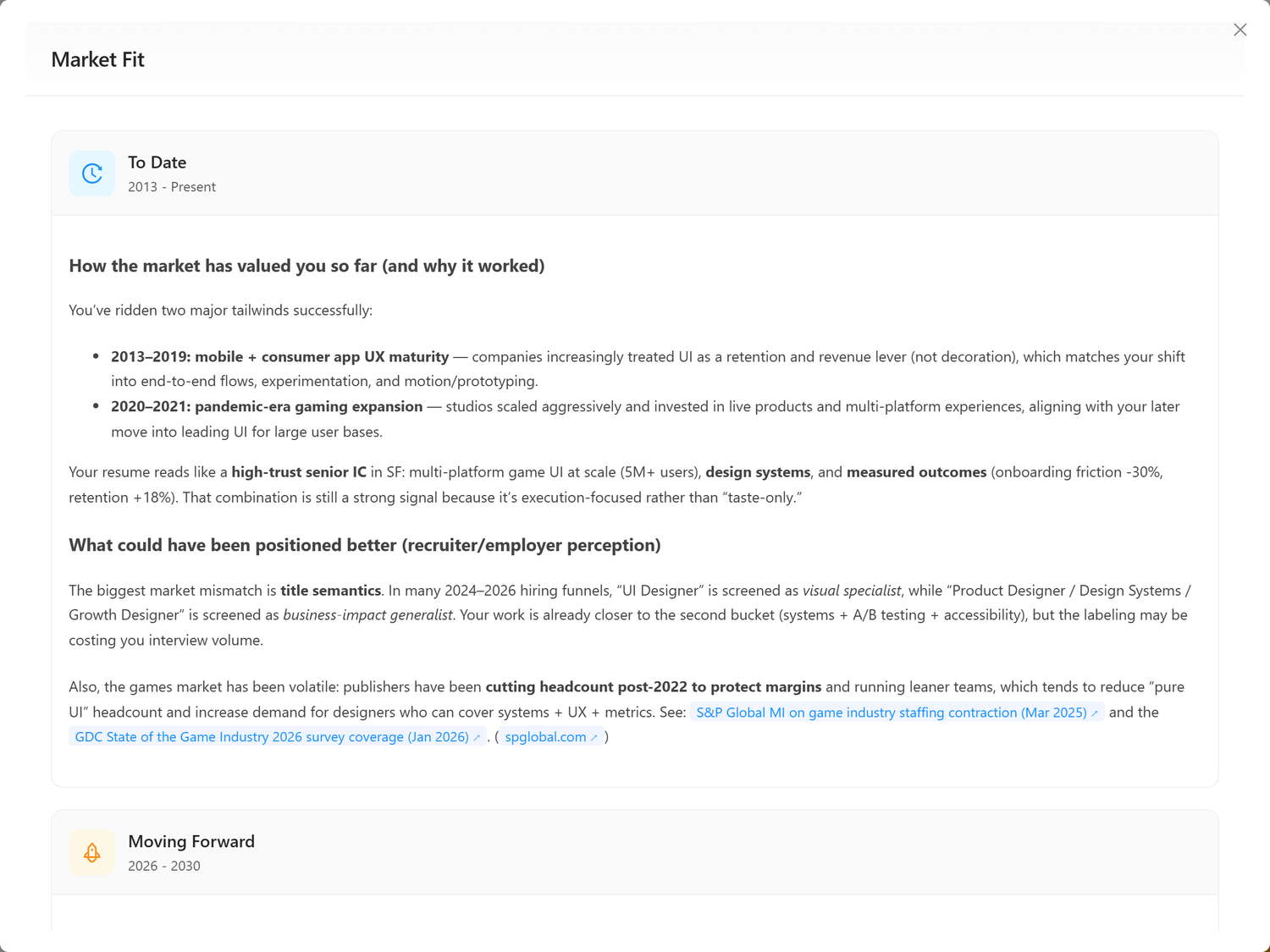
The Market Fit section provides a two-part analysis: your historical market fit and your forward-looking alignment with emerging trends.
To Date
The "To Date" analysis reviews your past roles and experiences, placing each within its economic and market context at the time. It explains:
- Why certain roles were good fits: Understanding why you had that job and that role in context
- What market environment existed: Economic conditions that shaped your career decisions
- Why decisions made sense at the time: Reframing your career moves as strategic responses to market conditions
This analysis helps you understand the fluidity of market fit: your alignment with the market has evolved throughout your career based on external forces, not just your choices. It reframes your career history as a dynamic relationship between you and the market, not a series of isolated job moves.
Example: The report might explain that your role in enterprise software made sense in 2018 because digital transformation spending was at a peak, or that your pivot to healthcare tech aligned with increased funding in that sector. This context helps you, and others, understand the why behind your trajectory.
Moving Forward
The "Moving Forward" analysis examines how your skills and background align with current and emerging market trends over the next 4 years. It identifies:
- Skills that are increasing in demand: Where your background positions you well
- Areas to focus on or double down: Strategic investments of your time and energy
- Skills or domains that may become less relevant: Potential headwinds to monitor
Each insight is grounded in market signals to help you make informed decisions about your career direction.
Learn more: Where relevant, the report includes links to articles, papers, and industry reports so you can explore topics in greater depth.
Market Risk
The Market Risk section identifies potential vulnerabilities in your career positioning that could affect your marketability.
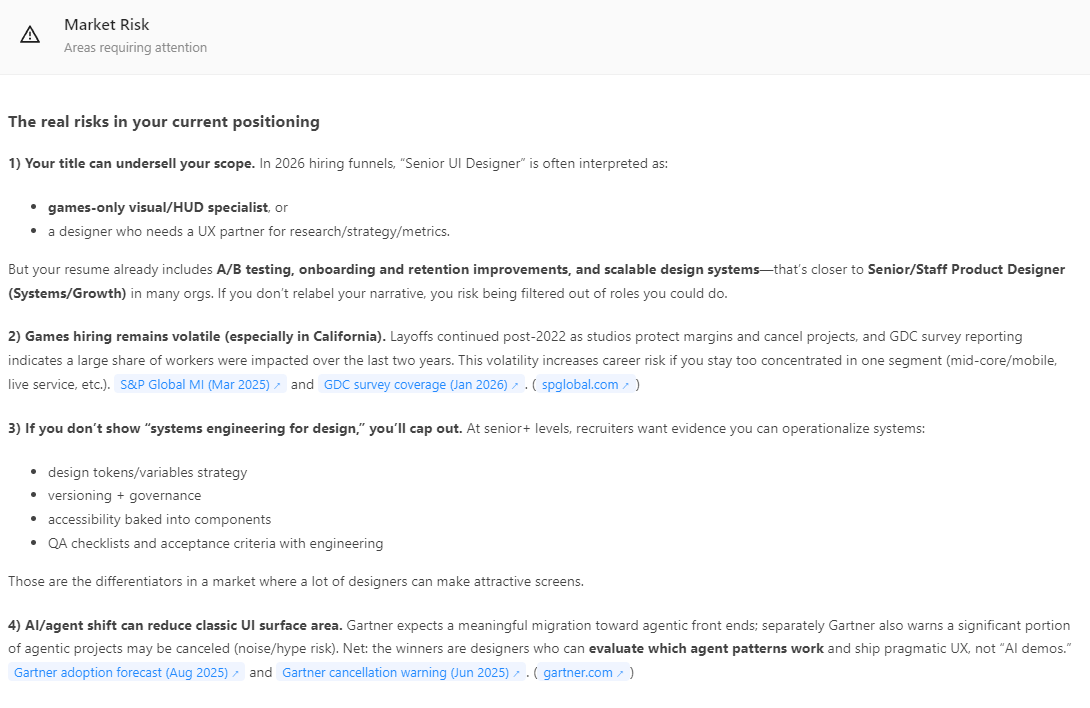
This section analyzes risks related to:
- Outdated positioning: Labels and messaging that worked five years ago may not resonate today
- Market misperception: How employers might misunderstand or undervalue your profile if you don't communicate properly
- Skill obsolescence: Technologies or methods that may be declining
- Over-specialization: Being too narrowly focused in a changing market
- Industry headwinds: Sectors facing structural challenges
Why this matters: The market evolves constantly. Your positioning and messaging need to evolve with it. A label that made you highly desirable in 2020 might make you seem outdated in 2026. The Market Risk section helps you identify where your current narrative might be creating friction with the market, before you hear "no" in an interview.
Marketable Skills
The Marketable Skills section identifies your top 10 skills ranked not by how prominently they appear in your resume, but by how much the market is looking for them.
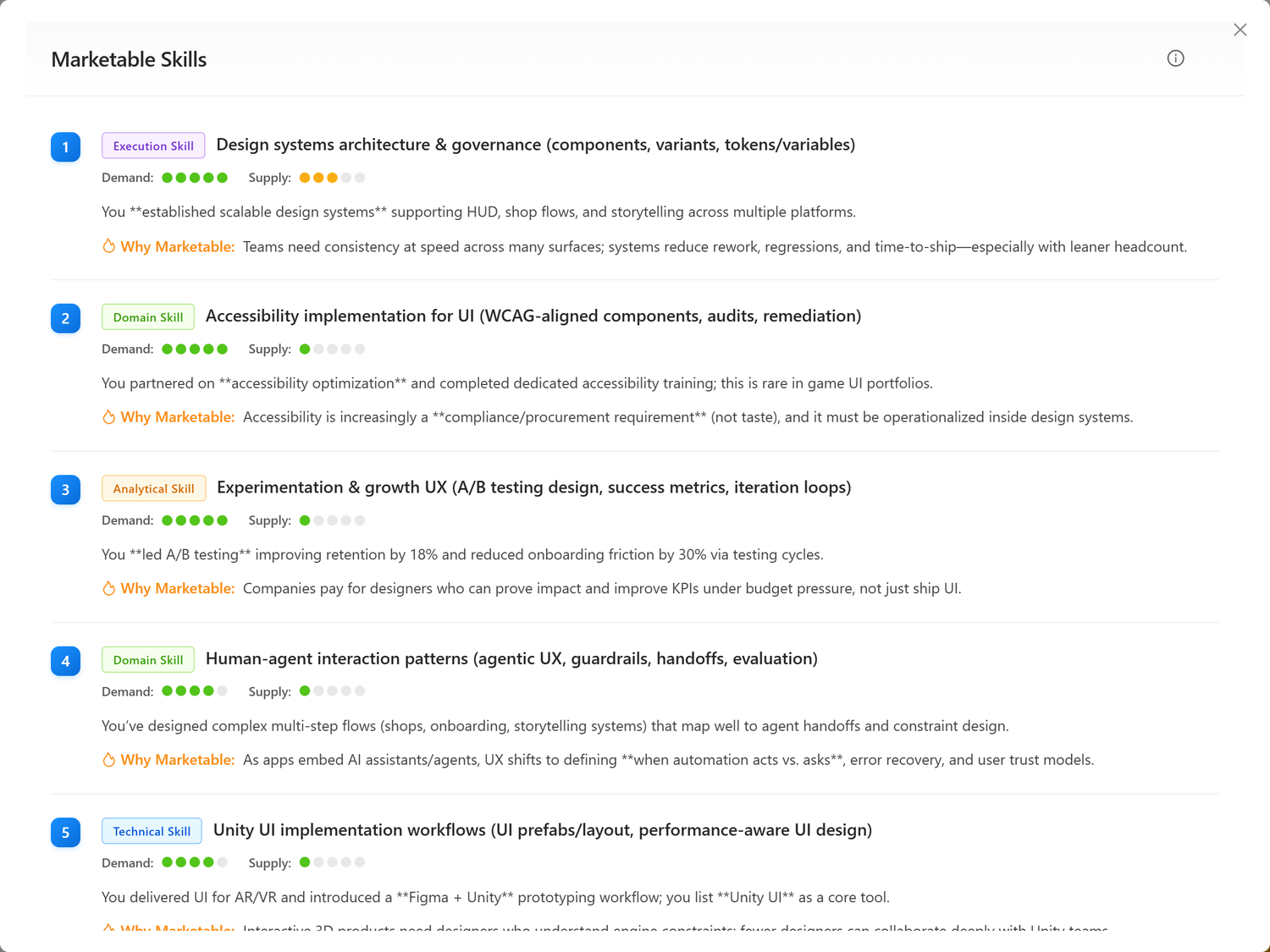
This isn't a simple keyword extraction. The analysis:
- Reads through the lines of your experience to identify implied capabilities
- Takes the market's perspective: If we give the AI all the pieces, all the words, and all the readings between the lines of your background, which skills would the market prioritize?
- Filters for you: These are skills the market is actively seeking that you have
For each skill, the report provides:
| Field | Description |
|---|---|
| Rank | Position based on market demand relevance |
| Skill | The capability or skill cluster |
| Evidence | Where this skill appears in your background |
| Why Marketable | Market forces driving demand for this skill |
| Market Demand | Visual indicator (1-5 dots) of current demand level |
Beyond What's Obvious
Your resume might prominently feature "project management" because that was your job title. But this analysis might surface that your experience with "cross-functional stakeholder alignment" or "legacy system migration" is actually more in-demand right now.
The goal is to help you understand: - What to lead with in applications and interviews - Terms the market uses that you might not be using - Skills you may be underselling because they seem ordinary to you
How to use this section: - Lead with high-demand skills in applications and interviews - Consider investing in skills with rising demand - Learn the language the market uses for capabilities you already have
Market Positioning
The Market Positioning section proposes three strategic positioning options: different ways you could frame and present your professional identity to the market.
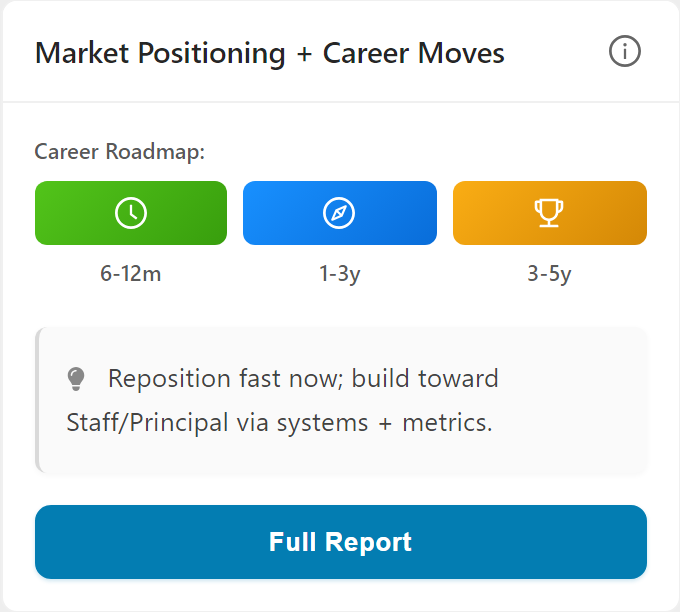
Each positioning option includes:
- How to brand yourself: The narrative frame for your professional identity
- Which narrative to lead with: What you emphasize first when introducing yourself
- What roles or value propositions to emphasize: The specific angles that resonate with different audiences
From Understanding to Action
The earlier sections help you understand the market. This section helps you do something about it. Market positioning is a concept many job seekers have never encountered: it's the kind of strategic thinking usually reserved for executive coaching.
The three options are: - Actionable: You could adopt one of these positions today - Thought-provoking: Designed to help you think about positioning as a concept - Mergeable: You might combine elements from multiple options to create your own
Why multiple options? Different contexts call for different positioning. A startup might respond to "builder and innovator," while an enterprise might prefer "seasoned leader with scale experience." Having multiple positioning strategies ready helps you adapt your message to your audience.
Target Sectors
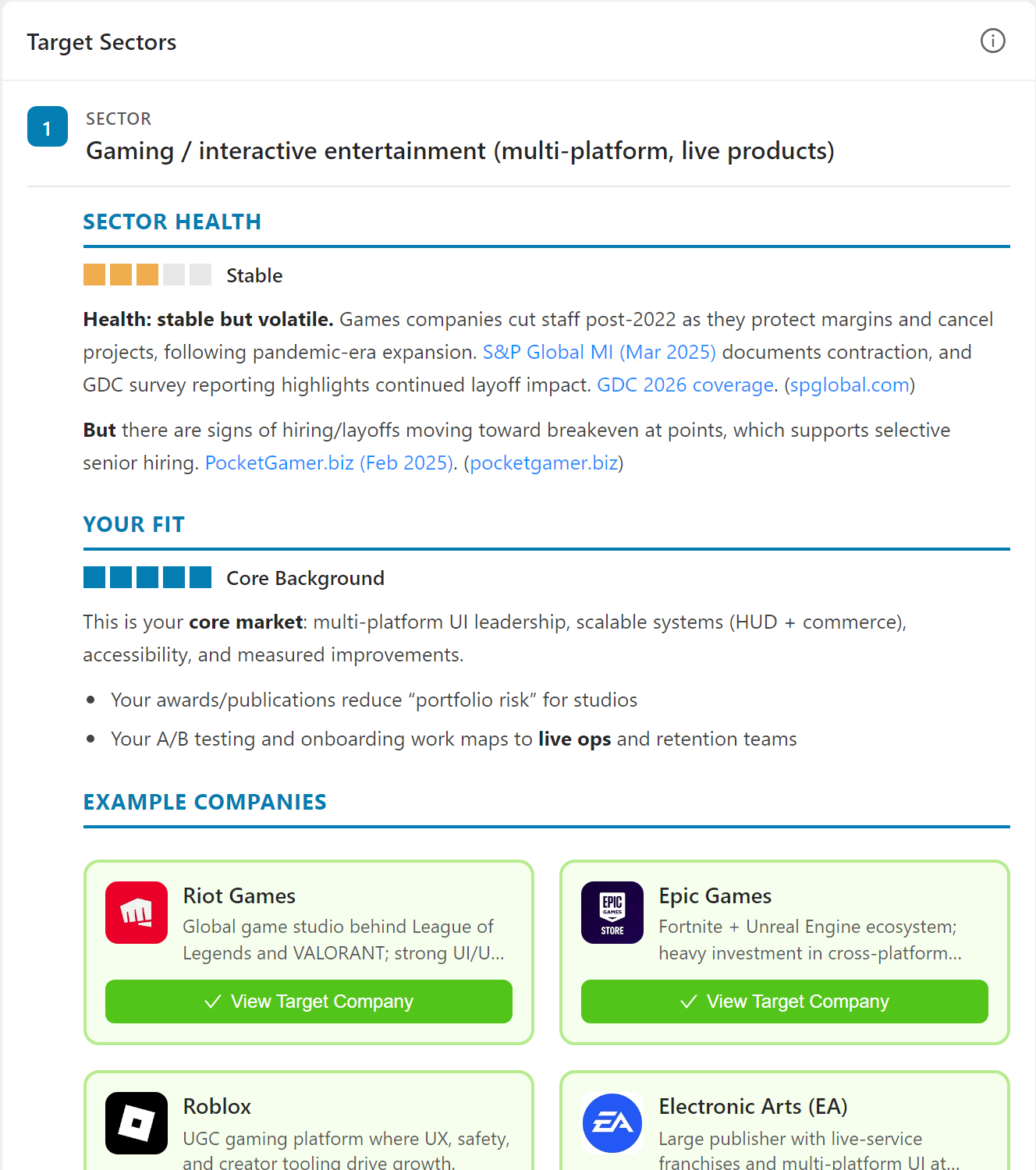
The Target Sectors section recommends five industries where you're likely to find strong interest based on your background and current market conditions.
Beyond the Familiar
Some sectors will be familiar, such as industries where you've historically worked. But the real value is in the peripheral markets: sectors you might not have considered but where your skills are in demand.
Example: If you've been a software developer, one sector might be education technology: have you considered teaching or curriculum development? If you've worked in non-profit, the report might suggest for-profit companies with social missions. These aren't random suggestions; they're based on analyzing where your specific skills are transferable and valued.
Each sector includes:
| Field | Description |
|---|---|
| Rank | Priority based on fit and opportunity |
| Sector | The industry or vertical |
| Why Hiring | Macro trends driving demand in this sector |
| Why Good Fit | How your specific background aligns with sector needs |
| Example Companies | Five companies selected because your marketable skills match what they need |
From Report to Action
This is where the report becomes truly actionable. Each example company is: - Selected specifically because your skills are relevant to what they do - A mix of company sizes and stages (established enterprises to specialized startups) - Clickable to add directly to your networking pipeline
Adding companies to your Target Companies list: Each example company displays a + icon. Click it to add the company to your Target Companies list in the Networking tab. From there, you can generate a personalized Company Report that explains why this specific company fits you: not generic company information, but a tailored analysis based on your background.
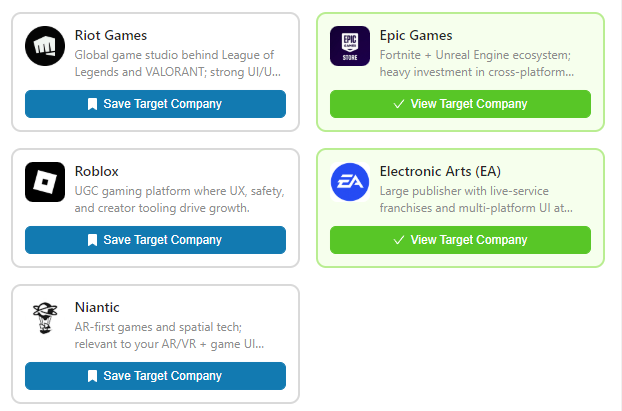
This creates a complete workflow:
Discover sectors → Identify companies → Add to networking pipeline → Generate company reports → Build relationships
Career Moves
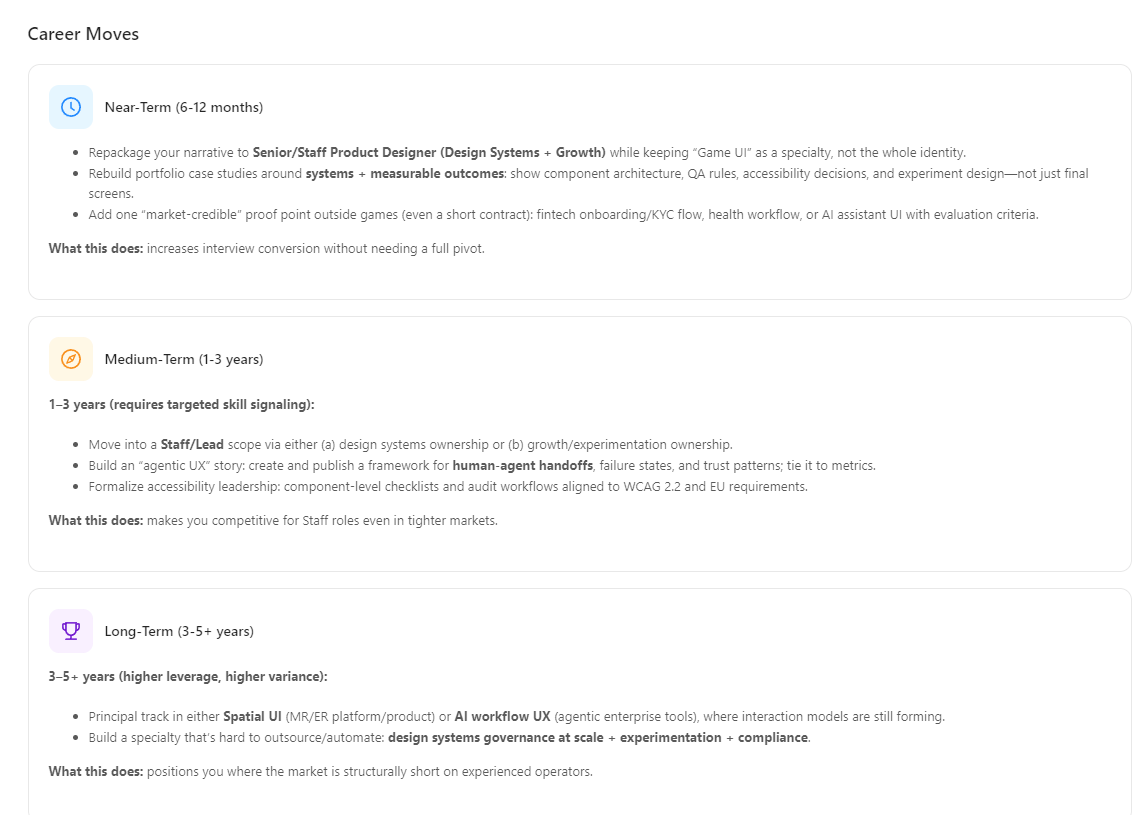
The Career Moves section provides a phased roadmap for navigating the market, whether you need to move quickly or want to take a more gradual approach.
Why Phases Matter
Not every career transition needs to be a dramatic leap. Sometimes: - A jump is too scary right now: You might need stepping stones - You're in a hurry: You need quick wins while building toward bigger goals - You're negotiating with yourself: Unsure whether to pivot or stay the course - You need to learn new skills first: A gradual approach builds credibility
The Career Moves section provides options for different timelines and risk tolerances.
Near-Term (6-12 months)
Immediate positioning and actions with high confidence and low risk: - Quick wins to improve your marketability - Skills to highlight or develop now - Roles to target in your current job search
Medium-Term (1-3 years)
Strategic progression and skill reinforcement: - Career moves that build toward longer-term goals - Experiences to seek that fill gaps in your profile - Industries or domains to explore
Long-Term (3-5+ years)
Target roles and market alignment: - Where you could be positioned in 5 years - The narrative arc of your career - Big bets worth considering
Why a phased approach? Career strategy isn't just about the next job: it's about building a trajectory. Each phase builds on the previous one, creating compound advantages over time.
Dig Deeper
The Dig Deeper section highlights gaps in your current thinking, areas you may be underexploring, undervaluing, or simply not seeing.
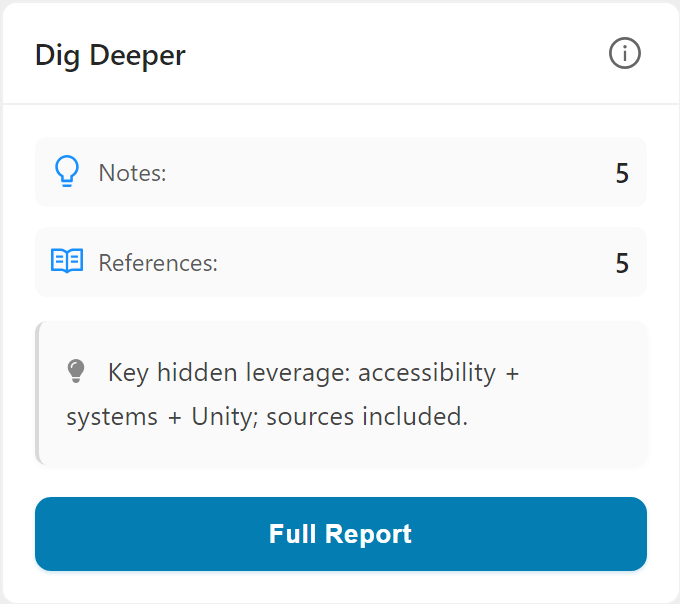
Common items include:
- Overlooked strengths: Capabilities you take for granted but others value
- Adjacent opportunities: Roles or industries you haven't considered
- Underutilized experiences: Background elements you're not leveraging
- Assumptions worth questioning: Beliefs about your career that may be limiting
- Topics worth investigating: Areas where deeper research could reveal opportunities
Why this matters: We all have mental models that shape how we see our careers. Sometimes those models have gaps. This section aims to surface what you might be missing.
References
The References section provides external sources for deeper exploration: curated reading materials and transparency about the data sources used.
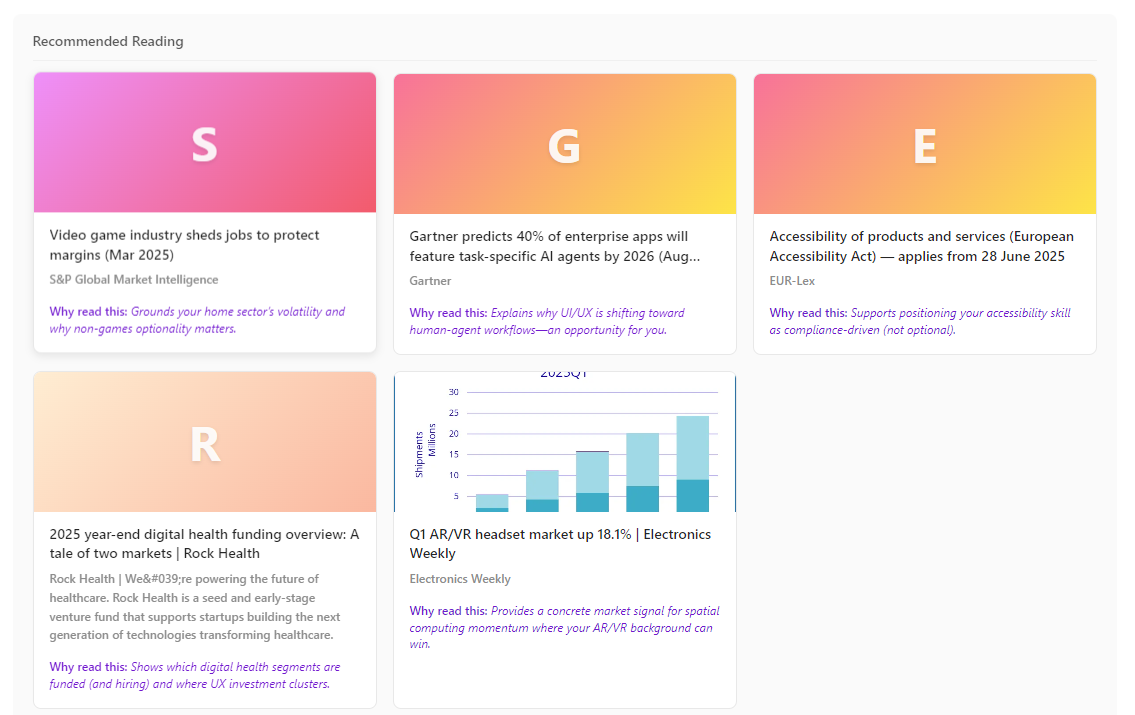
Recommended Reading
Five curated articles and reports that provide deeper context on trends affecting your career:
- Industry analyses: Sector-specific insights and forecasts
- Skills demand reports: What the market is hiring for
- Future-of-work predictions: How your field is evolving
- Funding and investment reports: Where money is flowing in your sectors
Example: If you have a healthcare background, you might see "Digital Health Funding Overview 2025" to help you quickly understand who the major players are and where investment is going. If you're in tech, you might see "Top Strategic Technology Trends for 2026."
These aren't generic career advice articles; they're selected to help you catch up quickly on the markets you'll be navigating.
Sources Cited
Links to the external sources referenced throughout the report, organized by the section where they appear. This provides:
- Transparency: You can see what data informed the analysis
- Deeper exploration: Drill down into topics that interest you
- Verification: Check the underlying sources yourself
Card Layout
The Market Fit Report is shown under the My Insights tab strip, with a toolbar above the content area.
Header Utility Icons
In the top-right corner of the card header:
| Icon | Purpose |
|---|---|
| ⚙️ Settings | Configure paper size for PDF exports |
| ℹ️ Info | Quick tips and usage guidance |
Card Toolbar
The toolbar provides quick actions:
| Button | Action |
|---|---|
| Download the full report as a formatted PDF document | |
| Regenerate | Generate a fresh report based on your current profile (requires subscription) |
Side Navigation
The left side of the content area displays navigation for all eight sections. Click any section name to scroll directly to that content. The active section is highlighted as you scroll.
Generating the Report
First Generation
- Navigate to My Profile → My Insights → Market Fit
- Click Generate Market Fit Report
- Wait 2-3 minutes for processing (you can leave the page)
- Return to view your completed report
Regenerating
Click Regenerate in the toolbar to create a fresh report. Regenerate when:
- You've updated your resume or questionnaire answers
- Your career goals have shifted
- Significant time has passed (market conditions change)
- You want fresh perspective on your positioning
Note: Regenerating replaces your current report. Download the PDF first if you want to preserve the previous version.
Download PDF
Click the PDF button in the toolbar to download your full Market Fit Report. The PDF includes all sections formatted for printing or sharing.
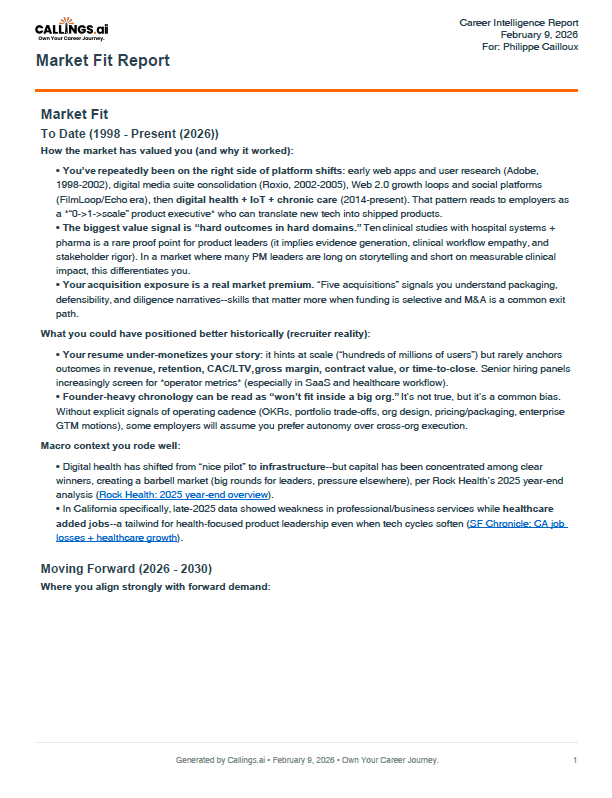
Use the PDF to: - Reference during networking conversations - Share with career coaches or mentors - Keep a snapshot of market conditions at a point in time - Compare with future reports to track evolution
Tips & Best Practices
Treat It as Strategic Input, Not Gospel
The Market Fit Report provides data-driven perspective, but your career decisions should factor in: - Personal values and priorities not captured in your resume - Network connections and relationships - Timing and life circumstances - Gut instincts about opportunities
Use the report to inform your thinking, not replace it.
Act on the Target Sectors
The report is most valuable when you act on it: 1. Review the Target Sectors with an open mind, including unexpected ones 2. Add companies that interest you to your Networking list 3. Generate Company Reports to understand fit at a deeper level 4. Build relationships with people at those companies
The path from insight to opportunity runs through action.
Use Positioning for Different Audiences
Different contexts call for different positioning: - Startups might value builder/innovator framing - Enterprises might prefer scale and stability narratives - Transitions might emphasize transferable skills
Adapt your positioning strategy to your target audience.
Revisit Periodically
Markets change. Your profile evolves. Regenerate your Market Fit Report: - Every 6-12 months for routine updates - After major career milestones - When entering a new job search - When considering a career pivot
Comparing reports over time reveals how your market position has evolved.
Address Risks Proactively
The Market Risk section isn't meant to discourage you: it's meant to prepare you: - For skills at risk of obsolescence, consider upskilling - For positioning unclear, refine your narrative - For over-specialization, seek breadth opportunities
Awareness of risk enables mitigation.
Frequently Asked Questions
Q: How long does the report take to generate?
A: Approximately 2-3 minutes. You can leave the page while it's generating, and the report will be ready when you return.
Q: What data is used to generate the report?
A: The report uses your primary resume and questionnaire answers. For the most accurate analysis, ensure your primary resume is up-to-date and complete.
Q: How is this different from the Job Fit Report?
A: The Job Fit Report analyzes your match with a specific job. The Market Fit Report analyzes your position in the overall market: a macro view of your career rather than a job-specific assessment.
Q: Can I edit the report content?
A: The Market Fit Report is read-only: it's an analytical output, not editable content. However, you can regenerate the report at any time to get updated analysis.
Q: How do I add companies to my Networking list?
A: In the Target Sectors section, each example company has a + icon. Click it to add the company to your Target Companies list, where you can generate personalized Company Reports.
Q: Is the report accurate about market conditions?
A: The report is based on AI analysis of current market trends and your profile. While it provides valuable perspective, market conditions are complex and constantly changing. Use it as one input among many in your career decisions.
Q: How often should I regenerate the report?
A: Regenerate every 6-12 months, or when your circumstances change significantly (new role, new skills, new career goals).
Q: What if I disagree with the analysis?
A: The report represents one perspective based on your resume and market data. You know your career best. Use the analysis as a starting point for reflection, not as definitive truth.
Q: Is this report useful for students or early-career professionals?
A: Yes! While the "To Date" analysis is most valuable for professionals with 4-5+ years of experience, the forward-looking sections (Market Risk, Marketable Skills, Target Sectors, Career Moves) are valuable at any career stage. The report adapts its analysis based on your experience level.
Q: Can this report teach me about job searching?
A: Absolutely. Beyond the personalized analysis, the report introduces job search concepts that many professionals never encounter, such as market positioning, the hidden job market, sector analysis, and phased career strategy. Many users find the report educational even beyond its specific recommendations.
Q: How do I use this with the rest of Callings.ai?
A: The Market Fit Report connects directly to other features. When you find interesting companies in Target Sectors, click the + icon to add them to your Target Companies list. From there, you can generate Company Reports and identify contacts at those organizations. This creates a complete workflow from market insight to networking action.
Related Topics
- My Insights Overview - Overview of all My Insights features
- My Goals - Define your career priorities
- Personal Branding - Articulate your professional identity
- Networking Targets - Build relationships at target companies
- Target Companies - Get personalized company analysis
When you lose your job or decide to make a change, you're suddenly navigating a world you may know little about. The hidden job market, market positioning, sector analysis: these are concepts most people only learn through expensive coaching or extensive reading. The Market Fit Report brings that strategic intelligence to you, personalized for your background, grounded in real market data, and designed to turn insight into action. Your career is a dynamic asset. This report helps you understand its current value and how to grow it.