My Goals
My Goals is a Callings.ai feature that helps you define and prioritize your career requirements across six dimensions (role type, work environment, location, compensation, culture, and industry) with AI-generated suggestions based on your resume that you can customize and tag by importance level (HIGH, MEDIUM, LOW) to evaluate any job opportunity.
The My Goals section helps you define and prioritize exactly what you are looking for in your next role. By clearly outlining your needs and wants, you can evaluate job opportunities with confidence and ensure they align with your career aspirations.
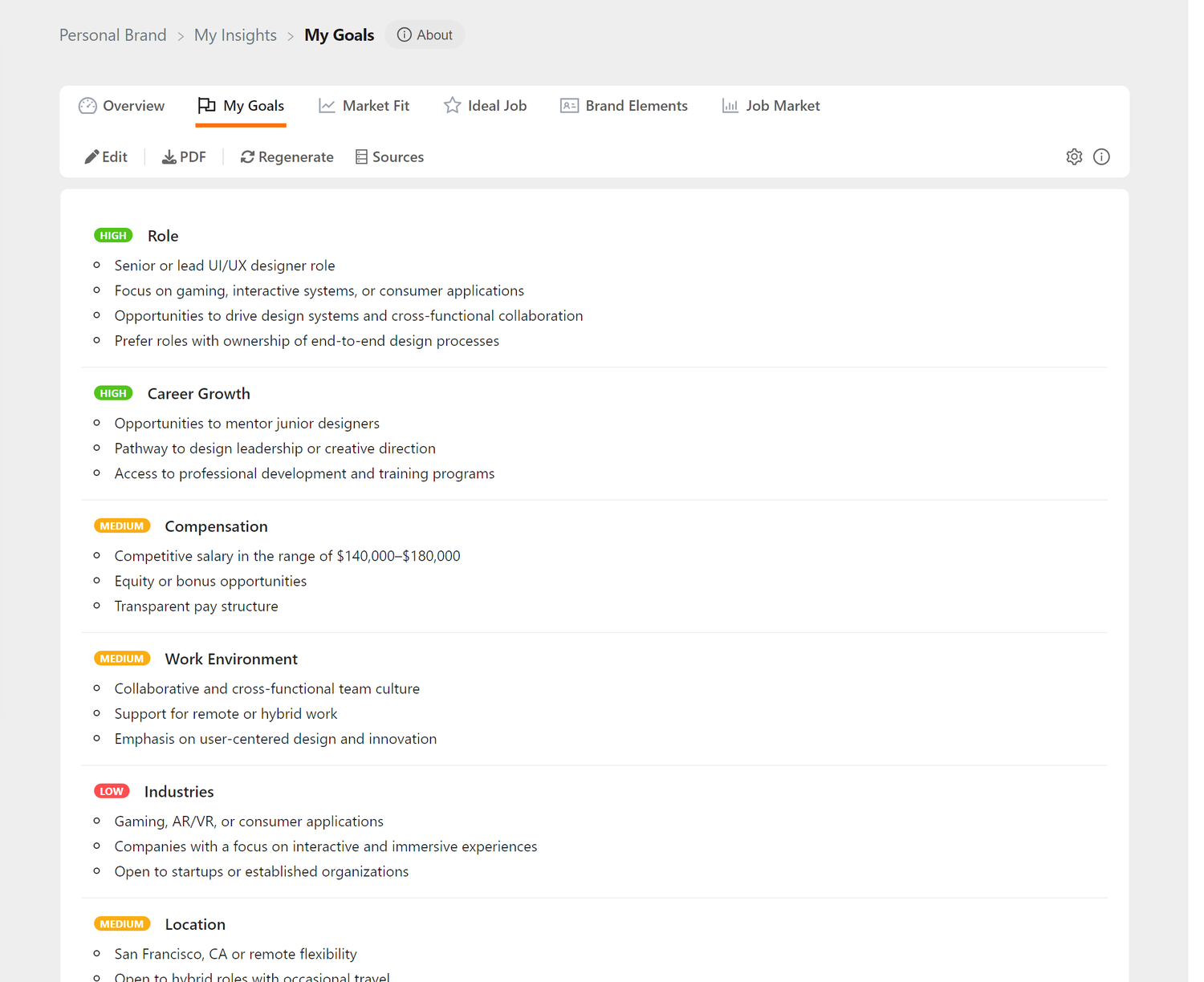
Card Layout
My Goals is shown under the My Insights tab strip, with a toolbar above the content area.
Header Utility Icons
At the right-hand end of the toolbar you'll find:
| Icon | Purpose |
|---|---|
| ⚙️ Settings | Opens a modal to configure paper size for PDF exports |
| ℹ️ Info | Opens a quick tips modal with usage guidance |
Card Toolbar
The toolbar provides quick actions:
| Button | Action |
|---|---|
| Edit | Opens the goal editor modal to customize all your goals |
| Download your goals as a formatted PDF document | |
| Regenerate | Generate fresh goals based on your current resume and questionnaire answers (requires subscription) |
| Sources | Shows which parts of your profile and resume the content was drawn from |
Click-to-Edit Content
The goals are displayed in a list format. Edit in the toolbar opens the full goal editor modal.
Understanding Your Goals
Your goals are organized into categories that cover all the key dimensions of a job:
- Role - The type of position, responsibilities, and seniority level you're targeting
- Work Environment - Team size, company stage, and cultural attributes you prefer
- Location - Geographic preferences and remote work flexibility
- Compensation - Salary expectations and benefits priorities
- Culture - Values, leadership style, and team dynamics
- Industries - Sectors and markets you're interested in
Each goal is tagged with an importance level (HIGH, MEDIUM, LOW) to help you stay focused on your most critical requirements.
Generated For You
To give you a head start, your goals are generated based on your primary resume and your answers to the My Goals Questionnaire. Our system analyzes your professional background along with your stated preferences to suggest a set of prioritized requirements that match your career aspirations.
Benefit: Start with intelligent defaults rather than a blank slate, saving hours of self-reflection while still maintaining full control.
Editing Your Goals
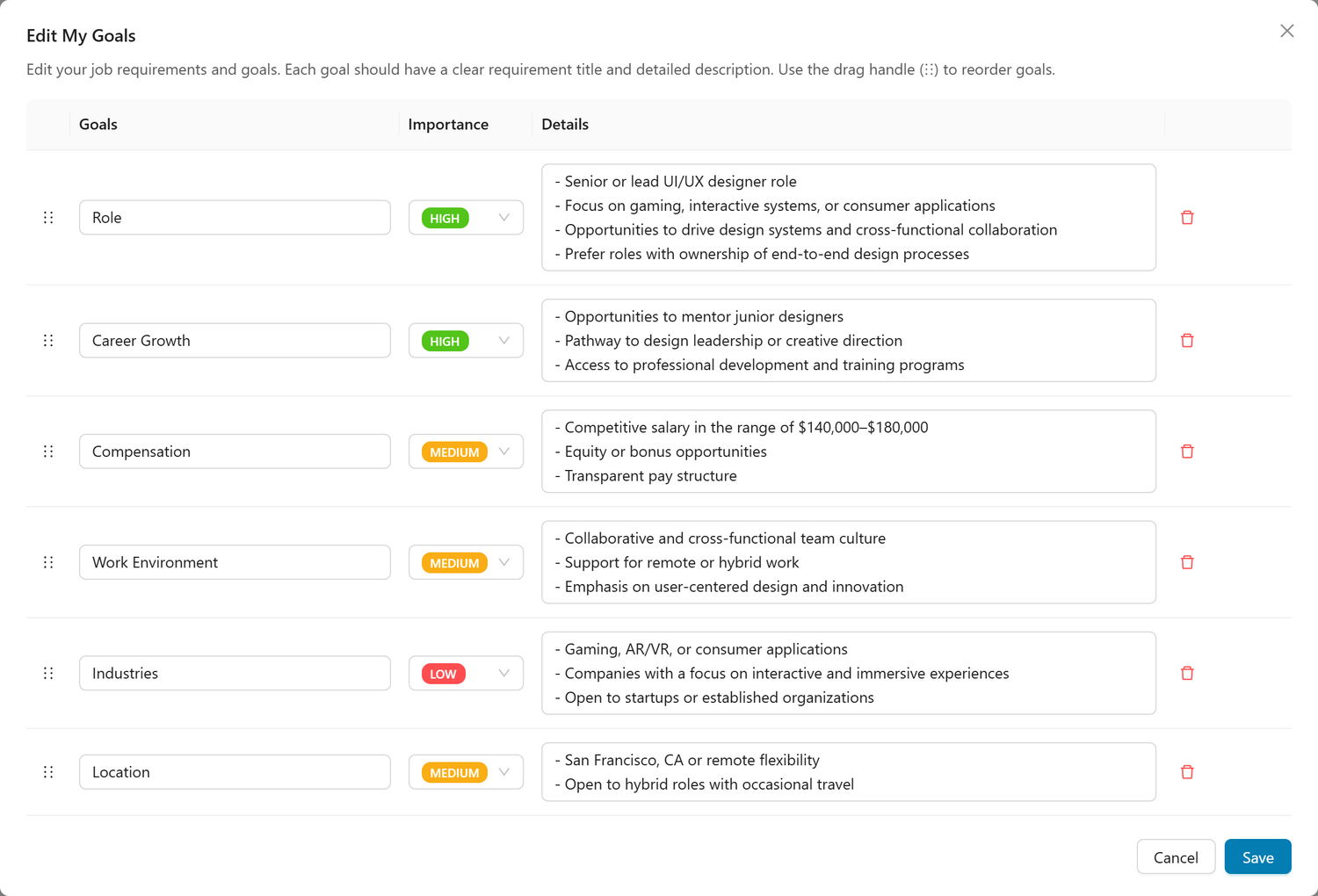
Click the Edit button in the toolbar to open the Goal Editor modal. Here you can:
Customize Each Goal Category
For each goal category, you can: - Set Importance Level - Choose HIGH (must-have), MEDIUM (nice-to-have), or LOW (optional) - Add Specific Requirements - List detailed criteria as bullet points - Reorder Goals - Use drag handles (⋮⋮) to prioritize which goals matter most - Delete Goals - Remove categories that aren't relevant to your search
Adding New Goals
At the bottom of the editor, click "+ Add New Goal" to create a custom goal category. This lets you track requirements that may not be covered by the default categories, for example, "Company Mission," "Growth Opportunities," or "Team Composition." Each new goal you add works just like the built-in ones: you can set its importance level, add detailed requirements, reorder it, or delete it later.
Add Detailed Criteria

Each goal can contain multiple specific requirements. For example, under "Work Environment": - Small, multidisciplinary, highly creative teams - Series A or B startups preferred - Fast-paced, exploratory, and mission-driven environment - Support for experimentation and fast testing
Benefit: Clarifying your priorities helps you communicate more intentionally when networking and evaluating opportunities. If you receive multiple offers, this becomes a valuable tool to recenter on what truly matters.
Using Your Goals
Self-Clarity
Your goals serve as a personal reference document that helps you stay focused throughout your search. When opportunities arise or conversations happen, you'll have a clear framework for evaluating whether something aligns with what you want.
Benefit: Maintain clarity and intentionality rather than getting swept up in the moment.
Networking & Communication
Use your goals to articulate what you're looking for to your network: - Share specific requirements with mentors who can provide guidance - Communicate priorities clearly to headhunters representing you - Stay consistent in conversations with friends and professional contacts
Benefit: When people understand exactly what you want, they can help you more effectively.
Interview Preparation
Your goals serve as a ready-made list of questions to ask during interviews: - "Can you describe the team structure?" (Work Environment) - "What's your approach to remote work?" (Location) - "How do you support experimentation?" (Culture)
Benefit: Enter interviews prepared to gather the information that matters most to you.
Download & Share
Click the PDF button in the toolbar to download your goals. Use the PDF to: - Keep handy as a personal reference during your job search - Share with mentors or career coaches for feedback - Provide to headhunters who are representing you to hiring managers
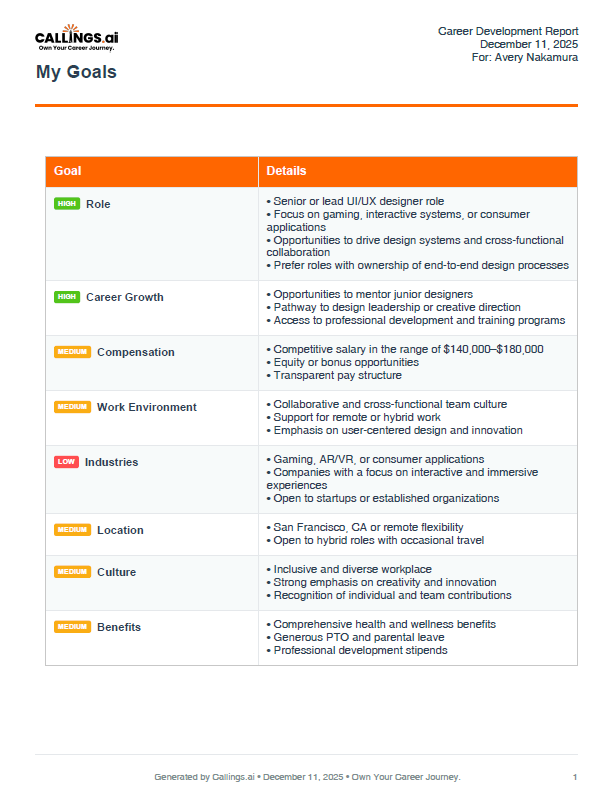
Benefit: The PDF provides a professional, shareable format that makes your priorities crystal clear.
Regenerating Goals
If your career direction changes or you want a fresh perspective, click Regenerate in the toolbar to have the AI analyze your resume and questionnaire answers again and create new goal suggestions.
Use this when: You've made major updates to your resume, updated your questionnaire answers, or are pivoting to a different type of role.
Frequently Asked Questions
Q: How are my goals initially generated?
A: Our AI analyzes your resume, including job titles, responsibilities, industries, and career trajectory, along with your answers to the My Goals Questionnaire. Together, these inputs help us infer what you're looking for in your next role. These are intelligent starting points, not final answers.
Q: Should I trust the AI-generated goals?
A: Use them as a starting point for reflection. Review each goal carefully and edit anything that doesn't resonate. You know yourself better than any AI!
Q: How many goals should I have?
A: There's no magic number. Most users have 5-8 goals covering the key dimensions: role, environment, location, compensation, culture, and industry. Focus on having a few unique, personal goals rather than a long list of generic ones that everyone has. Quality over quantity: make each goal count.
Q: Can I add my own custom goal categories?
A: Yes! Click "+ Add New Goal" at the bottom of the editor to create custom categories that aren't covered by the defaults. For example, you might add "Company Mission," "Growth Opportunities," or "Team Composition." Custom goals work just like built-in ones: you can set importance levels, add detailed requirements, reorder, or delete them.
Q: What's the difference between HIGH, MEDIUM, and LOW importance?
A: HIGH = non-negotiable (dealbreakers), MEDIUM = strong preferences, LOW = nice-to-haves. Use these tags to stay clear on what truly matters versus what would be a bonus.
Q: Can I change my goals later?
A: Absolutely! Your goals can evolve as you learn more about what you want. Update them anytime to keep your personal reference current.
Q: Should I share my goals with others?
A: That's up to you! The downloadable PDF is designed to be shareable with trusted contacts: mentors, coaches, close friends, or headhunters who are representing you. Headhunters in particular can use this to better understand you and advocate for you with hiring managers. Sharing your full requirements isn't typical with general recruiters, but it can be very valuable with people who are truly invested in helping you.
Clarity on what you want makes finding it infinitely easier. When you can articulate your priorities, what's essential, what's preferred, and what would be a bonus, every opportunity becomes easier to evaluate, every conversation becomes more productive, and every decision moves you closer to a role that truly fits.