Understanding Portfolio Careers: The Future of Work
By Julie Marcus · · 3 min read

The world of work keeps evolving, including types of roles and work situations. For many, making adjustments is a choice, but for others, adjustments are forced upon them due to circumstances beyond their control.
According to a recent Wall Street Journal article, Generation X, born between 1965 and 1980, is increasingly embracing portfolio careers. This shift is driven by factors such as job dissatisfaction, desire for flexibility, and the need for financial resilience. Data indicates that Gen Xers are more likely than millennials to be “actively disengaged” with their jobs, and only about two in three report being happy at work.
The Concept Isn’t New
In 1994, Charles Handy, a management guru, wrote about the portfolio career professional (sometimes referred to as a side hustler, solopreneur, or multi-hyphenate). In recent years, the word “slasher” has also appeared in the lexicon. The concept has gained popularity and continues to flourish.
Handy had the foresight to recognize that people would need to build skills for a fast-paced world that would require “portable” skills. Interestingly, it’s the Gen Xers who have pushed this concept as they look for self-discovery that may not be found in full-time employment. COVID-19 propelled portable skills into the public discourse. According to a survey published by The Sunday Times on October 2021, 22.5% of Gen Xers had changed career paths since March 2020, with 67% attributing their decision directly to the pandemic. An incredibly high 45% of Americans admitted to having a side hustle, which falls right into the portfolio career conversation.
What This Really Means
The portfolio career is here to stay, and for many, this type of employment is desirable and necessary. For companies, the noncommittal hire-as-needed decreases headcount and minimizes their investment in the employee.
This article is not about the pros and cons of companies, but about the options that all of us have in the workplace. How do we land opportunities that are both challenging and fulfilling, all while reaping consistent monetary benefits and feelings of self-worth?
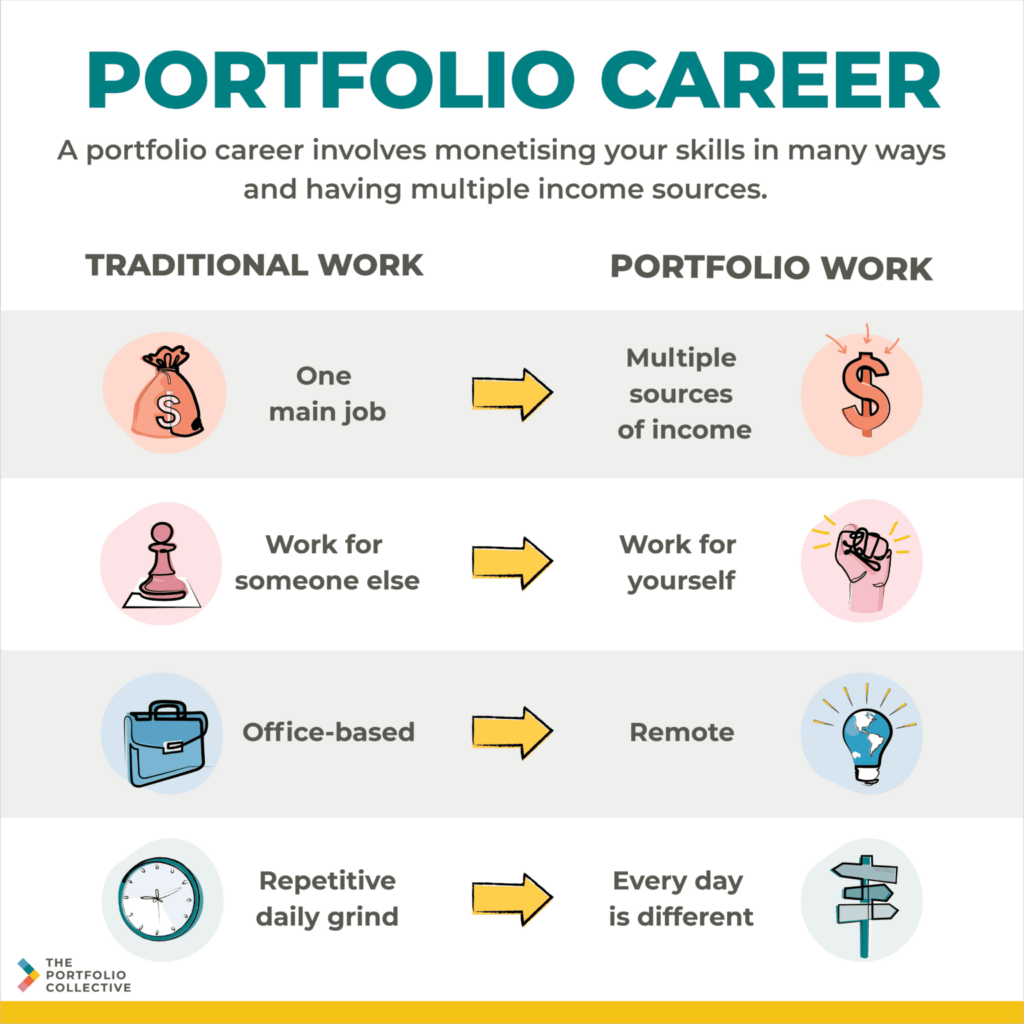
To be clear, a portfolio career is not a “gig” role that only involves one client, one project, or multiple clients that are short-term. A portfolio career is strategic and often includes several revenue streams with a focus on building expertise in areas where we have long-term interest or passion. It can be a compilation of several opportunities at the same time. Creative industries known for freelancing have been a natural fit for the portfolio career. When we have honed a variety of skills, the combination of things we can accomplish is endless.
What Companies Get Out of It
The portfolio career has several benefits for a company: diverse experiences, new perspectives, and the ability to work across a variety of industries and think out of the box.
It’s Not for Everyone
A portfolio career may not be right for everyone. Those who lean towards this type of employment do so for a variety of reasons:
- Disappointment in their corporate career (13% of corporate employees love their jobs)
- Having the choice to pick what they would like to do
- Working on a variety of projects where they can use different skills
- Doing volunteer work
- Not working a 9-5 job
- Choosing who they work for and who they don’t
- Finding a work-life balance
- Working full-time and part-time simultaneously
- Having a diverse background that sets them apart from other job seekers
- Developing transferable skills
- Ability to test drive a career
- Weathering an uncertain job market and economy
The Reality Check
With every positive also comes negatives, so consider these before pivoting:
- Work-life balance may be elusive depending on the projects you have
- You will probably lack benefits, such as paid time off and health insurance
- You will need to keep track of your anticipated tax situation
- Career advancement might not happen at a predictable rate, if at all
- Some hiring companies may not understand why you are choosing a portfolio career, and they might look down upon you
- In some environments, your experience, which is steeped in expertise, is not held in the same regard as a full-time employee
Making It Work for You
Forbes highlights that senior technology leaders are embracing roles such as fractional consulting, board memberships, and startup ventures, transforming traditional career paths. These approaches offer greater autonomy, flexibility, and intellectual stimulation.
For some, the portfolio career is the ideal professional journey. Since we spend a great deal of our time working, why not strive to make it worthwhile?
If you are considering a portfolio career journey of your own, reflect upon what makes you different than other professionals. How are you unique? Reach out to your network for support as you find a way to make your job work for you.