Passions, Skills and Opportunities
By Garrett Rice · · 4 min read

“Mamas don’t let your babies grow up to be cowboys…let ’em be doctors and lawyers and such”. — Ed Bruce (as sung by Willie Nelson)
Career success depends upon the choices we make. That’s obvious to everyone. What educational focus do we pick in College? What industries, companies, and job roles do we pursue? What skillsets do we collect on the job? Conservative parents express this choice to us from an early age. They say, “You should become a doctor or lawyer!” But it only took me watching one Spinal Laminectomy to kill my mom’s dream that I become a doctor. She may have been wrong about my future, but her parental desire to find a high-earning, low risk path for me wasn’t completely misguided. A secure financial life is, for most of us, based on our career path.
Alas, we are also bombarded with societal messages to pursue our dreams! To be ourselves! To find our passion! The conflict is obvious. There are fascinating paths that lead to low wages and poor job security. I know several musicians that struggle to make ends meet pursuing their passion. I loved being a Fiction Writing English Major in college, but no job awaited me on graduation with this degree.
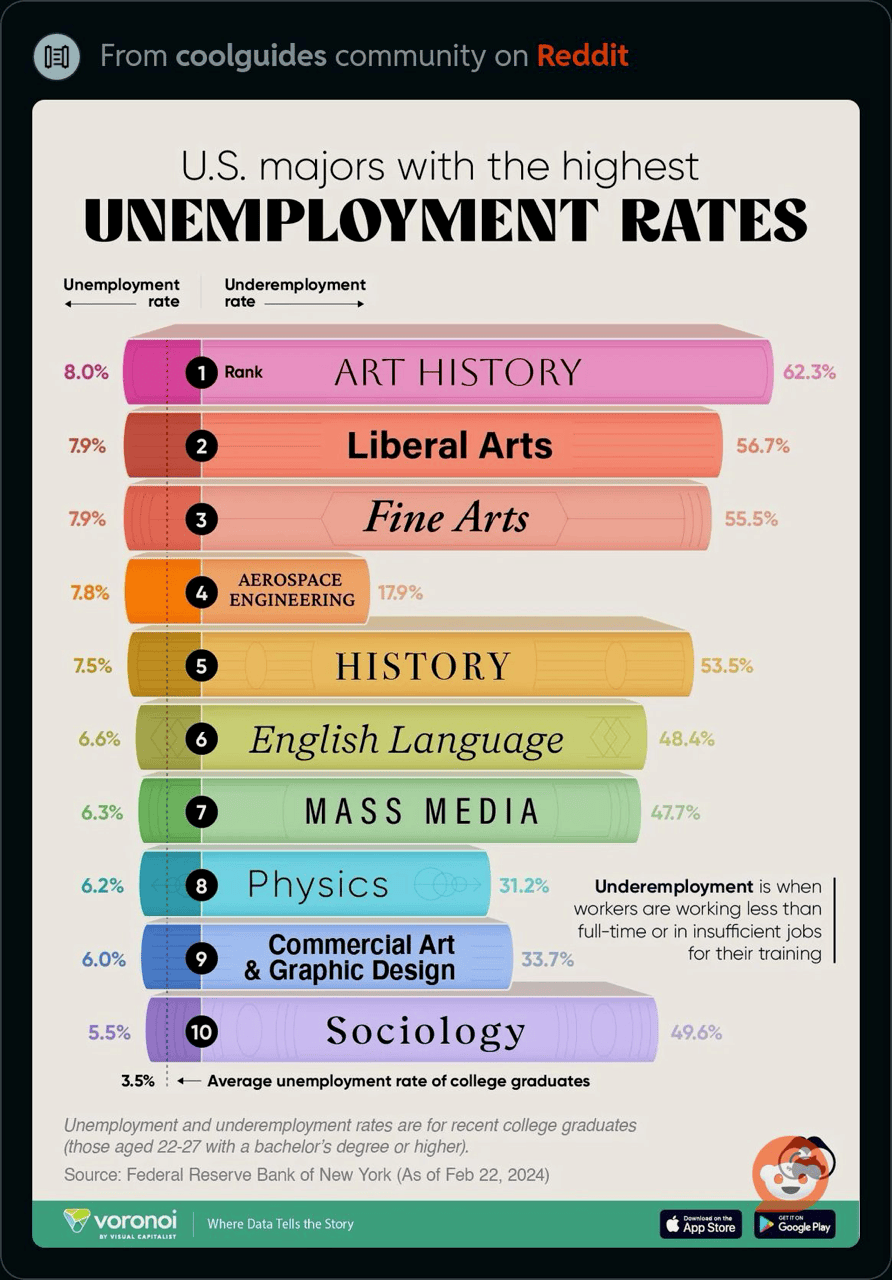
As the chart from Reddit I’ve included with this article shows, our choice of a college major might lead us down more difficult paths. In that chart, we see that some college majors are dramatically more likely to lead to unemployment and underemployment. These include Art History, Liberal Arts, Fine Arts, History and my poor old English degree. Why are these ‘bad’ majors? I suspect that they do not provide the obvious (superficial) operational skills that employers covet. [Note: the one strange inclusion is Aerospace Engineering which I believe falls into the ‘one of these things is not like the others’ category and likely relates to industry dynamics.]
So focusing on those classic Liberal Arts majors, what advice is available? Are they doomed to take part time roles at the community center teaching writing or pottery? Well, before we explore that, I’d first like to say that those degrees can be immensely valuable, even if they are not directly marketable. Liberal arts skills are necessary for everybody; the ability to write, to speak, to be creative, to understand current dynamics against the backdrop of the past. So my suggestion, assuming that you’re already in the job market with an ‘unsavory’ major you had and the skills you’ve accumulated, is twofold. First, articulate your skills in a way that better matches market expectations. Second, supplement your skills with those that are in demand through the process of lifelong learning.
What do I mean by articulating your skills to better match the market? Simply this: recast your skills around what the hiring company needs. If you’re an Art History major applying for a marketing job, focus on how your skills have made you successful in the past as a marketer and tell them how these skills will deliver successful marketing executions if they hire you. Focus on what they want you to deliver for them. You’re not an Art Historian, you’re a professional who’s passion and knowledge of Art makes him more creative and wise.
How do you supplement your skills with those that are more in demand? That depends on your life circumstances. I realized early on that my English major itself was not marketable, even though the skills made me more effective. So I went back to school and got a business degree. I still think my English skills have served me better in the long run. But the MBA provided a better calling card. I know many folks who have built domain expertise (e.g., IT Security, AI/ML, 3D design) during their career to increase their tactical value too. When people say “never stop learning”, this is what they mean.
Even more disturbing are those macroeconomic changes that can blow up perfectly good professions. Imagine how Buggy Whip makers felt after the invention of the automobile? The disruptions caused by technical, industrial or societal change are hard to anticipate and never stop coming. Anybody who has been using ChatGPT and other AI/ML technologies will quickly recognize that it is going to disrupt a lot of lucrative professions. Given their reliance on templates and standard terms, I think lawyers have a hard time coming in the new AI world, for example. That said, people in professions that are in line to be disrupted who can demonstrate AI/ML skills just might MORE valuable than before.
So, in summary, don’t mourn your past choices, appreciate what they have brought you. The right path to marketability is flexibility and adaptability. Pursue your passions AND build a toolbox of sellable skills, recognizing that it will be impossible to predict what might be valuable in the future. Sustain your curiosity and continue to learn and change on ways that help you adapt. And, finally, articulate the ‘story of you’ with an eye to audience, emphasizing those capabilities that they find most valuable.